
Memories of the Lama Temple in Beijing.

Memories from Lama Temple in Beijing.
April 2010.
I fell for Chinese temples in that first year in China — my first year in Asia — when everything about them felt fresh, fascinating, and almost magical. The riot of colours, the intricate art, the manicured gardens, the sudden hush of hidden courtyards, and that drifting perfume of incense all pulled me in.

Much like the fondness I would later develop for churches, I could never stroll past a Beijing temple without being drawn inside. Some of these visits I’ll save for my eventual Beijing roundup. However, for now one stands apart — a place that deserves its own moment in the sun. Step forward: the Lama Temple.

Memories from Lama Temple in Beijing.
Cover photo courtesy of xiquinhosilva.
The temple rises from Yonghehong Street in Beijing’s northeast-central Dongcheng district, a landmark so celebrated it even lends its name to the local subway stop. One sunny afternoon, I surfaced from that very station, brimming with anticipation to see what is hailed as the largest and most important Tibetan Buddhist temple outside Tibet itself.

Memories from Lama Temple in Beijing.
The large square opposite the temple’s main gates — and indeed the warren of side streets fanning out around it — buzzed with life that afternoon. Visitors drifted up and down the long, tree-lined approach. At one corner, I lingered to watch an orange seller banter with a customer as he tipped a heap of juicy beauties onto the scales.
Memories of the Lama Temple in Beijing.

Oranges. And, err, bricks.
Elsewhere, I sneakily captured a fortune teller chatting with some passing locals. As I would later learn, it’s a common business to find in and around China’s ancient temples. This dude’s name, written on the signage, was/is Master Juehuai from Mount Wutai, who apparently specialised in “marriage and career” readings. No, I wasn’t tempted.

“You are going to meet a tall, dark, stranger”.
There was also a fiercely contested card game, and one that had attracted quite the crowd of excited onlookers. Locals also come here to play chess (xiangqi) and mahjong, both staples of any temple visit wherever you might find yourself in China.

Memories of the Lama Temple in Beijing.
Moreover, construction sites dotted the neighbourhood, the air carrying the clatter of hammers and the smell of fresh paint. Dongcheng was deep in the throes of gentrification, with a new shop or guesthouse seemingly springing up on every corner.

Memories of the Lama Temple in Beijing.
Inside the temple complex itself, it was every bit as crowded as I’d expected. And no wonder, with such fabulous and fascinating history. The story begins in 1694 when Emperor Kangxi of the Qing Dynasty announced its inception as a court residence for his son, Prince Yin Zhen (who later became emperor himself).
The Kangxi Emperor.

Kangxi: Loved horsing around.
Back in those days the joint was known as the Prince Yong Mansion. As the home of one of Kangxi’s favourite sons, the lavish grounds became an important venue for court gatherings, banquets and political networking.
Even in those early days there were plenty of Tibetan Buddhist elements in the design, including red walls, yellow accents, gold and bronze roof ornaments, upturned tiered eaves and gilded finials. A sign that the emperor was sympathetic to Tibetan Buddhism.

Memories of the Lama Temple in Beijing.
Photo tourtest of Rolf Müller.
I imagine the prince thought he was going to be emperor a lot sooner than it actually happened. But daddy stayed on the throne for over sixty years (!) before the prince finally ascended in 1722. Known as the Yongzheng Emperor, one of his first moves was to convert the compound into an even grander imperial palace.

An 18th century painting of the Yongzheng Emperor.
Unfortunately, Yongzheng didn’t enjoy his father’s longevity, passing away suddenly in 1735 aged just 56. While nobody knows for sure what precisely befell him, most historians accept that he was assassinated.
One particularly juicy theory was that a granddaughter of the literary Liuliang family poisoned him. An act of revenge, apparently, after the emperor executed several of her loved ones for so-called literary crimes against the Qing government.
Memories of the Lama Temple in Beijing.

Grabbing a photo from a rare peaceful and discreet spot.
Yongzheng’s successor was Emperor Qianlong, who transformed the compound into a Tibetan Buddhist monastery in 1744. Within months the emperor had invited monks from Tibet and Mongolia to come and help establish a prestigious school of Buddhism.
As a result, its status blossomed throughout the 18th and 19th centuries, all the while helping to maintain Qing influences in Mongolia and Tibet. Clever, clever.

Memories of the Lama Temple in Beijing.
Between 1899 and 1901 the temple managed to survive numerous attacks during the bloody Boxer Rebellion. This was no small feat, as rebellious militias succeeded in destroying many of Beijing’s most revered temples and monasteries.

A steady stream of visitors.
Its eventual decline took place between the 1940s, 50s and 60s. Although the temple remained active following the founding of the People’s Republic of China, the number of resident monks dwindled. What’s more, it only survived The Cultural Revolution after Premier Zhou Enlai stepped in to grant the temple special military protection.

Zhou Enlai (1898-1976).
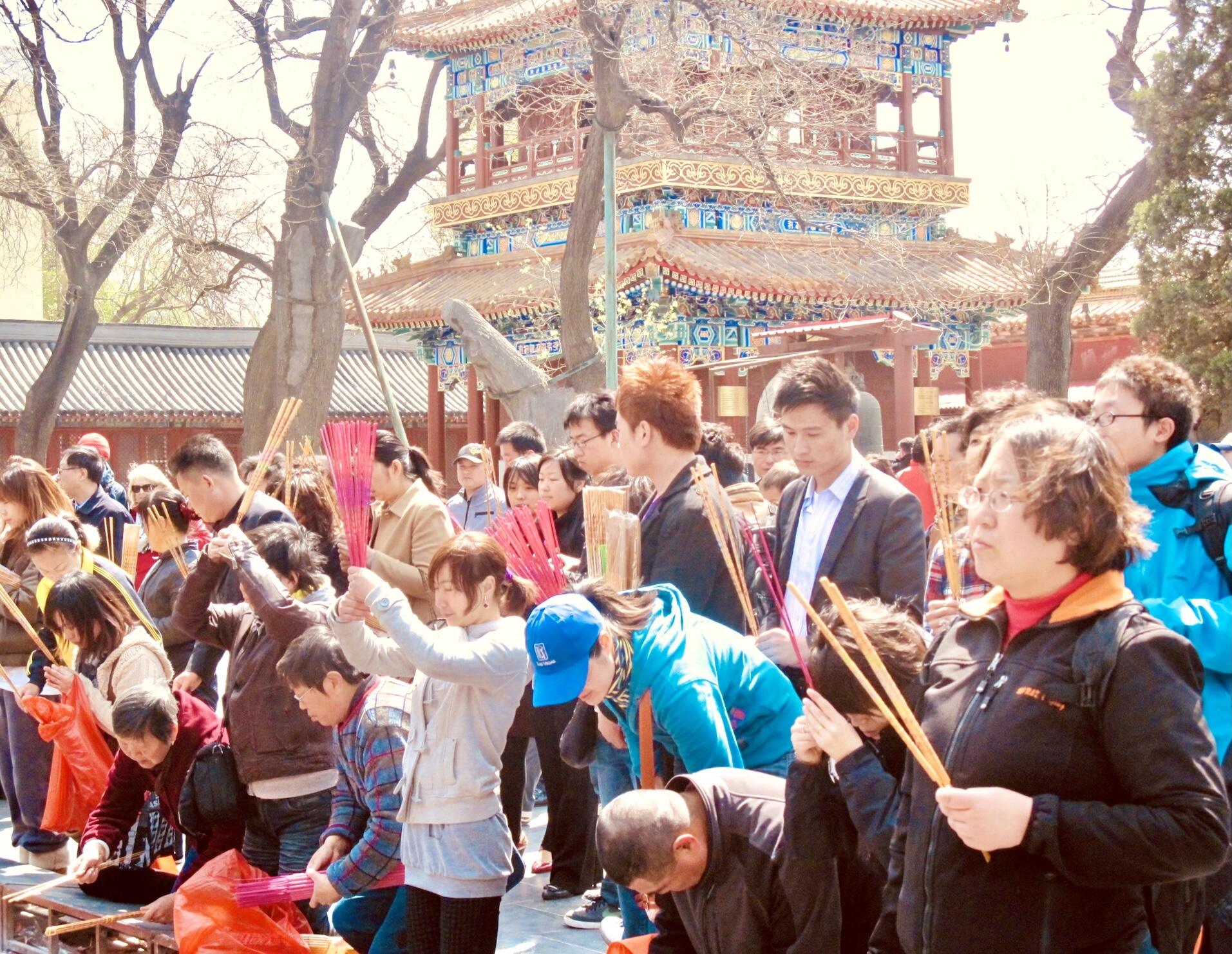
All but abandoned by the start of the 1980s, the Lama Temple opened to the public as a site of historical and cultural importance. And so it remains to this day, with a number of monks (approximately 70) still taking up residence. That day, as I explored the grounds, I had to take care not to get in the way of the steady stream of visitors who had come to pray and light & plant incense sticks.
A Busy April Afternoon.

Memories of the Lama Temple in Beijing.
It was moving to observe these age-old traditions. All around me visitors approached the large bronze incense burners, sticks in hand. Traditionally, one takes three sticks which represent the Buddha, the Dharma (teachings), and the Sangha (monastic community).

Memories of the Lama Temple in Beijing.
They lit their sticks from the furnace’s open flame. Once the tips glowed red and smoke had begun to rise, many began gently waving their sticks in oder to encourage an even burn. One curious point is that the sticks should never be blown out by breath, an act that is considered impure.

An elderly lady clearly enjoying watching the rituals unfold around her.
Still holding their sticks, worshippers then find the nearest hall or favoured Buddha statue. Bowing three times, they silently recite a prayer or mantra.
Finally, comes the planting of the incense in the sand-filled troughs of the burners. The rising smoke is seen as carrying the prayer from the devotee to the buddhas and bodhisattvas, bridging the human and spiritual realms.
Memories of the Lama Temple in Beijing.

Worshippers fill one of the temple halls, patiently awaiting their turn in front of their chosen Buddha.
It wasn’t easy getting anywhere near most of the statues that day. Eventually though, I managed to get a good look at this confrontational dude, a Tibetan Buddhist guardian deity and lord of war called Begtse. With his bright blue body, fierce expression, flaming red hair and bared fangs, he protects Buddhist teachings from malevolent forces.

Begtse: Declaring war on obstacles along the path to enlightenment.
Elsewhere, it was fun to take part in the latest good luck / good wealth superstition that was already becoming familiar to me wherever I went in Beijing. At the Forbidden City such fortune was granted by touching one of the ancient water vats. Here, it was all about throwing a coin at an incense burner. A bit like chucking a coin down a wishing well.

Memories of the Lama Temple in Beijing.
The Chinese simply can’t get enough of these kinds of sights. Thus there is an additional chance for extra good luck and financial fortune by paying to ring one of the temple’s 18th century bronze bells. Engraved with sutra texts and auspicious patterns, the sound (they say) can purify the mind, ward off evil and carry prayers to the right ears. Every January meanwhile, during Chinese New Year, the temple’s resident monks line up to ring the bell one by one, an event that brings huge crowds.
Good Luck and Great Fortune. Again.

Memories of the Lama Temple in Beijing.
Before leaving, I made sure to check the small ancient art exhibition in the Pavilion of Ten Thousand Happinesses. Home to all manner of spectacular carved buddhas and deities, I stopped to photograph two golden statuettes that caught my eye. First, say hi to Vajrapani, the Buddha’s protector and guide in Mahayana Buddhism.

Memories of the Lama Temple in Beijing.
And, last but not least, this limb-blessed deity goes by Yamantaka. In Vajrayana Buddhism he is the destroyer of death, and represents the overcoming of (death, obviously) as well as ignorance.

Yamantaka: “Handy” in a fight.
Lama Temple opens daily from 09:00-16:00, with entrance tickets priced at 25RMB (£2.60/€3/$3.50). The best way to get there is by subway. The nearest station is Yonghegong on lines 2 and 5. Jump off at Exit C, it’s about a five minute walk from there.
Like this? Why not take a look at more of my reports from around Beijing.
Wanna delve further afield? I’ve written stacks of travel reports from all over China.
I’ve been living, working and traveling all over the world since 2001. So why not check out my huge library of travel reports from over 40 countries.



.jpg)

38 Comments
What is it about Buddhist temples and Shinto shrines that draws us Westerners in? Such fascinating architecture and colours as well as ancient beliefs and practices still as fresh today for so many. This looks like a worthy visit Leighton, but the crowds, so many people. Thanks for sharing. Happy Sunday. Allan
I agree that it’s all those things that tempt us again and again into temples. Indeed it took me quite a few years of travel around Asia to become “templed out”. The crowds… yeah… I had much more patience for it all back then. Thanks for the read and comment Allan 🙂
Hey Leighton, I really enjoyed reading your memories of Lama Temple. One thing that really stood out to me (as with many of your posts) are the sensory details. It’s amazing how many bloggers leave out this stuff. After all, isn’t travel truly about what we experience and feel? Anyway, this looks like another unmissable Beijing spot and one that leaves me thinking about a visit, something i have definitely never considered before! The rituals are curious, I’d love to witness all of that first hand though like Alan the crowds would leave me a little anxious.
Hey James, I really appreciate your kind words. Travel all about meaningful experiences and sensory awakenings? Definitely! I’m also delighted (and a little surprised) that you are considering Beijing as a travel destination. If you did go and spend say a week exploring the city, I don’t think you’d regret it! Although it can be overwhelming at times, I had so many fantastic experiences with the sights and people.
I can definitely see the Tibetan influence, but also how much more elaborately decorated it is from its time as a palace. Interesting to read the different customs at this temple too. I’ve seen incense at many, but never so much as at Lama Temple. Some look like they have 20 sticks of incense. Nice post. Maggie
Hey Maggie, come to think of it this was definitely the most incense-heavy temple I’ve ever visited, the joint was thick with smoke in most areas of the complex. Thanks for reading about Lama Temple!
This was such a vivid and engaging account! I could almost smell the incense and feel the energy of the temple. A great read!
Thanks Susan for reading and leaving a comment!
Temples in China, let alone much of Asia, are major community hubs for the people. The Lama Temple is especially stunning, yet modest at the same time, and it looks like you had a wonderful time checking it out, as well as many other temples, throughout your stay in China. Thanks for sharing, Leighton!
Thanks for checking in Rebecca, Lama Temple is definitely one of the biggies to see when in Beijing.
It was a very interesting overview of the Lama Temple in Beijing. It is somewhat confusing that an important Tibetan Buddhist temple would be in Beijing. As usual your photos and travel stories/history are amazing.
Hey Thomas, thanks for checking in. The Lama Temple is indeed something of an oddity, especially with it serving as both a royal palace and a centre of Tibetan worship. Both Sladja and I would live to go to Tibet itself one day, but it is a complicated prospect, so for one reason or another we keep putting it off.
a fine addition to your beijing files leighton i get a positive feeling from the lama temple. what a privilege to visit and soak up the history as an observer taking a step back from the rituals. i have always enjoyed the smell of incense can only imagine the intensity of the experience with so many people and burning sticks
Cheers Stan, I do love being an observer, away from the heart of the action. Especially when I can be somewhat invisible and pick up on all the little details and quirks of a place and the people that inhabit it.
What a stunning temple with such a rich history! It’s so wonderful to get to experience different cultures and customs.
Glad the Lama Temple appeals Lyssy. Thanks for reading and commenting, it’s good to have you back on these pages.
I especially liked the images you captured of the locals reverently holding the incense sticks and your description of each one.
Thanks Annie, I appreciate the read and your continuation to the thread!
Lama Temple looks like an intriguing and beautiful place to explore. It certainly draws a huge crowd! I’ve enjoyed visiting temples and shrines in Japan and South Korea, and, like you, find the appeal very strong. Wonderful post, Leighton!
Thanks for touring Lama Temple with us, Tricia. 🙂
Very interesting! I know next to nothing about Buddhism so I appreciated learning more about the rituals and customs too.
Ah that’s cool that this was something of a journey of discovery. Buddhism is pretty complicated (to me at least), but I am totally addicted to the atmosphere of Buddhist temples, as well as the peacefulness (well, not exactly in the Lama Temple) and all the gorgeous art. Cheers Diana!
Thank you for sharing your vivid journey through the Lama Temple. Your words and images brought the temple’s rich history and vibrant atmosphere to life, allowing us to experience its spiritual and cultural significance from afar. The blend of ancient traditions and lively street scenes you captured paints a beautiful picture of Beijing’s dynamic heritage. Looking forward to more of your insightful travel narratives! Keep ‘em coming! 🏄♂️
Thanks, Chuckster. That’s it for Beijing just now, but there is a two-parter on the way , starting next Sunday, on one of China’s most curious and unique cities.
I can relate to the allure of temples. We felt the same when visiting Japan. I love how each one is unique and has its own story and history. It was neat to hear more about the Lama Temple. Impressive that the dad stayed on the throne for over 60 years! Interesting to hear about the theory about how the Yongzheng Emperor was poisoned by family. Go figure.
Hey Linda. Well, the temples in Japan are every bit as mesmerising I’d say, perhaps even more so than in China for me, though it’s all a matter of taste. Being in the royal family back in those days, with all that murky politics, nothing but a can of worms. Somehow, I feel the Yongzheng Emperor probably had it coming.
This was possibly my favourite of the several places we visited on our brief stay in Beijing a few years ago. As you describe, the atmosphere here, enhanced by the heavy scents of the incense, is mesmerising. Thank you for including that history of the temple which I confess I either didn’t research at the time or have completely since forgotten!
Hey Sarah, I’ll be honest, I remembered very little of the Lama Temple’s backstory before writing this article. But it was fun to remind myself and even find out some stuff I’d never been aware of. It is indeed such an atmospheric place, I’m glad that you also got to experience that.
Like you, I can never resist a temple! Though I do have to say I think I’d struggle with the crowds – but it’s an important religious and historical site, and it looks like a memorable place to explore 🙂
Yeah, it’s worth braving in spite of everything, especially if one is new to Chinese temples. Thanks for checking in, Hannah.
Nice mix of place and people! Will soon be delving into your posts on Vietnam and India. Visits on the horizon!
Cheers Geoff, how exciting that you’ll soon be making tracks across two such fabulous countries. I hope you find my posts useful, looking forward to hearing more about where you’re planning to go.
I can easily see why this temple would be such a favorite. Stunning architecture, a little family history intrigue, and a wonderful collection of the people who were there. I really love these candid real life moments of people that you captured so beautifully.
Thanks Meg, this was one of those rare occasions where it was super easy getting people shots. Everyone was so intently focused on the rituals at hand that I could snap away entirely undetected.
An excellent read. The temple’s history is a rollercoaster – royal palace, Buddhist haven, Boxer Rebellion survivor, Cultural Revolution narrow escape – proof that even temples have a wild past! Thanks for transporting me to Beijing’s spiritual (and smoky) heart.
Thanks Marle, I’m delighted that you enjoyed the post. I appreciate the read, and it’s always nice to see a new name on the comment thread. Cheers!
Leighton, your incense descriptions make me half-expect to see smoke curling out from under my keyboard. The idea of meticulously waving sticks instead of just blowing them out like a normal person? Pure dedication. And Begtse, the confrontational dude, sounds like a temple security guard who’s really into his job. Love the witty insights and the sense of place – it’s like being there, stuck in the crowd, waving your incense like it’s a lifeline. Keep those reports coming; you’re making Beijing sound like the most interesting place on the planet, even with the sheer *number* of people wanting good luck.
“A temple security guard who’s really into his job” ha ha. I’m glad that those sensory details really came through, and that there was no internal damage to your computer 😉