
Industrial Dreams: Inside Beijing’s 798 Art District.

Industrial Dreams: Inside Beijing’s 798 Art District.
March 2010 & July 2014.
No matter where I am in the world, I always enjoy diving into a city’s street art. Indeed long-term readers may recall my guides to the street art of Malaga, the murals of Belgrade and the local artists of Siem Reap.

A mural in Siem Reap by the Cambodian artist Nak Noy.
Back in the autumn of 2009, as I began settling into my new life in the Chinese capital, one of the things that struck me about the city was its almost total lack of street art. This seemed a pity, with many neighbourhoods packed with colourless high-rises that seemed to be crying out for a splash of colour and personality.

“Hello, I am looking for some colour, have you seen any?”
One evening, during drinks with a friend, I lamented Beijing’s perceived lack of art. To which he replied: “Sounds like you’re in need of a visit to 798”. I had not heard of 798, so, filled with curiosity, I did some online research before excitedly pencilling in a visit for a weekday morning in March.

Industrial Dreams: Inside Beijing’s 798 Art District.
Even back then, in the spring of 2010, 798 was fast becoming Beijing’s premier hub for traditional and contemporary art. Home to dozens of galleries, cafes, restaurants, bookshops, arts & crafts stores and several small museums, I definitely underestimated the size of the complex on that first visit. How big? I’m talking roughly 6000 square metres.
Industrial Dreams: Inside Beijing’s 798 Art District.

Taking in the rapidly expanding array of things to see and do.
What’s more, there is a fascinating history to the compound that set it apart from any art project I had ever seen. Its story begins in 1951 when the Chinese government announced the construction of a brand new factory complex for the production of advanced military and aerospace electronic components.

Ruins of 798’s original factories, which still stand today.
Photo courtesy of gongfu_king.
Acting on Soviet advice, China turned to East Germany for support with its new industrial venture. A socialist cooperative agreement was soon established, known as Joint Factory 718.
A team of East German architects arrived shortly thereafter, and by the spring of 1954, construction had begun in Beijing’s Dashanzi district—then a rural outskirt, now part of the city’s central Chaoyang neighbourhood. Today, some still refer to the site as Dashanzi Art District.

Many Beijingers remain proud of 798’s history.
Enjoying great success, the facility grew and grew, culminating in the opening of Factory 798 in the late 1950s. This one was an absolute beast that incorporated a clutch of smaller factories churning out high frequency electronics, power supply units, military communication gear and radio equipment. Much of what they made went directly to the People’s Liberation Army.
What to See & Do in Beijing.

Industrial Dreams: Inside Beijing’s 798 Art District.
According to info boards onsite, the 1960s and 70s was 798’s golden era of production. During these decades, it also became a model socialist workplace with standards of worker care that became the envy of the rest of the country.
After all, a 798 employee would have one of the best salaries in China for a factory worker, while in some cases help was provided with housing and medical/education fees.

One of 798’s former factory floors, now an exhibition space.
Photo courtesy of Charlie Fong.
The glory years couldn’t last forever. In the 1980s, 798 fell victim to shifting politics and new economic priorities. Under the leadership of Mao’s successor, Deng Xiaoping, China began transitioning from a Soviet-style economy to a more market-oriented model. As a result, factories like 798 were encouraged to pivot towards commercial production, something they were poorly equipped to do.

Industrial Dreams: Inside Beijing’s 798 Art District.
Moreover, the rapid modernisation of the global electronics industry soon left 798 behind. In came microchips, miniaturisation, and digital systems. 798’s bulky analogue hardware, of course, couldn’t compete. With facilities now technologically outdated, the Chinese government simply moved on. But the buildings, now free of thousands of laid-off workers, had not.
Industrial Dreams: Inside Beijing’s 798 Art District.

An original metalworking lathe on display in a gallery. Likely used for turning cylindrical parts and thread cutting for bolts or electrical component casings.
After a period of dormancy, artists, designers, and cultural organisations began trickling in, drawn by large, naturally lit spaces and rock-bottom rents. By the mid to late 1990s, a wave of high-profile artists—among them Huang Rui—had moved in, and momentum began to build.

Huang Rui (1952-)
Known for creating controversial artwork channeling social and cultural criticism, Huang Rui became instrumental in establishing 798 as a public art venue. Impressively, he also succeeded in saving the compound from demolition on multiple occasions across 2004-2005.

One of 798’s many galleries.
Photo courtesy of Khalid Albaih.
In 2006, after years of struggle, 798 became China’s first state-recognised and protected art district. From there, it never looked back, attracting more artists, more exhibitions, and a steady wave of entrepreneurs opening new businesses across the complex.

Industrial Dreams: Inside Beijing’s 798 Art District.
It was a pleasure to wander around 798’s wide streets, leafy squares and narrow alleys. A laid-back pace prevailed as I paused to admire the murals, statues, sculptures and installations. Suitably chilled, I stopped into a cafe for a cappuccino.
Exploring 798.

Industrial Dreams: Inside Beijing’s 798 Art District.
Following my nose, I wandered into a small workshop where a young man chiselled away at a terracotta figurine. On the wide wall behind his workstation, I spied a display of his many finished creations. Known as naïve folk art, these raw, unglazed pieces depict children in playful, whimsical and innocent poses.

Industrial Dreams: Inside Beijing’s 798 Art District.
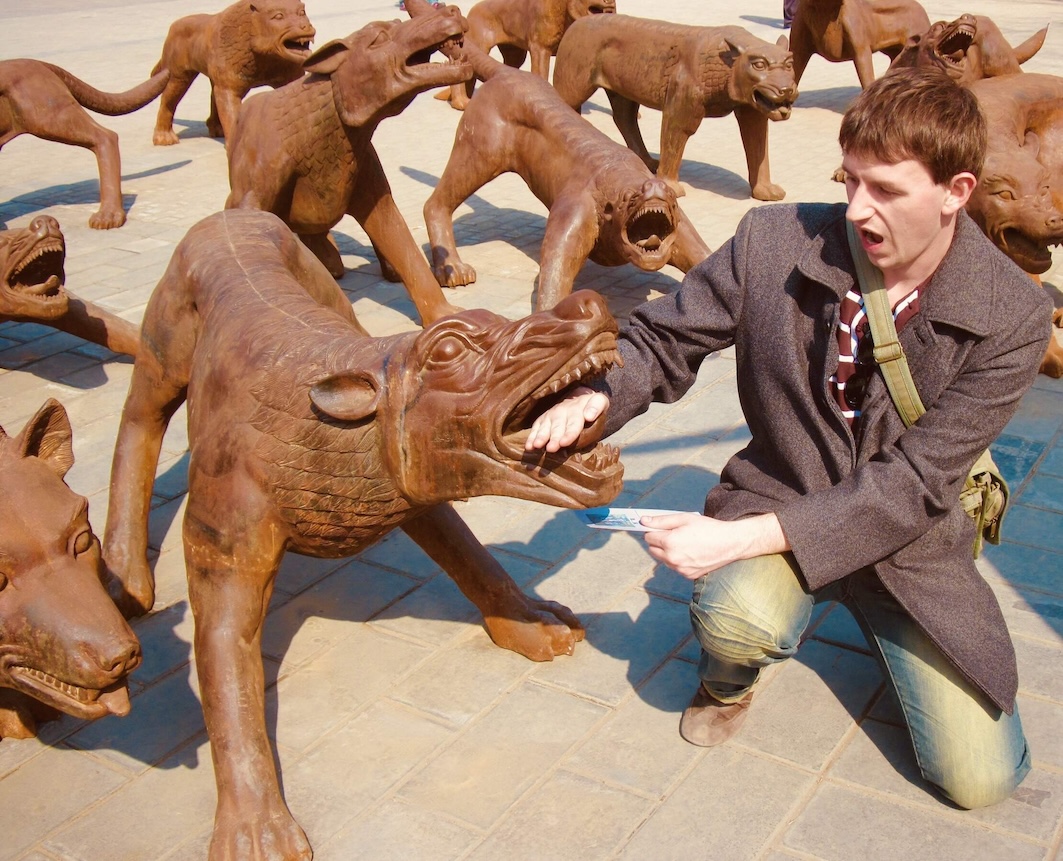
Back out on the street, I soon came across an arresting (and somewhat terrifying) installation called Wolves Coming! by the artist Liu Ruowang. This monumental piece consists of no less than 110 life-sized wolves cast in steel.

Industrial Dreams: Inside Beijing’s 798 Art District.
The artist portrays the wolves as fierce predators (naturally), fighting back against humanity’s relentless assault on nature — a stark reminder of the imbalance between civilisation and the natural world.

Wolves Coming!
Behind the wolves, lining the façade of a large gallery, stands another striking Ruowang installation. Titled The East is Red, the collection takes its name from the iconic Chinese revolutionary song. The bronze, Terracotta Army-like figures resemble warriors from Chinese folklore, evoking themes of national identity and the effects of modernisation.
Industrial Dreams: Inside Beijing’s 798 Art District.

The East is Red.
Nearby, I came upon another terrifying installation, this one a warning of the impact on smoking on the human body. Essentially a forest of vertical cylinders resembling giant cigarettes, some are partially “burnt” or corroded—arranged like a squadron of warning signs. The staging certainly distills the act of smoking into a visceral metaphor: every cigarette systematically erodes health and vitality.

Industrial Dreams: Inside Beijing’s 798 Art District.
Even more gruesome were the images that sporadically flashed across the walls. I almost jumped when the first tumour-faced creature appeared — a bulging, distorted growth evoking the ravages of cancer, an aggressive beast that disfigures and consumes. Never had I been so glad to be a non-smoker.

Yikes!
After those awful tumours, I was definitely looking for something altogether lighter and fun. Happily, I got just what I’d asked for at a small garden square, where half a dozen sketch artists sat at work offering portraits and caricatures.

Industrial Dreams: Inside Beijing’s 798 Art District.
One dude must have been head and shoulders above the rest, as he had managed to attract an impressive crowd.

Can’t remember if he was drawing the guy with the backpack.
The more I explored, the more I realised that 798 always had another surprise around the corner. This surreal car, for example, stationed in front of Wenyun Time Coffee, was sculpted from polished metal. Its gleaming chrome-like surface gives the impression that it’s melting before your eyes. With no accompanying explanation, I could only guess that perhaps this was a comment on consumerism? The absurdity of status symbols and human appetite for luxury and glamour?
Industrial Dreams: Inside Beijing’s 798 Art District.

798: Expect the unexpected.
If I thought the melting luxury car was unexpected, how about this baffling mash-up of imagery and ideology? Playful and no doubt highly provocative, this jarring yet oddly cohesive arrangement is perhaps (and again I’m just guessing here) a comment on mass devotion and the effects of how power, charisma and belief systems function across contrasting contexts. Lordy.

Heal The World… make it a… um… better … place?
I have to admit, one of the day’s biggest thrills was getting up close to the old factory ruins. Not everything had been converted into galleries and exhibition spaces, and there’s real value in leaving some structures standing just as they were left; reminders of the past.

Industrial Dreams: Inside Beijing’s 798 Art District.
One cool bonus that I hadn’t been expecting was this original JS Class locomotive. Manufactured in the late 1950s and used until around 1988, this handsome vehicle would chug up and down factory-linked rail lines that ran across northern China. Now it stands as a symbolic homage to the broader industrial logistics that once powered 798 and its surrounding factories.

Industrial Dreams: Inside Beijing’s 798 Art District.
My year living Beijing was always supposed to be a one-off experience. I never dreamed I’d be back. But in 2014, I found myself back in the Chinese capital for a fresh 16 month adventure. Naturally, I found time to revisit 798 and see how far the old place had come.
Four Years Later…

Back at Wenyun Time Coffee where some additional sculptures had sprung up.
It had grown immensely, with seemingly hundreds more studios, workshops, cafes, eateries and bookshops. By this time the CFA (Central Academy of Fine Arts) had established a strong presence within the complex. I ended up sauntering into this cool Interactive Graffiti Chamber, where artists and indeed visitors can draw, paint, scribble and scrawl away to their heart’s content.

Industrial Dreams: Inside Beijing’s 798 Art District.
It’s crazy—and a little depressing—to realise my second and last visit to 798 was over 11 years ago. Sladja has never been to Beijing, so I’d love to think I might squeeze in one last trip someday. If we do, I’m sure 798 will get another afternoon. Until then…

For more on this very cool Beijing attraction and for news on the latest resident artists, take a look at 798 Art District’s official website.

Want to read more about my time in the Chinese capital? Check out more reports from Beijing.
Like these? I’ve also written a zillion travel reports from all across China.
Or maybe check out my short story series Challenged In China!
I’ve been living, working and traveling all over the world since 2001. So why not check out my huge library of travel reports from over 40 countries


36 Comments
I had never heard of 798 before. During my stay in Beijing, the site must have been at the beginning of its transformation process. It’s true that industrial wastelands are fertile ground for artistic creation, as no authority is really interested in what goes on there. I have just explored the Gdansk shipyard, which is undergoing the same transformation. In China, I would have thought that the authorities would be more suspicious of artists, which would explain the absence of street art elsewhere in the city.
I agree that it is perhaps surprising that 798 has been able to flourish so freely. And how important it must be to people in a city where street art is nowhere near as abundant as it is back here in Europe. The Gdansk Shipyard looks really cool, that must have been some great exploring.
How places undergo a rebirth! The old structures remain like grandparents looking down at their creative offrspting.
Rebirth, indeed. And I like the idea of the ruins as parents, observers, guardians even of the modern galleries, studios, installations, cafes and restaurants. The best city sights or even neighbourhoods are often the ones that blend history and tradition with forward-thinking art and architecture.
There seems to be a massive amount of art installations in 798; very impressive and it looks like there’s something for everyone. Great photo of you and the wolves. The use of the old factories is quite creative too. I get the importance of the cigarette and tumor pieces; fear can be a big motivator. Interesting history too. Excellent post, Leighton!
Art can indeed be used as a very effective tool of fear, as the propaganda merchants of history knew only too well. Still being used today, come to think of it. Thanks for reading about 798 Tricia, I’m glad you enjoyed the read!
What an awesome repurposing of a war machine into a peace machine. You can tell a lot about a country, city and people by the art presented and allowed. So glad that your second visit showed they were still moving forward with their expressions. Happy Sunday Leighton. Allan
War machine, peace machine, I like it. When I think about how much the place had grown between 2010 and 2014, it makes me want to go back to see what the last 11 years have brought to 798 Art District. Cheers, Allan.
a fascinating article leighton about a unique place with a curious history. perhaps the biggest surprise here aside from all the unexpected art is that a bunch of scallywag artists were able to persuade the chinese government to let this unusual experiment continue when they could have so easily repurposed the land into something far more profitable not to mention less problematic for them. you mentioned that huang rai’s art can be controversial how on eartn did he manage to stay out of prison i wonder. i had never heard of this place before today’s read bravo!
Hey Stan! Yeah, 798’s status as a survivor against the odds is an interesting tale in its own right. It’s a great story that greatly adds to the appeal of a day exploring the compound. So glad you enjoyed the read.
This was a really engaging read Leighton. Maybe I’m just a bit ignorant but I wouldn’t have expected a place like this to exist in Beijing! Between the history, the art and the fact that one can shop, eat and grab coffee there, it feels like you could easily wile away the best part of a day at 798. The Jacko, Jesus, Mao combo did make me laugh but it is the wolves installation that I find the most impressive. Not such a fan of the rather creepy kid statues though. I think it’s amazing that the factory ruins are still there – I thoroughly approve!
Hi James, thanks so much for the kind words, it was a fun and highly nostalgic piece to put together. One could easily have spent the day there seeing everything. And to think that by now it must have doubled in size and number of resident artists. I’m with you re: thumbs up to the ruins, thumbs down to the weird cherubs.
A curious and colourful place, I do like the wolves!
Thanks Helen, I appreciate the read and comment! 🙂
Hi mate. I absolutely loved 798 when I visited in 2017. An absolute “must-see”…
Great that you also went to 798 Chris, three years after me it seems. I agree that it’s an absolute must-see, but was a somewhat under-the-radar site when I first went. I’m guessing it has a much bigger status these days.
I have not heard of 798 Art District, but what a cool and modern gem in Beijing! I’ve only ever associate Beijing with capital/administration stuff in the country, but it’s great to learn that it has an artistic side, too! If I ever return to Beijing, I hope to take time to explore 798 Art District. Thanks for sharing, Leighton 🙂
Thanks Rebecca, I would say 798 could just about squeeze into a top 10 of essential stuff to see and do in Beijing. Cheers!
The history and your photos from 798 are amazing. From a dying industry complex to an arts district. Dallas, where I live, does not have a lot of street art either, but there’s a lot of it in small poorer district called the Bishop’s Arts district.
Hey Thomas, thanks for reading about 798 Art District. I am surprised that Dallas doesn’t have much of a street art scene, though I’m not sure why I thought it might have. I just took a look at the Bishop’s Arts District and I’m getting a bit of a Camden Town vibe, though I’m guessing on a smaller scale. Thanks for your comment!
How wonderfuly unexpected. It doesn’t look like anything else I’ve seen in Beijing. It’s like the artists took over before they could be told no. Definitely going on my if I ever return to Beijing list. Maggie
Hey Maggie, yes in many ways 798 feels like a very un-Beijingy site, which made it all the more delightful. Thanks for checking in, I’m glad I could tell you about a place you weren’t familiar with.
This area looks spectacular, amazing art work and sculptures! The graffiti chamber seems like a neat way to get creative too!
Thanks Allie, there is so much varied art to enjoy at 798 Art District!
Like you I don’t know if we’ll ever go back to Beijing but if we do 798 will be top of the list of places to see, thanks to your post!
Thanks Sarah, I’m glad to hear that 798 Art District appeals!
“Hello, I am looking for some colour, have you seen any?” had me laughing. What a fascinating history – it was a socialist production powerhouse! That cigarette art and face tumours are utterly terrifying!
Ha, I’m glad that caption amused someone other than myself. And yes, a socialist production powerhouse sums it up, though I’m glad that they didn’t simply bulldoze it to the ground. Thanks for checking in, Hannah 🙂
Extremely Cool Leighton! I love these type of atmospheres! Thanks for sharing!
Cheers Chuckster, I’m glad you enjoyed the read!
What a cool place to get your street art fix! I really love that they took the old factory and gave it a new life as an art district. It seems a perfect backdrop for the modern and contemporary art scene. I’m not a big modern art fan, but I do love that I see it with zero preconceived ideas about it. It forces me to see it purely with first impressions. Great piece Leighton!
Hey Meg, so glad you enjoyed this post. Like you I’m no modern art fan, but there is something about the overall vibe of 798 Art District that I really liked! Thanks for the read and comments, as always.
It’s neat to hear about the history of 798 and to get a glimpse of some of its art. The factory ruins have an artistic feel about them as well and are a good connection to its past. It’ll be interesting to see what this place is like now.
Thanks Linda, I’d also love to teleport myself to Beijing for the afternoon and see how 798 has evolved over the last eleven years.
Amazed at how adventurous much of the art was in the 798 Art District during both your initial visit and then again many years later. Thanks for the recap, Leighton.
I was also surprised by how bold the artists were able to be and that everything seemed to be on display without censorship. Thanks for checking in Annie, your comments are always welcome on these pages. 🙂