
Beijing’s Summer Palace: January Silence, May Heat.

Beijing’s Summer Palace: January Silence, May Heat.
January 2010. May 2010. January 2015.
Cover photo courtesy of xiquinhosilva.
I’ll always look back on my two years in the Chinese capital as an unqualified privilege. Over time, I was able to peel back the city’s many layers—meeting its people, ticking off the major sights, unearthing hidden gems, and gorging on unforgettable food.

Tucking into some hotpot in Beijing’s Shangdi neighbourhood.
But I’m mindful that most visitors come for only a few days and with a shortlist of must-sees. If I had to recommend just two, I’d argue there’s a compelling case for putting the Forbidden City and the Summer Palace right at the top.
The Summer Palace’s story begins in 1750, nearly 350 years after the creation of The Forbidden City. Emperor Qianlong, the fifth big cheese of the Qing Dynasty, commissioned its construction as a birthday present for his mother, who was turning 60.

The Qianlong Emperor: “Only the best for mumsy”.
While the Forbidden City served as the emperor’s formal seat of power, Qianlong wanted his summer palace to be a place of leisure, reflection, and familial intimacy. A place to escape, if you will, from the suffocating protocols of court life.
Beijing’s Summer Palace: January Silence, May Heat.

Beijing’s Summer Palace: January Silence, May Heat.
The site was originally known as the Garden of Clear Ripples. Though modest compared to the vast complex it would later become, the core design remains intact today.
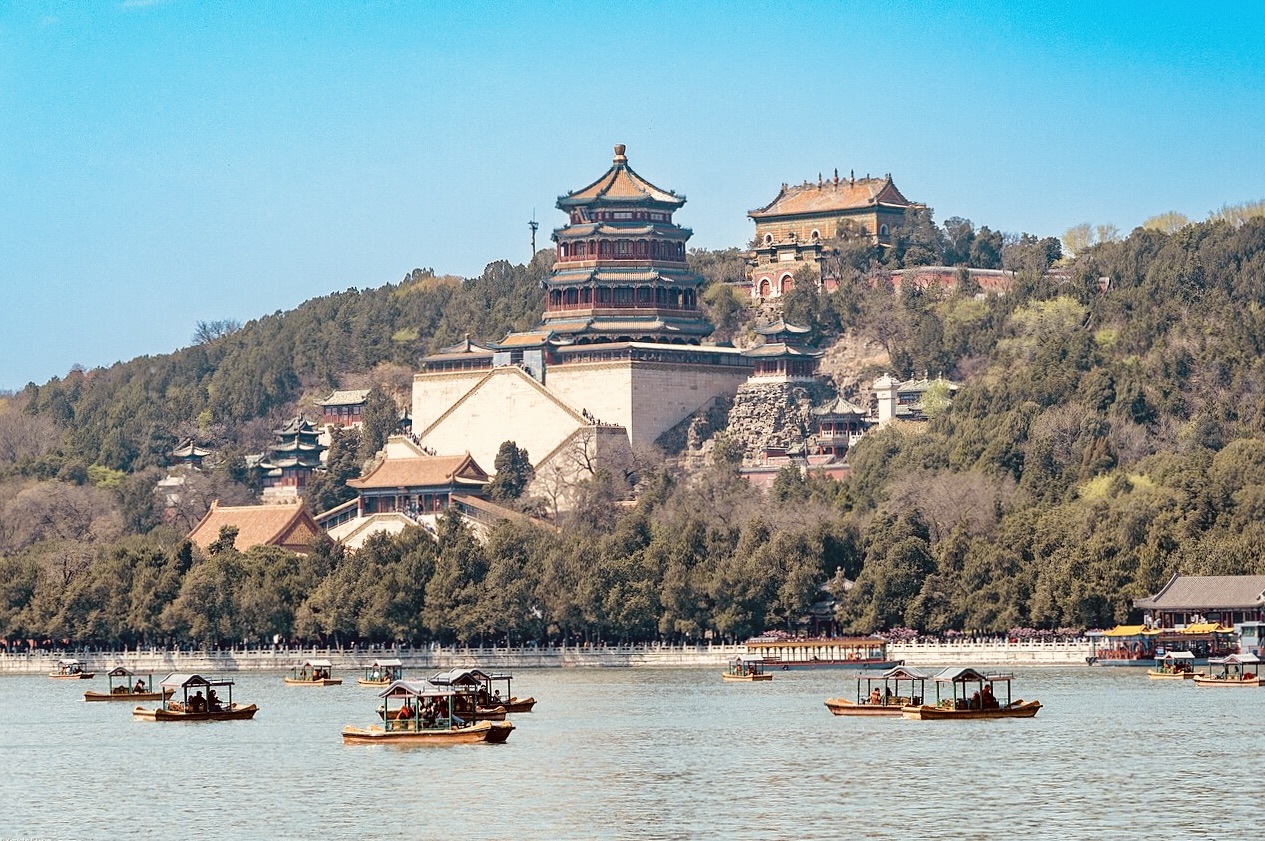
At its heart lies Kunming Lake, shaped to evoke the famed West Lake in Hangzhou. Rising behind it, Longevity Hill was formed from the lake’s excavated earth, adhering to the feng shui ideal of water in front and mountain behind — a layout symbolising harmony and stability.

Beijing’s Summer Palace: January Silence, May Heat.
For 110 years the palace blossomed handsomely. Until, that is, Anglo-French forces looted and burned the compound during the Second Opium War. A period of stagnation followed, and it wasn’t until 1886 that Empress Dowager Cixi rebuilt the whole thing and renamed it Yíhéyuán (Summer Palace).

Empress Dowager Cixi.
The project to revive the palace came with great controversy, due to the fact that the empress diverted a whopping 30 million silver taels from the Imperial Navy’s budget to bolster funds for her new luxurious complex.

Although she maintained her official residence in the Forbidden City, Empress Cixi spent long stretches of her later years at the Summer Palace, especially after her semi-retirement from formal politics. This was where she chose to host foreign dignitaries. Where she orchestrated court rituals and entertained herself with opera performances, boating excursions, and garden strolls.
Longevity Hill.

Beijing’s Summer Palace: January Silence, May Heat.
Photo courtesy of xiquinhosilva.

A pictorial plan of the newly rebuilt palace dated 1888.
Following the fall of the Qing Dynasty, the Summer Palace opened to the public in 1924. Over the next decades—particularly throughout the 1950s to 1980s—a series of major restoration projects gradually revived its former splendour. In 1998, with much of its grandeur restored, UNESCO recognised the site’s cultural and historical significance by adding it to the prestigious World Heritage List. Hooray!

Imperial roof decorations.
Photo courtesy of Hermann Luyken.
Curiously, my visit to the palace came on an icy day in January, deep in the dead of winter. With a free afternoon on my hands, I thought, why not? — time to see the old joint for myself.
Stepping into the grounds, I found several of the grand courtyards alive with local activity. Before long, I stumbled upon a group of residents enthusiastically practising Tai Chi, their movements slow, graceful, and utterly unfazed by the biting cold.

Beijing’s Summer Palace: January Silence, May Heat.
In the next courtyard, an impromptu concert stopped me in my tracks — a dozen seniors gathered in a loose semicircle, pouring their hearts into a rousing folk tune. There was no real audience, just me and a scattering of bundled-up grannies perched nearby, swaying gently to the rhythm.
Beijing’s Summer Palace: January Silence, May Heat.

An amazing experience, if only I’d had subtitles.

Beijing’s Summer Palace: January Silence, May Heat.
The music was unexpectedly lively: lutes twanged, violins sang, a lone saxophone cut through the winter air. Moreover, a woman at the back kept time with a soft thud of her bass drum.
It was an oddly moving scene — part performance, part ritual — and if any of the players noticed the wide-eyed foreigner lingering in the shadows, they gave no sign. The music wasn’t for applause; it was simply theirs, and I was lucky to catch it.

Beijing’s Summer Palace: January Silence, May Heat.
Reluctantly, I tore myself away to take a look at nearby Suzhou Market Street, which has -to put it mildly- a bizarre history. The street dates back to Emperor Qianlong’s days. During a visit to the city of Suzhou, the emperor had been so charmed by the canal-side storefronts and markets that he ordered a replica to be built within his imperial grounds.

Suzhou Market Street.
Now, I’m not kidding when I say replica. You see, the market wasn’t a market at all, but rather an illusion designed for the emperor’s amusement. Indeed he would role-play browsing, bartering and buying goods from actors and servants who took on the roles of merchants, herbalists, teahouse owners and other vendors. All so that he could treat himself to a stylised version of “common life”.
Suzhou Market Street.

Suzhou Market Street, pictured four months later during my second visit to the Summer Palace in May 2010.
My original plan was simply to wander the garden paths and see where they led. But down by a pavilion on the edge of Kunming Lake, I spotted a line of locals scaling a precarious stretch of fence.

Beijing’s Summer Palace: January Silence, May Heat.
To my delight, I realised that the lake was frozen solid. I watched as they clambered over onto the ice, picking up a few useful techniques for hauling myself across—along with some unintentionally comic lessons in how not to do it.

This could get messy.
Luckily, I managed my own scramble with dignity intact. And it was worth every bit of the effort. Stepping out onto the frozen lake, I breathed in the crisp January air and savoured the hush that blanketed everything.

Beijing’s Summer Palace: January Silence, May Heat.
Half-wondering just how safe it was to be out on the lake—and with Yoko Ono’s eerie Walking on Thin Ice playing in the back of my mind—I drifted casually toward a pair of men who’d come to do a spot of ice fishing.

Beijing’s Summer Palace: January Silence, May Heat.
I’d never seen ice fishing before, so I paused to watch for a while. The men seemed amused by my presence and even invited me to have a go. Sadly, the fish weren’t playing along—not so much as a nibble. We exchanged good-natured shrugs, and I carried on with my exploring.
Beijing’s Summer Palace: January Silence, May Heat.

(Hello, hello, hello) Is there anybody in there?
That afternoon, at the very zenith of the off-season, beautiful yellow and red dragon boats lined the shore. In the summer, they would run hordes of tourists around the lake. But now they were resting, recharging their batteries for the balmy summer days ahead. Among these vessels, I found the iconic (and peculiar) Marble Boat, also known as the Boat of Purity and Ease.

Beijing’s Summer Palace: January Silence, May Heat.
Built at Qianlong’s request in 1755, the Marble Boat was designed as a luxurious lakeside pavilion, styled after a traditional paddle steamer. Despite its name, it wasn’t made of marble at all, but of stone and wood, painted to give the impression of marble. Old Qianlong really did love his illusions.
Beijing’s Summer Palace: January Silence, May Heat.
The boat was badly damaged during the Second Opium War, but fear not, the ever-reliable Empress Dowager Cixi had it rebuilt in 1893. She added ornate European-style mirrors, giving it a flamboyant twist that made it stick out like a sore thumb among the traditional boats moored on the lake.

The Marble Boat, pictured in 1926.
So… the boat that couldn’t float. According to some historians, its symbolism lies rooted in a Confucian saying: “The waters that float the boat can also sink it”. One might also see this as a warning to rulers about the power of the people and the decline of the Qing Dynasty.
The Marble Boat.

Beijing’s Summer Palace: January Silence, May Heat.
Despite the biting cold, I knew I had to climb Longevity Hill—to see its timeworn structures and claim the sweeping views over Kunming Lake. Rising 60 metres above the northern shore, I made the ascent, passing shuttered pavilions, silent halls, and locked-up temples, their doors sealed for winter.

The Tower of Buddhist Incense poking out of the top of Paiyun Hall (Hall of Dispelling Clouds).
At last, I paused for a well-earned breather at the Tower of Buddhist Incense, once the emperor’s ceremonial space of worship. Octagonal in design, it reflects the eightfold path of Tibetan-style Buddhism.

Tower of Buddhist Incense.
As striking as the structure is, I was more captivated by the views from the vast stone terrace beneath it. A low fog had crept in, softening the scene, though I could still make out scattered strings of visitors below, wrapped in January’s silence.

Beijing’s Summer Palace: January Silence, May Heat.
I didn’t get any further that day, but I knew I had to return—if only to see the place in full summer mode. As it happened, I came back on a warm afternoon in May, the sun blazing, the sky a lazy blue. Visually, the transformation was striking: hundreds of visitors wandering the garden trails, and boats bulging with tourists criss-crossing the lake.

Beijing’s Summer Palace: January Silence, May Heat.
Buzzing with excitement, I made straight for Longevity Hill to take in the view—the same sweeping vista once enjoyed by Qianlong and Cixi centuries ago. It didn’t disappoint. This time, Nanhu Island came into sharp focus: the man-made imperial playground where music, puppet shows, theatrical performances, painting contests, and lavish feasts once unfolded in full splendour.
Beijing’s Summer Palace: January Silence, May Heat.

A view fit for an emperor/empress.

Beijing’s Summer Palace: January Silence, May Heat.
The views stirred me into action—I headed back down to the lake, eager to get out on the water. Steering clear of the sardine-tin dragon boats, I managed to rent a small electric paddle boat for an hour.

On Kunming Lake.
It was a joy whizzing across the lake, viewing its iconic landmarks from the water. On foot, the shoreline trails stretch nearly seven kilometres, but by boat, I breezed through them with ease.

Beijing’s Summer Palace: January Silence, May Heat.
Gliding past the eastern shore, I slowed to admire the charming Kuoru Pavilion—a classic Qing creation with sweeping eaves and intricate latticework, its airy, open design welcoming the breeze.

Beijing’s Summer Palace: January Silence, May Heat.
Next, I cruised past the spectacular 150-metre Seventeen-Arch Bridge, the sole pedestrian link to Nanhu Island. With its seventeen arches (naturally) and 544 individually carved stone lions, it’s the palace’s longest—and most iconic—bridge. Come sunset, it’s swarmed with photographers, all vying for that perfect golden-hour shot.
The Seventeen-Arch Bridge.

Beijing’s Summer Palace: January Silence, May Heat.
Having experienced the Summer Palace in both January’s hush and May’s heat, I didn’t expect I’d ever return. But life has its twists, and in January 2015, I found myself once again living in the Chinese capital. When an old friend got in touch to say he’d be visiting, I knew exactly where to take him: back to the old girl.

Beijing’s Summer Palace: January Silence, May Heat.
On that occasion I really took my time—strolling the gardens at leisure, something I’d somehow overlooked on previous visits.

Enjoying the lack of crowds on another chilly January morning.
Just as it had been five years earlier, Kunming Lake lay frozen—transformed once more into a winter wonderland for those willing to brave the cold. Fathers and sons skidded across the ice on sledges, while grandparents looked on, sipping hot tea from metal flasks.
From our perch atop Longevity Hill, it was a magical sight. There we stood—two foreigners, quietly trying to make sense of our place in this fascinating, often bewildering country.

Beijing’s Summer Palace: January Silence, May Heat.
Like this? Check out more of my location reports from across Beijing.
To travel further afield, why not have a read of my travel articles from all around China.
I’ve also written a collection of short stories called Challenged in China.



41 Comments
Brilliant article Leighton I loved all the insight and that you have presented this historic site in two such very contrasting seasons. Emperor Qianlong was a nutter right? Never a dull moment with him in charge. Empress Cixi on the other hand feels like the heroine of the piece – well at least in terms of the Summer Palace’s preservation. Though I’m not certain the Chinese Navy would agree! You packed a lot into this post – from local performances, ice fishing and tai chi – to boating, that wacky marble boat and ridiculous market street. Based on your two articles so far I am assuming that overall your experience at the summer palace was much more enjoyable than the forbidden city?
Cheers James. Yes, I can imagine every day was a hoot with Emperor Qianlong. Seriously though, I bet everyone he knew hated him ha, ha. I’m trying to picture all that nonsense on Suzhou Market Street unfolding, all to tickle the emperor’s childlike fantasy. You are absolutely right, The Summer Palace was much more charming as an experience. Mainly because it is a much vaster complex and no matter how busy it gets, there’s always the feeling that you can escape to a quiet leafy corner somewhere.
Great article. Brings back memories from our own visit to the Summer Palace in 2014
Thanks John, I’m glad to have whisked you back in time for a bit. Cheers, I appreciate the comment!
A gorgeous place to visit Leighton, hot or cold. I guess the Chinese have long known what it takes to build a dynasty. Impoverish the people, create a god like status for yourself and heirs, build lavish palaces to live in and visit and then sit back and let everyone entertain you. Imagine hiring role playing actors to allow you, the Emperor to act just like a common man. I can see now how so many common men start off as dedicated public servants and get corrupted by the power until their ultimate downfall. Great that you were able to catch that local band doing their own thing and the ice fishers trying their luck. Those moments are what make visits to new places all worth while. I live in a frozen land and despite seeing it everywhere in winter here, have no desire to use my frozen assets to fish in winter…or even summer for that matter. Have a wonderful Sunday. Allan
Ha, I hear you, Allan. I have certainly never attempted to ice fish again, let’s put it like that. Totally concur about the small intimate experiences often turning out to be the highlights of a trip. Thanks for reading and for your thoughtful comment as always, and have a great Sunday too!
I loved Summer Palace, but either forgot or didn’t know so many details like the marble boat isn’t marble, or the market isn’t a real market! One part of Beijing’s culture that I found interesting was a different sense of personal space. People would go about what ever routine they wanted, in front of everyone, with no concern for what others may think. Sometimes it was wonderful, like your band, but others just felt like they should be in a more private location like a screaming at the top of their lungs person I remember. Great post Leighton, Maggie
Thanks Maggie, I’m glad you got a few new things out of this, even though you have visited yourself. Yes, the invasion of personal space and public etiquette in general is one of the toughest things to adapt to when visiting / living in China. The things I have seen take place in the street while I’m going about my daily business…. some of it just too grim to write in a comment thread ha ha.
I liked how you recounted experiences that tourists would not generally have a connection with. I can see how that would have made all the difference between visiting and living in Beijing. Thanks for showing us the palace in winter and summer.
Living in Beijing definitely did give me the opportunity to see the palace in such contrasting conditions. And I have to say that I enjoyed both experiences immensely despite the May crowds, so I’ll always be grateful for that opportunity. Thank you Annie, for taking the time to read and comment.
great adventure!
Certainly was.
It’s impressive you’ve visited the Summer Palace three times, and in different parts of the year! I’ve only ever visited in the hot, hazy summer, so it’s surreal to see your photos of the lake completely frozen over. Definitely a stunning work of architecture by royalty back in the day, and I’m sure you have fond memories of visiting the Summer Palace over the years. Thanks for sharing, Leighton!
Thanks for reading and commenting Rebecca, I’m glad you enjoyed seeing a different side of Beijing’s Summer Palace.
You make it sound wonderful, Leighton, and I’m sure it is. Yet I’m not sure we’ll ever get there, there’s so many places ahead of it on the wish list. Maybe you could convince me to raise its profile…..
Hey ho, I’d say The Summer Palace is my favourite of Beijing’s monster historical sights. As for the convincing, hopefully the articles speak for themselves, either the idea of Beijing seems worthwhile or it doesn’t. A few more from the Chinese capital on the way from 2009-2010, though I’ll be adding some additional posts from 2014-2105 further down the line. Cheers Phil! Stay safe out there.
I certainly do not know enough about Chinese history. What you saw and experienced is spectacular. The Summer Palace is beautiful even in winter. While reading your post I realized that the second Opium War happened during the Taiping Rebellion. The Taiping rebellion was huge, killing 20-30 million people. It must have affected the outcome of the second opium war by weakening the Qing dynasty. Anyway, I agree your two years in the capital was an unqualified privilege. Thank you for an interesting post.
Thanks so much Thomas. Yeah, Chinese history is dense, and I am certainly no expert. I have the bits of stuff I remember, the bits and bobs from my notes, and then the stuff I manage to dig up while putting my articles together. I would imagine it’s a full-time job becoming anywhere near knowledgeable about the subject. Now you’ve got me Googling the Taiping Rebellion. Cheers, Thomas.
Excellent article, Leighton. It’s interesting to revisit a place in a different season or years later to see how it’s changed. Reading about Emperor Qianlong’s replica of the market made me think of Marie-Antionette and her Petit Trianon, a place where she could pretend to be a peasant. Both are quite quirky behaviors. I chuckled at your ‘this could get messy’ photo. But yikes, it looks quite precarious! A fun read!
Thanks Tricia! Yes, it was a privilege to see the Summer Palace three times. And I wouldn’t rule out a fourth if I ever make it back to Beijing. Marie-Antionette – ha, I like the idea of some alternate universe history where she and Emperor Qianlong sat down to chew the fat over some tea. I’m certainly glad nobody was around to take a photo of me as I clambered over that fence.
The Summer Palace sounds like quite the birthday present! Funny how even then there was a desire to have a place to escape to enjoy some peace and quiet from everyday life. It’s neat that you were able to return and visit in a different season.
Ha right, what did YOU get YOUR mum this year? It’s never going to match up, is it? As for the escape thing, The Forbidden City had a huge imperial garden that seemed like it was a pretty decent oasis. Then again, can one ever have enough lakes, hill, pagodas, temples and marble boats to frolic around in? I think not, especially when you can just steal the money from the navy to pay for it all 🙂
What a place! I really enjoyed this article Leighton. I find Empress Dowager Cixi quite intriguing – she looks absolutely formidable. And those pavilion boats get about – I’ve seen them in a few Chinese inspired gardens around the world now (especially in Singapore). They seem to have a very special meaning in Chinese culture. How lovely you have been able to visit a couple of times, and enjoy your moments immersed in China.
Thanks Han, I’m glad you enjoyed your tour of the Summer Palace. I’m not surprised the marble boat thing caught on, it’s a pretty cool (if ostentatious) idea and perfect as an atmospheric restaurant cafe.
What a delight that you got to experience the palace in the summer and the winter. Very interesting read on the palace beginning and the Empress Dowager Cixi. She does not seem like someone to be on the wrong side of. But to be fair, to wear so many layers in the heat of summer would make that of anyone. I love that you ran into the different concerts and tai chi groups- quite a mix of history and the modern world coming together. Great piece Leighton- I have loved following along to these places around China with you. 🙂
Hey Meg. I think your instincts are spot on, I wouldn’t mess with Empress Dowager Cixi either. I mean, this is the woman who basically single-handedly screwed over the Chinese Navy, what chance would we have? Seriously though, I’m glad you enjoyed touring The Summer Palace with us, there is plenty more to come from Beijing over the next weeks.
I visited Beijing’s Summer Palace in February, with its fair share of frozen lakes. However, I have fond memories of it as a place that has been carefully constructed and decorated in such a characteristic Chinese style.
Yes, I think it’s a delightful place no matter what the season. Probably best seen in summer for its natural beauty, but also delightful and highly atmospheric in winter without all the crowds.
That is amazing that you were able to visit Beijing in both the summer, and into the icy adventures of winter as well! Thank you for sharing the complex history and how it weaves into the current being of the area.
Thanks so much Allie, it’s a special place and definitely one of a handful of highlights from a visit to Beijing! 🙂
I’d previously heard of the forbidden city, but never the Summer Palace. Thanks for the thorough tour!
Thanks Diana, these two are the biggest sites of historic imperial China in Beijing. You’d be looking at pretty much a whole day to do both.
wonderful writing and photos leighton. i believe this would be my priority over the forbidden city if i only had time to choose one. i also feel there is much more charm and atmosphere to the winter scenes though the palace is undeniably picturesque in your may photographs. the marble boat and suzhou market streets are such curiosities. oh to be a chinese emperor for a day.
Hey Stan, I think my line of thinking would be the same as yours. If one really needs to choose between the Forbidden City and the Summer Palace, I would also go for the palace for a smoother and more atmospheric overall experience. Thanks for your ongoing readership, old friend.
I really enjoyed how you described the history and culture of the Summer Palace. Reading your post felt almost like walking there myself. Someday I want to visit Beijing and experience Chinese history and culture directly, but I believe it is important to study in advance. Your blog was very helpful for me as a first step of that learning.
Hello Yuina, thank you for reading my article about the Summer Palace and taking the time to leave a comment. I’m so glad that you felt immersed in the site, I’m sure you are going to love your real life visit! Keep an eye open for a few more Beijing articles coming out on my blog over the next two Sundays. Cheers!
Hello, I am a first time reader. I loved how vividly you brought the Summer Palace to life, capturing both its grandeur and intimate local details. The contrast between the silent winter scenes and the bustling summer crowds made for a really engaging piece. I read a few of your articles today and I must say it’s better than most of the dross on WP. A truly immersive and captivating read!
Hi Samuel, welcome to LT, I’m glad you enjoyed what you’ve read so far. Beijing’s Summer Palace is such a special place and deserves to be experienced in several seasons. I appreciate you taking the time to leave a comment!
Wonderful to see a place in two such different seasons! I loved the Summer Palace when we visited back in 1994 (I think!) but it was far too short a visit and part of a tour, so we didn’t get to climb Longevity Hill which I now see from your photos was a real shame!
Hey Sarah. The climb up the hill for those sweeping views was probably the highlight for me, although getting to lark around on the frozen lake in winter runs it pretty close. Was it a summer visit for you back in 94′? Thanks for dropping by.
Late summer I think, though I can’t remember exactly!