
Huangluo Yao Village & the Longji Rice Terraces.

Huangluo Yao Village & the Longji Rice Terraces.
Guangxi Autonomous Region, China.
May 2010.
Cover photo courtesy of xiquinhosilva.
After my cycling and cooking adventures in Yangshuo, I returned to Guilin by bus, where, reluctantly, I boarded a large coach for my day trip into the mountains. I had hoped to avoid a group tour, but with only a day to spare and an awkward local bus schedule to contend with, I swallowed my disdain and booked through China International Travel Service.

I remember thinking to myself: How bad could the group tour be? Unfortunately, not in my wildest imagination, could I have anticipated just how bad. The misjudged nature of the tour began at concept level. What I had not realised, is that the group was a mix of Chinese domestic tourists and foreigners: including a young Spanish family, an Australian couple and a handful of solo travellers like myself.

Huangluo Yao Village & the Longji Rice Terraces.
The drive from Guilin to our first stop, the ethno-village of Huangluo Yao, tucked deep in the Longsheng mountains, took just under two hours. Much to the frustration of many, the tour guide spent the entire journey blaring information through a loudspeaker. He barely paused for breath, rattling through the landscape, local history, cultural curiosities, weather conditions, and plenty more.

Longsheng Mountains.
For the most part he spoke in Chinese, though every so often he’d switch to English to summarise. His English was so poor I could barely follow a word of it. At one point, a Spanish woman stood up and asked if he could turn the loudspeaker down. But he just stared at her blankly, clearly having no idea what she was asking.
Huangluo Yao Village & the Longji Rice Terraces.

A long, painful ride.
With a steadily worsening headache, I tried to focus on the unfolding landscape as the bus twisted along narrow mountain roads that felt ill-suited to a coach of this size.
By the time we began the approach to the village, the mood onboard had soured. Indeed my lasting image is of a young Swedish guy sat opposite me. He leaned forward, his head pressed against the seat in front, silently begging for the guide to shut up. As if in answer to his prayers, the bus ground to a halt and we stepped out into the chilly, misty air of Huangluo Yao.

Huangluo Yao Village & the Longji Rice Terraces.
As we spilled out onto the village’s main street, the rain began. Light at first, then steady enough to send a few people fumbling for ponchos and hoods. Huangluo Yao revealed itself slowly through the drizzle: dark wooden houses on stilts, narrow walkways slick with rain, and the murmur of water already running off tiled roofs.
The guide, at least, had been prepared for this, and within seconds he was pulling umbrellas from his shoulder bag and handing them out.
A Rainy Day in the Longsheng Mountains.

Huangluo Yao Village & the Longji Rice Terraces.
Set deep in the hills of Longsheng, the village is home to the Red Yao, a subgroup of the wider Yao ethnic minority. They are long known for unique traditions that feel both preserved and very carefully presented for curious visitors.

A Red Yao lady.
Better known internationally as China’s long-haired ladies, the women are famous for their hair. Grown and preserved over a lifetime, they coil and sometimes wrap their hair into elaborate styles that carry markers of age, marital status, and identity.

Huangluo Yao Village & the Longji Rice Terraces.
Photo courtesy of Gerd Eichmann.
As we stood listening to the guide, who was already back on his loudspeaker, a few women appeared beneath the eaves. They smiled warmly, their long black hair wound thick and heavy. One of them beckoned me over to her stall of handmade crafts. I smiled back and browsed for a moment out of politeness, before rejoining the group.

Huangluo Yao Village & the Longji Rice Terraces.
Ignoring the guide, who I still couldn’t understand, I turned to my guidebook and picked up a few details about the villagers and their traditions. Yao girls begin growing their hair at around twelve, with elders treating it using a mixture of rice-washed water and herbs.
Huangluo Yao Village & the Longji Rice Terraces.

Red Yao ladies.
Photo courtesy of Youlin Magazine.
For the Red Yao, hair represents a happy, healthy life, one of prosperity and good fortune. It can grow to as long as 1.8 metres and is cut only once in a lifetime, usually at around eighteen or just before marriage. Women with their hair covered are single, awaiting a suitor, while married women wear theirs in a flat, tray-like bundle atop their heads.

Huangluo Yao Village & the Longji Rice Terraces.
When the guide’s latest monologue finally ended, a pair of long-haired ladies led us inside one of the homes on the main street. It felt quite surreal as we all filed through the vast, creaking structure in near silence.
The rooms were spacious but sparsely decorated. In the living room, half a dozen children sat on a small rug, watching cartoons on a bulbous old 1990s-era TV. None of them looked up as we passed. I didn’t dare take out my camera, it just felt… wrong.
Huangluo Yao Village & the Longji Rice Terraces.
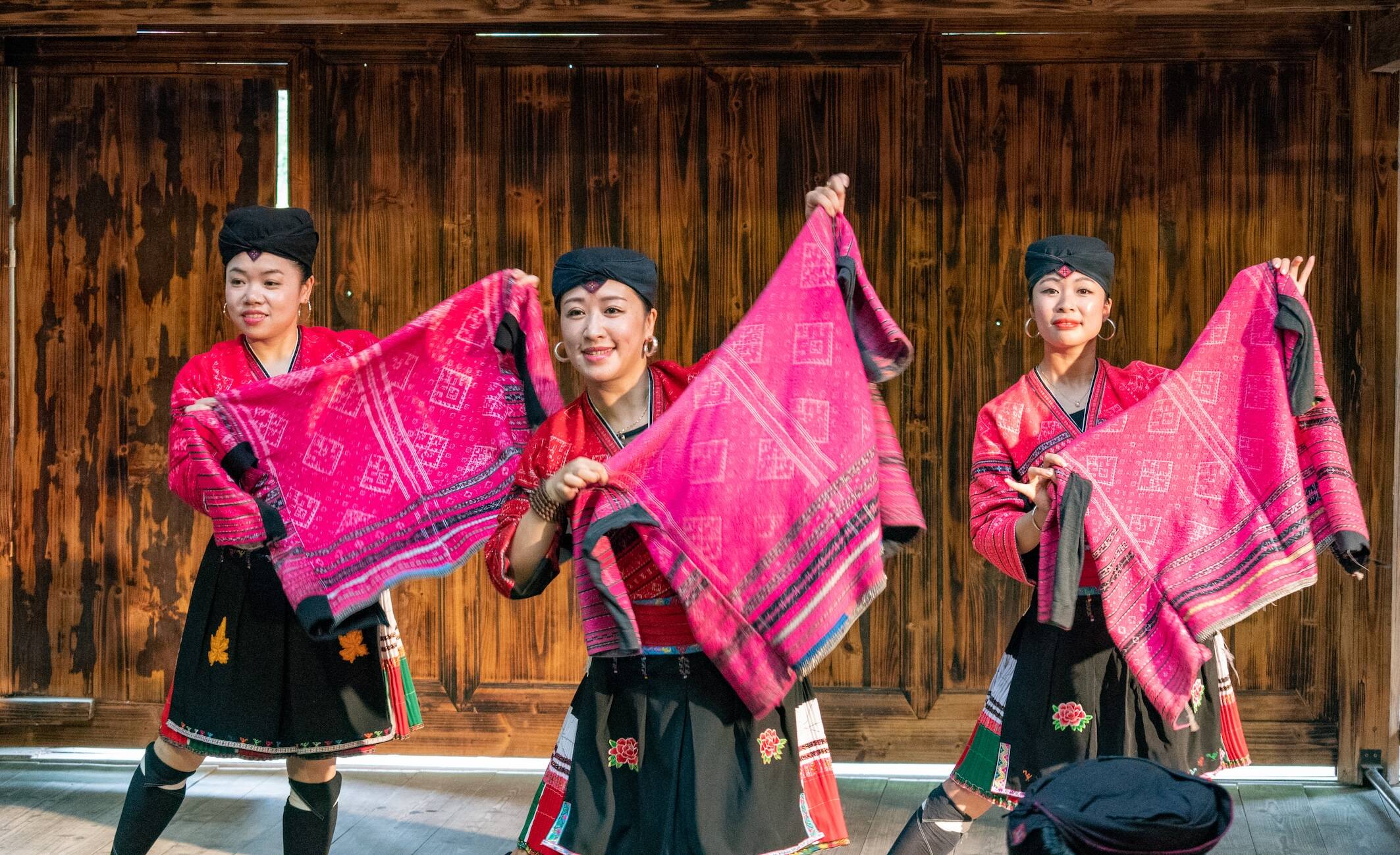
The main event of any visit to the village is the so-called Long-Haired Show, staged daily in a large theatre hall. Another tour group had just arrived, so the hall was packed to the rafters as the lights dimmed.
The Long-haired Lady Show.

Showtime.
The performance leans heavily on the village’s traditions and customs. It opens with music and choreographed dancing, the women moving in bright traditional dress, their hair coiled, wrapped, and then dramatically unfurled to appreciative murmurs from the crowd.

Huangluo Yao Village & the Longji Rice Terraces.
As the performance progressed, more women appeared, some at the windows high above the stage, where they waved before letting their hair fall—Rapunzel-style—down the front of the façade.

Huangluo Yao Village & the Longji Rice Terraces.
From there, proceedings took a distinctly odd turn. One of the women stepped up to a microphone and invited three male audience members onto the stage. Within seconds, two Chinese men trotted up, along with a bemused Australian who’d been handpicked by our guide.

The Long-haired Lady Show.
The compère then asked each man to choose a long-haired lady he liked the look of, which set in motion what I can only describe as a slapstick pantomime designed to explain the local courting process.
Huangluo Yao Village & the Longji Rice Terraces.

Choices, choices.
One of the Chinese men had to serenade his beloved, while the other endured a steady stream of ass pinches from his chosen partner. But the real humiliation was reserved for the unfortunate Aussie. First, his partner climbed onto his back as the crowd gasped, hooted and hollered.
Then the compère instructed him to run a full loop around the hall with her still clinging on. He looked mortified, but went through with it, every part of him willing the ground to swallow him up. When he finally shambled back onto the stage, the compère crowned him with a ring of flowers.

Huangluo Yao Village & the Longji Rice Terraces.
Moderately entertained, but wondering if there might be a more dignified way for these ladies to present their traditions, I joined the throng spilling out of the theatre. Moreover, it suddenly struck me that I hadn’t seen a single adult male. I could only assume they were out working the rice fields.
From there it was back onto the bus, winding slowly ever upward. This was where the landscape was meant to shift from gorgeous to something else entirely, as this stretch of the mountains is home to one of China’s most arresting sights: the Longji Rice Terraces.

What I had been hoping to see.
Photo courtesy of Anna Frodesiak.
Also known as The Dragon’s Backbone, the terraces have been shaped over centuries, first by the Zhuang people and later by the Yao. On a clear day, as pictured above and below, they are a wonder to behold.
The Longji Rice Terraces.

What I had been hoping to see, Mk II.
Photo courtesy of Dariusz Jemielniak.
But that afternoon they revealed themselves only in fragments, half-lost in the mist. Initially there were faint lines etched into the hillside, then the ghosts of several curves disappearing into cloud. Atmospheric for sure, but not without its frustrations.

My best shot from the bus window between the villages of Huangluo Yao and Ping’an.
Gradually, we edged closer to Ping’an, the road narrowing further as the world beyond the windows seemed to dissolve. The guide was back on his loudspeaker, and with some effort I gathered that Ping’an is predominantly home to the Zhuang. And that without the long-hair tourism, their income comes mainly from the rice terraces, along with a growing number of family-owned guesthouses and restaurants.

Arrival in Ping’an.
In Ping’an we had over an hour to wander and grab some food. That was music to my ears, and off I went, soaking up the misty mountain atmosphere. Perched high on the mountainside, the village is little more than a tight cluster of dark wooden houses stacked along steep, narrow paths.
With clouds drifting quite literally through it, the place felt half-hidden, rooftops and balconies appearing and disappearing before me. Wooden walkways creaked underfoot, lined with small guesthouses, a convenience store, and quiet, lantern-hung doorways.
Huangluo Yao Village & the Longji Rice Terraces.

A special place.
It quickly became apparent how hungry I was, and that in actual fact there was only one restaurant open. So in I went, only to find half the tour group already sat down and in various states of ordering and eating. The food was pricy but good; I had no complaints whatsoever about my fried beef dish, served swimming in greens and a rich, garlicky broth.

Huangluo Yao Village & the Longji Rice Terraces.
However, the star of the show was undoubtedly a portion of Sticky Bamboo Tube Rice (zhu tong fan / 竹筒饭). Mixed with mushrooms and beans, locals roast it slowly over a charcoal fire, the bamboo steaming the rice from within while infusing it with a faintly sweet, almost grassy aroma. Tinted green from the natural oils, it was delicious, especially dipped into the sauce of my beef and cabbage dish.

Sticky Bamboo Tube Rice.
As I finished up my meal, I got word from the Spanish family that the guide had set a time for everyone to gather at the village’s main square. There, we would all walk down the hill together, alongside the terraces, down to the halfway point between Ping’an and Huangluo Yao, where the bus would be waiting for us.
Immediately, I decided that I would make a five-minute head start, so that I could enjoy the atmosphere away from the group and with the guide out of my ear.
The Dragon’s Backbone.

Huangluo Yao Village & the Longji Rice Terraces.
The walk only took around twenty minutes, but it felt good to be on my own for a while. Making peace with the weather I took in the terraces as they came in fleeting, half-hidden glimpses. Then, in the final stretch, much to my surprise, the mist lifted altogether and I finally got a taste of the scenery I’d been dreaming about.

Longji Rice Terraces.

Homes built directly into the terraces.

Yours truly and the Dragon’s Backbone.
On the journey back, the guide stayed quiet and everyone drank in the peace. Between Guilin, Yangshuo, and the Longsheng mountains, Guangxi had delivered some fantastic adventures. My trip was drawing to a close, as indeed was my year of living in China. But I wasn’t quite done yet. The city of Hong Kong, I hoped, would provide one last hurrah.
Like this? Why not check out more of my travel articles from across China.
I’ve been living, working and traveling all over the world since 2001. So why not check out my huge library of travel reports from over 40 countries.



.jpg)


36 Comments
Really enjoyed this post. Your writing is wonderful.
Hey Annie, sorry for the late reply, your comment went through to junk for some reason and I only just caught it. Thanks so much for your kind words, I’m glad you enjoyed the read 🙂
That is a very cool photo Leighton!
Thanks Chuckster, which particular photo are you referring to?
Ha, sorry. Several, but I love the red Yao ladies with their hair unfurled, on display.
Aye Yai Yai, Leighton. Group tours are either the best or worst. For instance our 1982 Orient Escapade, with odd exception was perfection, but our 1984 Cosmos 5161 Europe in 15 days was God awful. Like you, we looked for ways to escape our Scottish guide and Italian bus driver combo and the constant harangue to buy the optional tours. The tour was only a means to get places, albeit late in the day and often when the tour sites had closed. The sights you saw look divine though and the long hair ladies were a Rapunzel delight. Thanks for sharing and happy Sunday. Allan
I remember your Cosmos Europe tour! Dear, oh dear. The Long-haired lady experienced was fun and one of the most unique villages I’ve ever experienced. Cheers, Allan. 🙂
Your tour had me laughing although for you, it wasn’t funny. I had the same experience in Vietnam so can empathize. I wanted to visit Halong Bay, but knew it would be packed with tourists, so did a day tour from Hanoi and had the exact experience—the guide with a loud speaker never stopped talking on the entire ride there.
Ah yes, Halong Bay can be such a trap in that regard. Luckily I managed to stay on Cat Ba island for a bit before doing the cruise, so avoided a bus tour. However, I did have to take a tour to get around the bay itself and once again it was our old friends the loudspeaker and verbal diarrhoea. I wonder what makes tour operators think this what people want. It’s like the blasting music on a boat thing, why, why why? Thanks for stopping by, Mallee.
I’ve heard of the Yao women and their extremely long hair, and it’s cool you got to visit and learn a bit about their tradition! I, too, have been on tours which were a bit…much. Not just Chinese-speaking ones, but also others in countries/regions with less international crowds. Despite the headache-inducing loudspeaker, it sounds like you got to learn a bit about this part of China and, if anything, use the tour as a mode of transport to get you around with limited time. Thanks for sharing, Leighton!
Hey Rebecca, the tour was definitely a means to an end, on this occasion the only way I could have seen both villages and the rice terraces in a single day. It also taught me to be way more discerning about the kind of tour I take in the future, though in all fairness I haven’t actually taken many tours over the past sixteen years. I would love to see a bit more of Guangxi one day if I do indeed managed to get back to China. Cheers!
As the Bard said, “Tour be or not Tour be!”
NOT to be!!! That is the answer.
Hahaha oh god the tour from hell! We’ve all had one I think! 🤣
And imagine, for many people, this kind of tourism is default mode.
Yeh I couldn’t deal. Once in a blue moon when you have to is ok, but not for every trip! Ugh!
Though it obscured your view, I quite like the fog in all your photos. It lends somewhat of a mysterious quality to the landscape. The long hair tradition is unlike anything I’ve ever heard before. Managing that much hair must take a substantial amount of time. Also, sorry to hear about your guide. It’s always frustrating when that ruins what could have been an interesting tour.
Thanks Diana, I was devastated about my photos back then, but time has a way of softening feelings and planting new perspectives. This trip showcased a very special corner of China, it’s just a pity that this particular tour operator had no idea how to best serve their customers.
It is tough when the weather doesn’t cooperate, especially after having to listen to someone yap for so long! I can’t imagine talking that long… At least the food was good, imagine being super hangry after all that too! I can’t help but think how difficult it would be to wash all that hair!
Hangry is a good word to describe how I was feeling, having finally gotten away from the guide and his wretched loudspeaker. Still, this was a highly memorable leg of my China adventures Lyssy, thanks for reading 🙂 Sladja and I hope all is well with you and the little one.
this might be my favourite of your recent china articles leighton. the tour although thoroughly miserable for you at the time makes for an amusing read while the long hair village is such a unique location. i imagine you were shrinking into your seat during the performance when they asked for volunteers. the rice terraces are beautiful and like others have alluded to there is an appeal to the way they flicker in and out of view through the fog.
Glad you enjoyed it Stan, and that your own virtual tour came loudspeaker-free. Even I had a few chuckles writing this and thinking back to how miserable most of us were on that damn bus. You aren’t kidding about trying to make myself as small as possible as possible when they were sniffing around for volunteers, that’s precisely what I did! Still, the landscape made up for it all, another incredible corner of China.
And this is exactly why I’m always reluctant to go on a large group tour. Sorry to hear that it was an awful experience. Even the ride sounds terrible with the blaring speaker. The long-haired ladies are fascinating. I can’t even imagine how long it takes them to wash, brush and style their hair. Good call on walking back to the bus ahead of the group. And glad you got some good pictures of the terraces and scenery.
I can probably count the number of group tours I’ve taken on one hand in the sixteen years that have passed since this trip. Basically, only if absolutely necessary! Thanks for reading about my travels across Guilin, Linda. 🙂
This looks like such a magical region of China. From everything you have posted in recent weeks I’d say Guangxi would be top of my list if I ever get over there. This last part -crappy tour aside – really captured my imagination and fuelled my wanderlust. Is it possible to actually stay in the long-hair village?
Cheers James, I think you could do a lot worse than focusing on Guangxi for a few weeks on your first visit to China. I know there are plenty more locations across the region I wish I’d had time for. I believe that while Huangluo Yao is predominantly a tour-stop village, there are a few homestay rooms for visitors who want to stay the night in Huangluo Yao. That said, I don’t think you’d be able to pre-book, and I’d be surprised if English is spoken in the village. Still, it would be an adventure to make an overnight stay of it. Failing that, there is definitely a hotel in Ping’an, just up the hill.
Oh no what an awful tour! When you said it would be bad I didn’t imagine that it would be that bad – the poor Aussie guy must have been mortified! Apart from that I’m glad you got to enjoy the beautiful scenery with more peace and quiet and that the mist lifted a bit too! It really looks like a magical place!
Thanks so much for reading Juliette. I would summarise this trip as “amazing landscapes, fascinating people, substandard weather, shit tour.” There we go, I just saved myself a 2000 + word blog ha ha.
What a day trip Leighton! Though I did smile quite a lot as I was reading it. The rice fields and village look beautiful even in the rain, so I can only imagine how picturesque they’d be on a bright crisp morning. The tour guide sounds absolutely awful so I’m glad you got some solitude later in the day. And that bamboo rice, yum!
Absolutely, I think if you were to roll into those villages on a warm sunny day the landscape would be just spectacular. Still, I appreciate my experience for what it was, and like you I can’t help but chuckle when I think back on it all. Thanks so much for reading and commenting, as ever. 🙂
Tour groups are just one of my least favorite groups to be in. That was a great move to get a head start up the trail for those precious minutes before the group. It is so fascinating to me how in different cultures and time periods, women’s hair is viewed. Here it seems they have created a whole unique pride and display of their hair. The rice fields are really lovely, even in the rain.
Hair traditions across different cultures around the world would make for an interesting article, right? Thanks for reading about the last of my experiences in Guangxi, Meg. Next up, I finally get to wrap my 2009-2010 China adventures. It’s taken a long time, but I’m there at last.
Such a shame about the guide who wouldn’t shut up! Also the rain to some extent, though the terraces do look very atmospheric. We had exactly the same experience in the Philippines – maybe those terraces always look so green for a reason! I’m glad you managed to ditch the group and enjoy them in peace for a while 🙂
That’s a good point about the rain and lush terraces, Sarah. Was it the Cordilleras you visited in the Philippines?
Yes – around Banaue and Bangaan
I’ve had a few bad tours and, like you, prefer to go on my own if possible, but this one has them all beat. The Yao women with their long hair sound interesting, but having to run around with one on their back? and pinching? Yikes! Glad you got a little time on your own in the rice fields.