
Exploring the Chinese City of Harbin.


Exploring the Chinese City of Harbin.
February 2010.
After six months of living and teaching in Beijing, I was more than ready for a break from work—and for an adventure. Life in the capital had been eventful, often chaotic and stressful, as I’ve detailed in my short story collection Challenged in China!

A typically manic lesson in Beijing during the autumn of 2009.
Indeed, that grand, rambling trip I’d taken through Shandong Province in the summer of 2009 already felt like a lifetime ago. My feet were itching, my wanderlust calling. As for where to go, the choice was obvious, nothing even came close. It definitely had to be Harbin in Heilongjiang Province, home to the world’s largest and most spectacular ice sculpture festival.

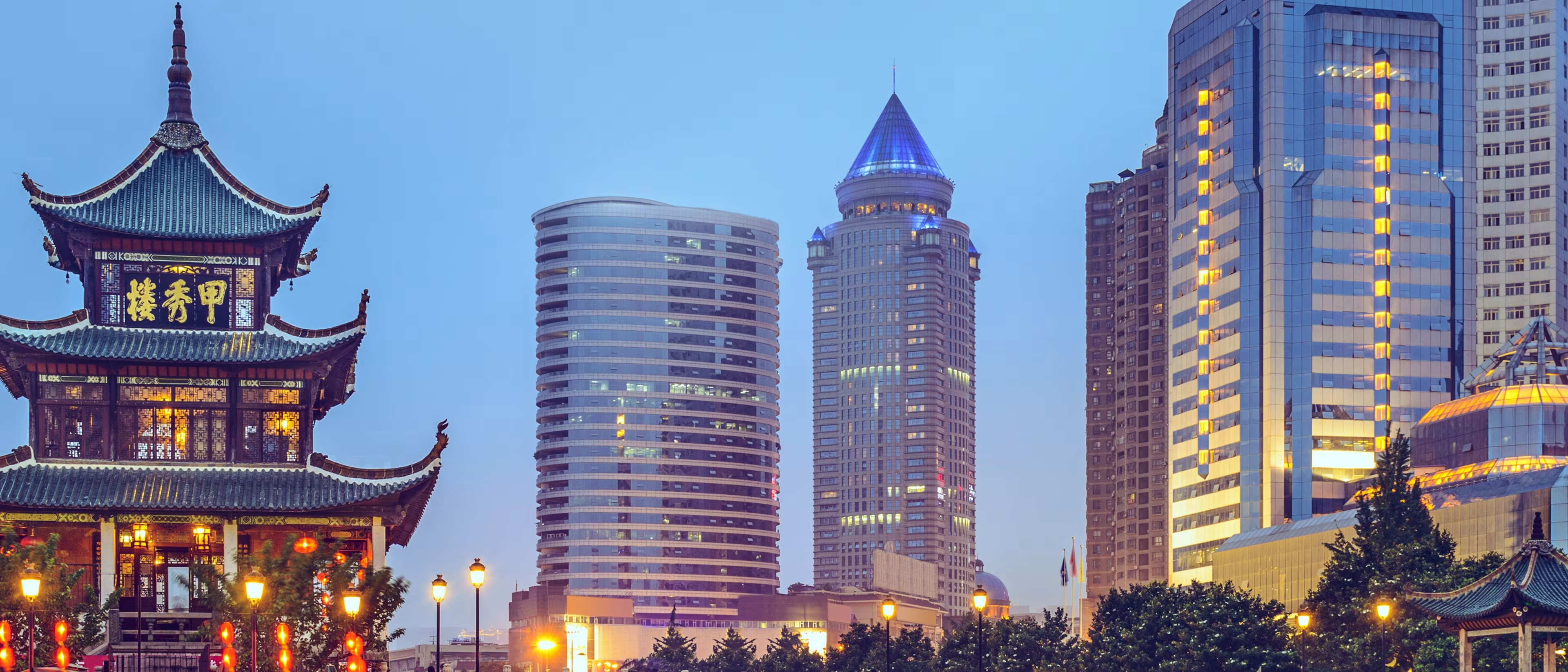
Harbin, an historic and cultural gem tucked away in China’s unloved northeast.
Predictably, the school principal Trudy was unimpressed with my travel plans. “You shouldn’t go there” she said, looking concerned. “Harbin is very cold, it is not a good choice”. Naturally, I told her all about the world-famous ice and snow sculpture festival. About its Siberian Tiger Park, Russian cathedral and Buddhist temples. But it all fell on deaf ears, because Harbin was “cold” you see.
Exploring the Chinese City of Harbin.
Unfortunately, the trip did not get off to a good start. While everything was fine with my two-hour flight, disaster soon struck as the taxi dropped me off at my booked lodgings, Little Fir International Youth Hostel.
I knew I’d taken something of a risk when I booked this dirt-cheap accommodation, though I certainly wasn’t prepared for just how much of a crap hole it turned out to be. Until, that is, I arrived at the main entrance with its appalling “welcome” mat.
Exploring the Chinese City of Harbin.

A miserable, miserable hostel.
What followed was truly one of the worst hostels I’ve ever been to. Right up there with the dreadful hostel in Tianjin and the famous shithole in Agra, India. First came the rude woman at reception who treated me as if I were something murky she had just discovered at the bottom of her shoe. Then there was my room, a filthy cupboard that had no heating and a few sheets of worn-out cardboard for a mattress.

Nothing but the best at Little Fir International Youth Hostel.
Reluctantly, I spent my first night at Little Fir before checking out the next morning. Not wanting to waste time or risk another disappointment, I booked an ensuite double in a charming four-star hotel right on Zhongyang Street, Harbin’s leafy pedestrian boulevard.

Zhongyang Street pictured during my second visit in the summer of 2014.
Having Zhongyang Street’s cobblestone charm right on my doorstep made all the difference. Stretching 1.4 kilometres from Xinyang Square to the banks of the Songhua River, the street has been at the heart of Harbin life since 1898, when businesses first sprang up to serve the Chinese Eastern Railway—an offshoot of the mighty Trans-Siberian network.

Exploring the Chinese City of Harbin.
With the flourishing of the railway, Harbin grew into a thriving international hub, attracting thousands of Russians, Jews, and Japanese. Its commercial artery pulsed with diversity, while the cityscape became an eclectic showcase: sprawling office blocks and elegant homes rose in styles ranging from Renaissance and Baroque to Beaux-Arts and Art Nouveau.
Zhongyang Street.

Lively Zhongyang Street pictured the mid 1930s. Exploring the Chinese City of Harbin.
The city suffered greatly during World War II and the Japanese occupation. Yet, even as most of Harbin’s Jewish and Russian communities fled, its architectural legacy remained largely intact.

Zhongyang Street pictured during my second visit in the summer of 2014.
The Soviets eventually drove out the Japanese, after which the Chinese communists took control. Decades later, in the mid-1980s, the government granted Zhongyang Street protected status, and in 1997, following a full restoration, it was unveiled as China’s first commercial pedestrian street.

Zhongyang Street in festive mode for Chinese New Year.
The excitement of Chinese New Year filled every corner of the lantern-draped street. Shoppers posed with mascots from a Korean restaurant, while tourists gathered around miniature ice sculptures. Though Christmas had long passed, a towering tree still loomed over a bronze carriage and driver—a tribute to the city’s transport heritage.

Exploring the Chinese City of Harbin.
Damn, it was cold—the coldest I’d ever felt in my then-tender 31 years. I was just wondering how low the mercury had sunk when I came across the Giant Thermometer Monument, part practical readout, part streetscape branding. It glared back at me: minus fifteen, the clock creeping toward 11 a.m
Exploring the Chinese City of Harbin.

Cold.
A short while later I came upon a small food market, which succeeded in reminding me how hungry I was. Though in truth none of the unusual snacks and finger bites on offer felt like a good choice for brunch.

Zhongyang Street Food Market.

I never could get onboard with these sickly sweet candied hawthorn berry sticks.
Luckily, redemption was just around the corner in the form of Bomele 1931 Café. Breakfast—brunch, call it what you will—can often be a challenge in China, but this bakery café was among the best I’ve found on my travels.

Exploring the Chinese City of Harbin.
Maybe it was the super-friendly girl behind the counter, or simply the joy of escaping the freezing cold for 45 minutes.

Bomele 1931 Cafe.
Either way, the coffee was hot and creamy, and my eclectic plate of pastries hit the spot: a mini hot dog sprinkled with pork floss, an egg custard tart, and a cherry-topped whipped cream bun. Because I was on holiday.
Bomele 1931 Cafe.

A hodgepodge brunch to warm the cockles.
Back outside, I continued along Zhongyang Street. Of all the historic influences on display, it was the Russian presence that stood out most. Bookstores and art galleries still traded in the Russian language, while hole-in-the-wall canteens served up steaming bowls of borscht.

Exploring the Chinese City of Harbin.
What’s more, just about every souvenir store stands packed from floor to ceiling with shelves of Matryoshka dolls.

Exploring the Chinese City of Harbin.

Wassup, doll?
Here and there, market vendors pedalled items of traditional Russian clothing, particularly the iconic ushanka fur hat with extendable ear flaps.

Exploring the Chinese City of Harbin.
One vendor, no doubt keen to make a sale, was only too happy to let me try one on, pose for a photograph and generally horse around. And he didn’t even seem too fussed when I eventually walked away empty-handed.

Exploring the Chinese City of Harbin.
If borscht-on-the-run doesn’t tempt in temperatures of minus fifteen (and falling), there was also a cosy sit-down restaurant called Cafe Russia 1914. Having never tried Russian cuisine, I thought what the heck, and came for dinner one evening.
Exploring the Chinese City of Harbin.

Cafe Russia 1914.

Cafe’s Russia 1914’s resident dog. Was friendlier than he looked.
Stuffed with art, antiques and curious bric-a-brac, the restaurant was brimming with old time Russian charm. Sadly the food wasn’t up to much, with small (quite possibly microwaved) portions of stew, borscht and beef dumplings falling to inspire. No wonder I forgot to take a photo.

Exploring the Chinese City of Harbin.

Cafe Russia 1914.
The heart of Harbin’s Russian soul is found in the magnificent Saint Sophia Cathedral, crowned with its unmistakable green onion dome. First built in 1907, soon after the completion of the Trans-Siberian Railway, the church served the city’s burgeoning Russian community—some one hundred thousand strong at the time, nearly a third of Harbin’s entire population.

Saint Sophia Cathedral.
Having survived World War II, Chinese authorities decided to close the church down and use it as a warehouse during The Cultural Revolution. But by the mid 1980s there had been a change of heart, with the cathedral receiving a protected status under the National Key Cultural Relic Unit.

Exploring the Chinese City of Harbin.
That day, as I wandered through its dilapidated yet atmospheric halls, I found myself experiencing the cathedral in its reincarnated role as the Harbin Municipal Architecture & Art Museum. The modest but engaging exhibition guided visitors through the building’s many lives, its story unfolding across a series of evocative archival photographs.
Saint Sophia Cathedral.

Exploring the Chinese City of Harbin.
At last I reached the northern end of Zhongyang Street, stepping onto the wide expanse of Flood Control Square. Overlooking the Songhua River, the plaza is dominated by the striking Flood Control Monument, a 22-metre granite tower erected in 1958 to honour the resilience of Harbin’s people in surviving the catastrophic floods of 1932 and 1957.

Exploring the Chinese City of Harbin.
It was difficult to imagine such devastation on that day, as I gazed across the river—completely frozen, a glassy turquoise sheet with sunlight dancing over its surface. The city’s carnival spirit spilled onto the ice, where families skated, sledded, and laughed across waters that are normally murky and forbidding.

Exploring the Chinese City of Harbin.
It was from here that I made my way over to Harbin’s fabulous Ice and Snow Festival. As one of my all-time China highlights from over four years in the country, it definitely deserves its own write up. Look out for that one next Sunday.

The 11th Harbin International Ice and Snow Sculpture Festival. February, 2010.
Late that night, still wired from the festival, I wandered back to Zhongyang Street to check out USA Bucks Bar—an over-the-top shrine to Uncle Sam. Over a bottle of Harbin (as watery as Snow, its only challenger for blandest beer on Earth), I fell into conversation with the bar’s eccentric owner.
Exploring the Chinese City of Harbin.

A Zhongyang Street oddity.
Dressed like Marlon Brando in The Wild One, he greeted me with relentless handshakes and proudly showed off his kingdom, though his limited English left my questions about his inspiration unanswered. It was frustrating, because this guy clearly had a story or two to tell.

Exploring the Chinese City of Harbin.
Imagine my surprise when, later that year, Mr. Jia Jihai appeared on Anthony Bourdain: No Reservations. In the episode, Bourdain visits USA Bucks Bar to meet the man behind the image and watch him perform karaoke. The two then head out for some ice fishing on the frozen Songhua. The episode can still be found online, though sadly USA Bucks has long since closed.

Photographs of Jia Jihai dressed up as a sea captain plastered the walls of USA Bucks Bar.
On my final morning in Harbin, before hailing a taxi to the airport, I set off from my hotel on foot to visit one of the city’s most celebrated temples. The walk carried me beyond the polished central district and onto dusty, hard-bitten roads where trucks and buses clattered past in endless streams.

Amid the chaos, I noticed an old man on a bicycle, struggling beneath a mountain of cardboard bound for recycling. Or maybe to the sorry beds of Little Fir International Youth Hostel. Hemmed in by traffic, he teetered, his load threatening to topple him entirely.
Exploring the Chinese City of Harbin.

A starkly non-touristy moment.
For a moment he froze, drew an icy breath, steadied himself, and pressed on—soon vanishing between a roaring bus and a hulking lorry.

Exploring the Chinese City of Harbin.
Known in Mandarin as the Temple of Bliss, Jile Temple sprang up between 1921 and 1924 under the guidance of Master Tanxu, one of modern China’s most renowned Buddhist monks.

Exploring the Chinese City of Harbin.
Though little known to overseas visitors, the temple is a magnet for domestic tourists. As the largest Buddhist temple in Heilongjiang Province, its entrance was a frenzy of worshippers, vendors, and beggars—several of whom made a determined beeline for me the moment I appeared.
Jile Temple.

Exploring the Chinese City of Harbin.

Outside Jile Temple.
Inside, I found a striking temple blending traditional Chinese Buddhist design with Tibetan and Manchurian flourishes. It was the coldest Harbin morning yet (around minus 19), so I joined the line of visitors warming their hands by open fires before lighting an incense stick.

Exploring the Chinese City of Harbin.
Like many of Harbin’s historic landmarks, Jile Temple is a story of survival. It endured rival Buddhist sects and Japanese occupation, when its grounds remained active but under military rule. After the founding of the People’s Republic, monastic activity was restricted. Next, during the Cultural Revolution, worship was suspended altogether and most shrines and statues were defaced.

Exploring the Chinese City of Harbin.
By the 1980s, China’s political storms had calmed, and a full restoration began. Today the complex stands proudly as one of the city’s most cherished heritage sites.

Statues of Chiguo Tianwang (left) and Guangmu Tianwang, two of the four heavenly kings of Mahayana Buddhism.
I wandered through its many halls, admiring the art, until a glance at my phone told me it was time to move on. My final stop was a statue of Bodhisattva Manjushri, embodiment of wisdom, seated on a blue lion—the symbol of wisdom’s power to conquer ignorance—his golden skin radiant with purity and enlightenment
Exploring the Chinese City of Harbin.

Jile Temple.
I guess some of that wisdom rubbed off. Instead of walking back, I opted to take a taxi to make sure I was well ahead of time for my flight back to Beijing. Cheers, Harbin.
Like this? Harbin also features in my short story Sub Zero Adventures.
Why not also take a look at my zillion reports from all around China.
Or my short story collection Challenged In China.
I’ve been living, working and traveling all over the world since 2001. So why not check out my huge library of travel reports from over 40 countries.



37 Comments
what a unique city leighton. i had only heard of harbin by name and had just the vaguest memory of it as the home of a famous ice festival. your introductory post does a fine job of presenting the city itself putting the famous festival and tiger park to one side. what a horrendous hostel! i am sure you had no regrets relocating to the pedestrian street. despite those uncompromising temperatures you paint a cosy picture with the welcoming cafe, eclectic architecture and russian inluences. how marvellous that you met that kooky bar owner and that he ended up on antony bourdain’s shortly after. the photographs of the cardboard bicycle man are superb!
Thanks Stan, I was also pleased (and quite surprised) at how well those shots turned out in the heat of moment, just as he was turning and trundling away. Harbin certainly is a unique city, especially in China where many tier 2 cities can be much of a muchness. I’m glad you enjoyed this overview, I’m looking forward to getting down to the nitty gritty of Harbin’s two main attractions in next Sunday’s post.
Oh Leighton, you don’t know cold 😊. How strange to see so many Russian shops and restaurants in a Chinese city. Interested to see the ice sculptures. I’ve been to a few here over the years, but wondering what they carve in China. Maggie
Ha, I know that minus fifteen in the morning, minus twenty five at night is the coldest I have ever experienced and ever wish to experience. If there are colder places, that’s fine by me! I am curious to see what you make of Harbin’s sculpture park, I’m sure they do a very good job of all that in your neck of the woods.
Excellent stuff Leighton, you’ve nicely set up the big reveal with the ice sculptures. And tigers, I presume? I watched the clip of the USA Bucks guy with Anthony Bourdain, what an eccentric dude no wonder they sought him out for some entertaining TV. Harbin seemingly has a lot to it and as always you do a fine job of providing history, context, culture and laughs. I also enjoyed getting to see another temple, it has a completely different look and feel to it than the Lama Temple in last week’s post.
Hey James. Yup, sculptures and tigers next week, Harbin’s main draws, though two very different experiences I’d say. Glad you enjoyed this look at the city itself. I loved exploring it, just as much as the spectacular ice sculpture park.
I’ve heard of Harbin, as it’s world-famous for its ice sculpture festival. I’ve been interested in visiting some day for that reason, although the bone-chilling cold doesn’t sound so appealing…given its geographic location, I’m not surprised that Harbin has a multicultural blend of Chinese and Russian cultures, along with Judaism. Despite the crappy hostel you initially stayed at, it looks like you turned it around with a better accommodation and made the most of your time in Harbin. Thanks for sharing, Leighton!
I’m guessing next week’s concluding Harbin post might tip the scales in favour of going and braving the cold. Plus, I would imagine it has only gotten bigger and bolder over the last fifteen years. Thanks for coming along for the first part of my Harbin double-header, Rebecca. 🙂
Wow that first hotel was awful. Well at least you stayed only one night. The Russian influence in Harbin was interesting but perhaps not surprising considering how close it is to the Russian border. I think the Thermometer Monument was cool and of course Harbin’s Ice and Snow Festival look amazing. Minus 15 is cold but being from northern Sweden I am used to colder. I slept outside in a tent at minus 40. As usual your photos are interesting and great.
Minus 40, I can hardly imagine. It did plunge down to around minus 25 on one night I believe, but heck, your Swedish tent experience sounds like a whole other ball game. Thanks for reading the first part of my Harbin double-header, Thomas.
I remember reading about Trudy, so I was not surprised to hear she discouraged you from visiting Harbin. Despite the cold though, the Ice and Snow Festival looks wonderful and well worth braving the freezing temperatures. I actually remember the Anthony Bourdain episode about USA Bucks Bar; what an intriguing character! Years ago, my mom and I were in Hong Kong together and took a break from our sightseeing to rest on a park bench. Soon, an elderly woman approached us and shaking her finger in our faces gave us quite a scolding. Thankfully, we had no idea what she was saying to us, but she was as severe and scary looking as the woman in your photo near Jile Temple. You’re brave to have taken her photo!
Great post, Leighton!
Thanks Tricia, for your always meaningful contributions. Your Hong Kong experience sounds awful, I actually had a similar experience in Jaipur, India. I’m not sure what made me instinctively grab a shot of that woman as she aggressively staggered towards me ha ha. Cool that you remember that particular Bourdain episode, I wonder what Jia Jihai has been doing with his life since he called it a day with USA Bucks Bar.
Oh my, so we’re part of an exclusive club; getting told off by old folks in foreign countries; lucky us!
Russian influence. Had to take a look at Google Maps to see its location, Not far from Russia nor North Korea. About that thermometer….you say it was cold, but didn’t that collosal instrument give you “high” temperatures???
Hey Geoff. Yeah, Harbin is right on Russia’s doorstep. It’s as close as I have been and likely ever will be to Russia. The thermometer scale runs from +40°C down to -40°C.
This wide range exists because Harbin’s climate is extreme: sweltering summers can push +35°C, while winters often plunge well below -20°C. It’s pretty cool (excuse the pun).
So very impressed that you can bring to life your Harbin visit from 15 years ago, Leighton! You wrote it as if you just stopped by yesterday. Some of the photos reminded me of our visit last year to Shanghai, another Chinese city I’d happily return to in a heartbeat.
Thanks Annie for your kind words. I rely heavily on notes taken at the time and the fact that I took so many photos that my album for that trip almost serves as a step-by-step account of my adventures. I am with you on what a fabulous city Shanghai is, I have been twice and absolutely loved it. Yet another location I need to write up someday.
All I knew about Harbin prior to reading this was its ice festival, so I was fascinated to learn about the strong Soviet influences. I reckon in those temperatures you should have bought that hat! I love your photo of the man with all the cardboard and the temple looks great 🙂
Glad the article gave you an idea of the city itself, Sarah. I must say it was a lovely base from which to visit the festival and tiger park. I don’t think I could have worn that hat with any sort of dignity outside of that fun moment. But yeah, I would’ve probably had warmer ears as a result! More on the sculptures and tigers in next week’s post. 🙂
Harbin sure is an interesting city! I am a bit with Trudy on the cold, but I’m glad you went so I can enjoy it from the comfort of my warm couch. You were brave to stay the night in that hostel!
Thanks Lyssy, if it was a choice between being cold and seeing the ice festival and not being cold and staying in Beijing (which was still pretty cold), for me there was really only one outcome. The hostel… god, what an irredeemable crap hole. All things considered, I would have expected the owners to be apologetic, not rude.
Oh my goodness it looks cold! I also smiled at the sentence “My feet were itching, my wanderlust calling” – I feel that way regularly, especially now as I’m so tied down with work – 4 weeks to go until an adventure! The hostel looks AWFUL, I am an accommodation snob as I refuse to be more uncomfortable on trips than I am at home!! You have bigger resilience than me 🙂
Ha, funnily enough we are heading in the opposite direction of stabilising and building a home together after four years living and travelling in different countries. I’m sure our wanderlust will return at some point, but until then, we’ll enjoy making a little kingdom for ourselves. Where are you off to in four weeks? I think I was more blasé about accommodation back then, but I certainly wouldn’t put up with anything like that these days. Thanks for stopping by, Hannah.
Ahh home building is super important too 😊 Off to Vietnam and Cambodia for 4 weeks, I am on countdown!
Two fabulous countries, I’m sure you’re gonna have a blast.
Good thing you didn’t listen to Trudy! Despite the rough start, it sounds like Harbin was worth visiting. Good call on finding a different spot to stay. I would have done the same. Too bad you didn’t get that hat! Looks warm and great on you!
Yes, a good thing that we ignored Trudy’s terrible advice. You are another reader who suggests I might have bought the ushanka. Truly, I think the only benefit would have been for the amusement of others 😉 Thanks for exploring Harbin with me, Linda.
What a great story, Leighton! I’ve never heard of Harbin nor the ice festival, which I’m looking forward to reading about. I also enjoyed learning the history of Harbin and seeing the Russian influence – it’s definitely different architecture than I’ve seen in your other tales from China.
Thanks Diana, yes Harbin is different from any other Chinese city I’ve visited. I’m so glad you enjoyed my overview of the city, next week I’ll be revealing all about the amazing ice festival and dishing the dirt on the tiger park. Cheers! 🙂
When you went into the Russian restaurant, I knew immediately you wouldn’t think much of the food. I once went mistakenly on a Russian cruise when my once partner desperately wished to do a cruise. The minute I walked into the ship’s restaurant with the smell of boiled cabbage hanging in every corner, I knew I’d be eating at every port.
Ha ha, your comment gave me a really good laugh Mallee, thanks for sharing. The only other occasion I tried Russian food was at a restaurant in Beijing, and I was left similarly underwhelmed.
What an interesting mix of Russia, China, holiday, and cold weather. The ice sculpture is pretty amazing- how on earth can someone make something so detailed out of ice! And that is a very fetching hat you tried on. Great piece Leighton of such an interesting corner of the world 🙂
Hey Meg, thanks for checking in and reading about Harbin. I suspect you might be suitably bowled over by my post on the actual Ice Sculpture Festival this coming Sunday. I agree that the level of craftsmanship is incredible.
Thank you for showing what life in China was like at that time. I also have memories of horrible hotels where I left after just one night.
Ha, I guess grotty hotels are (or certainly were) a rite of passage when travelling around China. A bit like India.
Brrr, you should have bought the hat! It might have kept you warmer. Not surprised about the Russian influence, but USABucks? And Bourdain! Glad you got out of that hell hole after the first night. It seemed the city had a lot to offer.
Ha, perhaps I should have bought “a” hat, but seriously, what a muppet I would have looked like walking around in a ushanka. USA Bucks Bar was such a hoot, I nearly fell off my chair when the owner popped up on my TV screen later that year entertaining the likes of Anthony Bourdain. Thanks for reading Ruth, Harbin has so much for the curious visitor, even beyond the world famous ice festival.