
Inside Belgrade’s Museum of Contemporary Art.

Inside Belgrade’s Museum of Contemporary Art.
November 2020.
It was a chilly morning as Sladja and I made our way through the Park of Friendship toward Belgrade’s Museum of Contemporary Art. Neither of us can pretend to have much expertise when it comes to contemporary art. Rather, the museum was right on the doorstep of our rented apartment, little more than a 10-minute walk. So a visit here felt like the missing piece of the jigsaw in our explorations of the neighbourhood’s local parks.

Museum of Contemporary Art Belgrade.
Thus we had ventured out to see what visual delights lay within. I certainly came armed with a bucketload of curiosity. After all, if I thought I knew very little about contemporary art in general, I would say that my knowledge of Serbian contemporary art was hovering around the zero mark.

As a national collection the museum’s works date back to 1958. However, it wasn’t until 1965 that everything moved into the award-winning modernist structure we see today.

Museum of Contemporary Art Belgrade.
Purpose built by the Serbian architects Ivan Antić and Ivanka Raspopović, it lies just metres away from the confluence of the Sava and Danube rivers. In fact, there are some fine river views on offer from its upper floors.
Inside Belgrade’s Museum of Contemporary Art.

Ivan Antic (front left) and Ivanka Raspopovic (front right) admiring the new museum after opening in 1965.
Before entering that day we paused outside the main entrance to check out a welcome installation called 10 Commandments For The 21st Century.
Created by the Finnish artist Tea Mäkipää, it’s hard to argue with her (admittedly preachy) overview of what’s wrong with the world and how we can better contribute to our time on Earth. Still, how many of these are we actually able to consistently follow?

Museum of Contemporary Art Belgrade.
Inside we were pleasantly surprised to find that entry was free. Moment later, we were strolling into the main hall on the ground floor. It’s a cavernous space with tall, dramatic floor-to-ceiling glass windows. Apparently the interior underwent a massive ten-year renovation project between 2007 and 2017. They did a good job.

Inside Belgrade’s Museum of Contemporary Art.
Immediately, we found our attention drifting towards an installation of hooded spectres running along the back wall. Which somehow reminded me of the death eaters in Harry Potter. But in actual fact they are representations of the iconic Russian writer and Soviet dissident Aleksandr Solzhenitsyn.
12 x Solzhenitsyn, an art installation by Dordije Crncevic.

Inside Belgrade’s Museum of Contemporary Art.
A Serbian sculptor by the name of Đorđije Crnčević created the piece. Unfortunately though he never got round to finishing them, so we’ll never quite know what effect he was going for with his aluminium creations. This is real life Aleksandr Solzhenitsyn pictured below. I reckon he could have played a death eater. Or Dumbledore.

Aleksandr Solzhenitsyn (1918-2008).
Next we took in this dizzying, maze-like photo montage called A Black and White Eye (1995). Its creator, Era Milivojevic, took the shots in the 1990s on an old analogue Canon camera.
The work is, in the artist’s own words, “a statement of memory, accumulation, selection and visualisation”. According to Milivojevic, it should initially be viewed from a distance as an incomprehensible labyrinth.

Inside Belgrade’s Museum of Contemporary Art.
Then the viewer should come gradually closer, allowing individual images to come into view. Milivojevic, who passed away in 2021 aged 77, exhibited his photographs, videos and performance art all over the world.

Inside Belgrade’s Museum of Contemporary Art.
A further collection of pictures celebrates the life’s work of the Croatian-born Serbian photographer Tomislav Peternek. Credited as one of the first Balkan photographers to bring genuine artistic value to photojournalism, he captured defining political and social events across Yugoslavia throughout the 1960s, 70s, 80s and 90s.
Inside Belgrade’s Museum of Contemporary Art.

The photojournalism of Tomislav Peternek.
Peternek often displayed these dramatic captures alongside moments of everyday life featuring ordinary people. Indeed this was evident in the collection we saw that day.
A crowd of students protest in Belgrade in 1968. An abandoned wedding dress hangs in the street in Kosovo (1992). Pictured below, a trio of devastated women in the aftermath of the 1979 Earthquake in Montenegro. Unlike many of the artists whose work we saw that day, Peternek is still alive today at the age of 90.

Inside Belgrade’s Museum of Contemporary Art.
Next came an astounding installation that has stayed with me over the years. Powerful, chilling and surreal, Death in Dallas marries video footage from the day of President John F. Kennedy’s assassination with a traditional Serbian folk song dirge.

Death in Dallas (2000).
Created by the video artist Zoran Naskovski, we see images of JFK’s private life and office work. Then of course flashes from the fateful drive through Dallas, including some graphic rarely seen moments from the shooting itself.
Death in Dallas.

Inside Belgrade’s Museum of Contemporary Art.
All the while the song Death in Dallas (Smrt u Dalasu) by Joze Karamatić plays out. At 17 minutes long, it is an uncompromisingly grim monologue that details the events of the assassination. Taken as a single piece of music, it is an exceptionally tough listen. But somehow, married up with the video footage, we both found the effect utterly hypnotising.
After Death in Dallas we definitely felt in need of something altogether lighter in tone. Luckily we found just that on the first floor with paintings from Serbia’s Modernism era, which roughly ran from 1880 to 1950.

Inside Belgrade’s Museum of Contemporary Art.
Regardless of how into art we all are, most of us have heard of and could probably recognise the works of Picasso, Monet, Matisse and Munch. But who were Serbia’s big players? I had absolutely no idea, which made pretty much everything here a revelation.
Let’s start with Jovan Bijelić. Born in Bosnia in 1884, Bijelić graduated from the Academy of Arts in Krakow. He then studied under the great Giorgio de Chirico in Paris before exhibiting his work across Europe in Zagreb, Berlin and Prague.
Jovan Bijelić (1884-1964).

Inside Belgrade’s Museum of Contemporary Art.
There were several of his paintings in the museum that day. Pictured below is his Portrait of the Writer Milan Dedinac, done in 1926. Dedinac is one of Serbia’s most revered surrealist poets and was a fearsome theatre critic. I love how he is captured, with an unapologetically cocky sneer and arched, Bond villain eyebrows.

Milan Dedinac: You really don’t want to know what he thinks of your new play.
Elsewhere, I quite liked Portrait of Ljubomir Ivanović (1930). Ivanović was one of Serbia’s first impressionist painters who later became professor of graphic and printmaking at Belgrade’s Academy of Fine Arts during World War II. The artist who painted the artist was Branko Popović, a famed painter, art critic and architect.

Inside Belgrade’s Museum of Contemporary Art.
Mića Popović meanwhile (it’s a very popular surname in Serbia) was a painter and experimental filmmaker. He was one of the key directors of the Yugoslav Black Wave movement, known for its dark humour and casting a critical eye over socialist Yugoslav society.

In the museum his infinitely more traditional Critique in the Landscape (1949) shows a trio of artist friends giving their opinions on Popović’s work. That’s Popović standing next to the piece in question.
Inside Belgrade’s Museum of Contemporary Art.

Yours truly critiquing the critique.
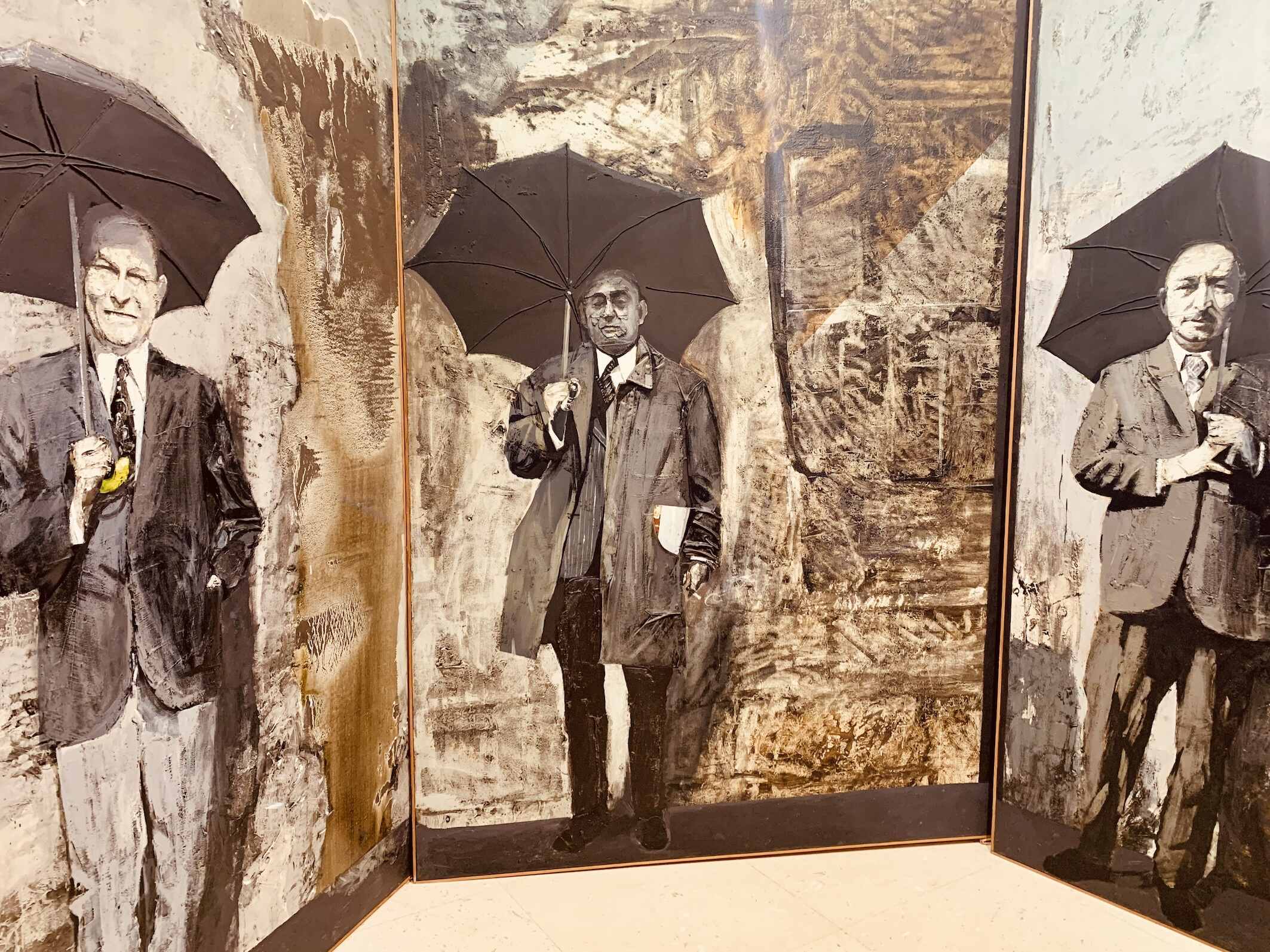
In terms of his artistry, I much preferred Popovic’s fantastic Simina Street 9A. This small hexagonal spatial composition, created in 1971, depicts the artist and his liberal, non-conformist friends. After the end of the Second World War they began to assemble on Simina Street to share their writings and anti-Tito views.

Inside Belgrade’s Museum of Contemporary Art.
The work shows, among others, Dobrica Ćosić (future Serbian president), Lazar Trifunović (historian and art critic) and Borislav Mihajlović Mihiz (writer and literary critic).
They appear on the street under umbrellas because of the need for discretion due to the political pressures they would have been under at the time. It’s an undeniably atmospheric piece, especially when you hear hushed voices representing those gathered as you enter the room.

Simina Street 9A by Mića Popović.
On the 2nd floor we stopped to admire the work of a contemporary Serbian artist, Daniela Fulgosi. According to an online article we read, much of her work explores “portraits as a metaphor for the psychological study of character and interpersonal relationships”.
White Man by Daniela Fulogsi (1997).

Inside Belgrade’s Museum of Contemporary Art.
While a simpleton like me isn’t exactly sure what that means, there is something arresting about White Man and Man in Japan. Probably in the scratchy way they have been crafted using a linocut printmaking technique.

Man in Japan (1997).
On the 3rd floor we came across another installation by Zoran Naskovski, the dude that did Death in Dallas. This one is called War Frames and is a collection of frozen images taken from TV news reports covering the various wars, conflicts and political upheavals across Yugoslavia and Serbia in recent history.
Some of the frames are unflinchingly depressing. As you would expect there are chaotic scenes of bombed out buildings and people running from burning cars.

Inside Belgrade’s Museum of Contemporary Art.
But one frame that particularly piqued my curiosity was a shot of the CNN reporter Christiane Amanpour. A well-known face on TV and on the ground throughout The Bosnian War, Amanpour was and remains a controversial figure for many Serbs.
In fact, they accused her of unobjective and manipulative reporting. In contrast, she was hailed in the west for her fearless approach, as seen when she confronted General Ratko Mladić, the so-called Butcher of Bosnia who was later convicted of war crimes at The Hague.
Inside Belgrade’s Museum of Contemporary Art.

War Frames by Zoran Naskovski.
Another frame shows the Serbian singer Ceca, a hugely popular entertainer affectionately dubbed “The Mother of Serbia”. Her heartfelt brand of pop folk dominated the 1990s, making her one of the faces of Serbian patriotism as The Bosnian War played out.
Check out the little airplane icon in the bottom left corner of the picture below. The caption next to it says “air danger”, which means her performance was unfolding during a NATO bombing of Belgrade.

Inside Belgrade’s Museum of Contemporary Art.
Sadly Ceca’s life has been riddled with controversy and tragedy. For many she will always be remembered for her marriage to Željko Ražnatović, the infamous paramilitary leader, mobster and eventually war criminal.
Until, that is, he was assassinated in 2000 by a corrupt off-duty police officer. Later, in 2011, she was convicted of embezzlement and possession of illegal firearms, serving a one year house arrest.

Ceca on her wedding day in what the Serbian media called “The Wedding of the Century”.
Up on the 4th floor a few pieces stood out. First, let me draw your attention to a quirky painting with an equally amusing title. It’s called Miki, Natalija and Milica Before Miki Started Drinking.
It was created in 1989 by the rock star and painter Zoran Marinković. With no accompanying notes of any kind we are left to draw our own conclusions of precisely what went wrong for this (presumably) young working class Serbian family.
Miki, Natalija and Milica Before Miki Started Drinking.

Inside Belgrade’s Museum of Contemporary Art.
And then there’s the photograph Flea Market Belgrade, taken by Milan Aleksić. The shot shows, in no uncertain terms, the harsh reality of everyday life for thousands of Serbian citizens in the mid 1990s. The image captures a moment at Buvljak, an open air market space where traders sold all manner of goods from blankets and sheets laid out directly on the dirt.

Flea Market, Belgrade.
In an almighty (and one could argue distasteful) change of tone, we subsequently found ourselves entering the museum’s special exhibition. Titled Love Is Love, Wedding Bliss for All à la Jean Paul Gaultier, this was the first international fashion exhibition in Serbia.

Inside Belgrade’s Museum of Contemporary Art.
Basically, this is a collection of 38 haute couture and prêt-à-porter wedding outfits created by Jean Paul Gaultier. The pieces are, in the fashion icon’s own words, “a great celebration of marriage, bringing together every type of union: straight, gay, transgender, cross-cultural and interracial, to rejoice in love in all its diversity”.
Inside Belgrade’s Museum of Contemporary Art.

No, you can’t afford it.
Getting married soon? How about this La Mariee gown from Gaultier’s Gypsy Indians collection? It is comprised of vintage pieces of embroidery on cotton and silk scattered with silver and multicoloured sequins. Handmade, the blurb says it took over 210 hours to complete.

Love Is Love, Wedding Bliss for All à la Jean Paul Gaultier.
And yes…. don’t worry…. it comes fitted with a backpack for any baby you might need to haul around as you make your way down the aisle. A bizarre end to a thoroughly absorbing museum.

Inside Belgrade’s Museum of Contemporary Art.
Like this? Check out my many articles from across Belgrade.
You may also enjoy my pieces from all over Serbia.
I’ve been living, working and traveling all over the world since 2001. So why not check out my huge library of travel reports from over 40 countries.



48 Comments
Fascinating post Leighton. I only have two criteria when viewing art. Do I like it or do I not like it? I don’t care what the artist’s motivation was, what he had for breakfast, what drug he was on or when he had his last BM. For instance, not a big fan of the art gallery architecture. Big fan of the work by Daniela Fulogsi. Those are amazing pieces, whether I understand them or not. As to the whole war torn sad look of this area, it is hard not to feel sad for the whole situation created by war. So many war crimes, depending on whose side you are. Have a good Sunday Leighton. Allan
Hey Allan, thanks for kicking off the thread. Broadly speaking I subscribe to the “do I or don’t I?” school of art appreciation. That said, there are times (usually when I don’t understand what I’m looking at) when I feel a burning desire to know what the heck the dude or dudess in question was thinking about. I also love Fulgosi’s works, so layered and vibrant. The architecture of the building, yeah, nothing to shout about despite its awards. The war stuff was sobering as always and it was so useful having Sladja to share her inside observations. Crazy to think that in the late 90s she and her family had to duck into bomb shelters outside her house. Surreal as that may seem it is of course nothing compared to what thousands of Bosnians went through during that period. Meanwhile, over in England, 21 year old Leighton had little more to concern himself with than girls, football, music and film.
Love the Simina Street collection and Peternek photos and must admit I knew nothing about Serbian art either.
Hey Malee, I’m glad there were some bits that piqued your interest. Peternek was a talented photographer and observer, while I also like Simina Street 9A and how there is a fittingly clandestine feel to it. Thanks for reading and commenting!
heavens Leighton youve really provided unique insights into serbian art history & culture. ive never been one for contemporary art in general but through such works we surely get a better understanding of a place and its peoples. some of these leave me cold others are genuinely beautiful and impressively complex. all of it is quite fascinating i listened to the folk song about jfk and can safely say it is an overwhelming attack of “music” that hits like a hammer. as for the gaultier outfits I can only shake my head in bafflement
Thanks Stan, I tried to do this museum a bit of justice and strike that tricky balance between informative and not boring ha ha. The Gaultier stuff is kind of disgustingly fascinating I feel, if that makes any sense. It really says something when someone’s installation about The Bosnian war comes across as more tasteful.
Hey, Leighton. There are so many moments that I love in this post and neither has anything to do with Gaultier. 🤭 I love the black and white photo of the architects, the idea behind the Black and White Eye of Milivojevic and the execution of that idea. I love the works of Peternek and Fulgosi. The thing that most intrigues me is the traditional narrative poem about JFK’s assassination. I did some research into oral traditions of various cultures during my university years. So, I know a little about the epic tradition in the Balkans (though language is a huge barrier) and this poem is a fascinating listen. I also admire and am fascinated by how layered your presentation of the displayed artworks is and how you managed to dig out all these interesting and revealing threads from the recent history and memory of Serbia.
Wow Helena… thanks so much. I think Sladja has to take a lot of credit for this article. Firstly she was able to tell me stuff on the day that helped put much of this art into perspective. Also, while I wrote this piece, she helped research a few things that only existed in Serbian language online. I’m super impressed that you have some expertise in the history of oral traditions, not sure many people can claim that! Thanks again 🙂
I had to watch the whole 8 minutes of the Kennedy drama. Compulsive viewing, wasn’t it? What a compelling place, Belgrade and its history, like so much of Eastern Europe. You have an insider’s viewpoint.
Mm, glad I’m not the only one who felt a bit transfixed by it. Thanks for following this series Jo and for your positive feedback, it’s great to have you onboard 🙂
🤗🩵
I don’t understand contemporary art either, but I can tell you after watching part of the JFK video, I’m not a fan of Serbian Folk Music. 🙂 What caught my attention on this piece though was the weird/poorly translated comment of the JFK poster. More than any of them though, the Flea Market in Belgrade was the most powerful to me. Maggie
I think that is a very particular brand of traditional Serbian folk music. Not exactly something to get the party started ha ha. Sladja believes she went to that flea market at some point in the late 90s, but I think by then it had improved a bit and they had actual stalls rather than laying out all their goods on the dirt.
I’m not one for museums, but Belgrade’s Museum of Contemporary Art is definitely eye-catching! I think contemporary art is pretty cool, and the special exhibition at the end really caught my eye. It’s interesting that fashion is also art, and the dress on display is extravagant and lovely!
Hey Rebecca, I remember that you don’t visit many museums. That’s a pity I think, as (good) museums can be an excellent way to dig a bit deeper into a country, find out what makes it tick, put other stuff that you see into context. Funnily enough, the fashion exhibit at the end was my least favourite part. The only section that had absolutely nothing to say about Serbia, its culture, history etc. But yeah, some beautiful and ambitious outfits, as we have come to expect from Gaultier.
Love your detailed museum posts like this. I would need to see this one in person for a prolonged visit, maybe a month if they rent sleep cubicles. Hard to disagree with any of the Ten Commandments but, like most commandments, harder to live them. Sure am glad you had Sladja to provide insight. I always seek out expert explanations, some of which I partially understand. They always give me so much to contemplate. Thoroughly enjoyed the Gaultier exhibit. But I must admit, it was more from amusement as I have no great fashion sense. Struggled with the Kennedy work. The video brought back such hopeful/painful memories. Wish I had a translation of what the lyric said. I’ll go to a museum with you any day. Thanks.
Well thankee Memo, I also feel that you’d be a good museum companion. If I’d been on my own I wouldn’t have appreciated the museum half as much as I was able to with Sladja as my guide, translator, historian and firsthand witness of a country at war. Gaultier definitely helped lighten the tone at the end.
I cant say this type of modern contemporary art is my thing, but still an interesting visit nonetheless. Your article as always has been most informative! X
Thanks Anna 🙂 I hope all is well with you guys.
Doing ok, living through heatwaves these days…. 44c is pretty wild!
Perhaps my taste isn’t very refined, but I don’t really get contemporary art. I couldn’t help but laugh at the doll in the backpack. It’s always an added bonus to find out admission is free though.
Well, as far as art goes it’s all a bit horses for courses isn’t it. For me some of it works and some of it doesn’t, while contemporary art museums are not usually places I actively seek out. And yes, you certainly can’t beat free.
There’s something for everyone here, covering almost all human emotions. The hooded spectres also remind me of Death Eaters, and a bit of Munch’s 😱; maybe that was the inspiration for the piece. I found Peternek’s photos particularly interesting. But I had to quickly pass by the JFK bit; I feel the US would be a much better place today if he and his brother Bobby had survived. Excellent post Leighton; thanks for sharing.
Hey Tricia, it’s interesting how many readers are drawn to the Death in Dallas piece. And that it also brings sadness and regret, even after all these years. I’m glad you enjoyed the article, thanks for sharing your thoughts.
I am not the biggest contemporary art fan either, I prefer the old stuff, but it is still important to see and appreciate. I love when museums are free and it seems like contemporary art museums always have a cool building to store the collection. You did a great job diving into the collection, I usually just kinda walk by thinking about what I will eat after haha.
I guess art makes you hungry 😉 Thanks for stopping by Lyssy 🙂
This museum is very interesting, and has so many different topics covered in its art collection! It did really focus on the human point of view with Peternek’s photos, and you can really see the emotions of how those individuals were feeling at that time.
Hey Allie, I’m glad you liked Peternek’s work and wholeheartedly agree with you that those human emotions jump out of the images. Thanks for reading and commenting.
Such an interesting place! I’m not an art fan, but this looks like a cool place to spend a few hours. I’d fail those commandments at number 1 – do not fly!
I suspect most of us would fail the commandments. And yeah, number 1 is a particularly hard one to overcome for most of us travel lovers here on WordPress. Thanks for your comment Hannah.
What a fascinating museum! It looks fantastic and very well curated, and it’s great it features so many different styles of art. I was particularly drawn to the photography exhibits (the photo of the three women after the earthquake is haunting) and the Jean-Paul Gaultier collection. I also enjoyed learning about the Serbian artists, too.
So pleased that this piece speaks to you, I always wonder about writing up a contemporary art museum. There are not many blog pieces on this museum so I thought what the heck, let’s see what Serbian art is all about. Thanks for your contribution.
I walked around the museum and took photos from different angles, there was a London double-decker parked out front at the time, I didn’t have the desire to invest any more time in this museum, perhaps I should have when I look at your photos.
I think when you’re on a visit and short of time the contemporary art museum is always gonna get bumped. For us, just living across the road, it would have been a bit criminal not to have toured it. I’m curious about the double decker bus and am left wondering if it was the real thing or something created by an artist? Thanks for reading!
I’m not a big fan of contemporary art, but I do always like that I go into it with absolutely zero preconceived notions about what I’m seeing and deciding for myself what I think it means. This museum looks like a very interesting and creative way to learn about the history and culture of this area. I liked the maze of pictures and the intricate wedding dresses. And the photos of the people in Yugoslavia are haunting. Great tour of this interesting place 🙂
Thanks Meg, I am certainly no contemporary art fan but with an open mind and just a bit of curiosity there are stories abound within this museum. Windows into the national psyche if you will. Cheers for the read, here in Georgia spring is on the way and with it comes that renewed sense of hope for the year ahead.
That was very beautifully and perfectly said. Wishing you brighter warmer days with the coming of spring 🙂
Nice post but must admit art goes right over my head and I think that bloke Miki had already been drinking when he painted that but what do I know. Art making sense to me is Tony Hancock’s film The Rebel 1961 just about sums up the art world to me.
Ha ha, chances are Miki was always a wrongun. I remember Tony Hancock from when I was a kid (Hancock’s Half Hour) but don’t think I’ve seen The Rebel. I’ll put it on the list. Thanks for checking in Gary, do you think the R’s are gonna scrape their way out of the brown stuff? Huge game tonight.
Good match last sat v Norwich, it’s a new team with the 4signings and we looked far to good to go down. New manager is a breath of fresh air, could be to late though if we don’t get anything out of the 6 pointer tonight and Bristol C away Sat
A great tasting palette for Serbian art!
Thanks for your comment 🙂
Fascinated by the labyrinth and would have loved to seleccione up the photographic images. And Amanpour, so young here but still going strong reporting in Ukraine.
Hey Geoff, glad there were some bits here that caught your eye. The labyrinth is a clever idea and very well executed. And yes, Amanpour has become something of a legend in her field.
I know very little about art, but I can state that the museum building is a work of art in its own right! I found the museum very interesting — the photos are poignant, especially of those three women (they tell a story without words). Oh yes, and typically woman, I love the display of wedding outfits! The baby on the back is a bit weird though …
Just coming back to the 10 Commandments … it makes me think, maybe the Finnish artist has never experienced a 40 degrees Celsius day during high summer in South Africa!
It’s nice to hear someone sticking up for the building design, as it doesn’t seem to get much love. Like many I did wonder about how many brides walk down the aisle with a baby strapped to their back. I’m sure Tea Mäkipää would say “ok, ok let’s do it” to the offer of air con when faced with an intense South African summer 😉
Thanks for that look into Serbian modern art. I most liked the maze of photos, and the chilling photo of the three older women. Many interesting portraits, and a dark view of society in the last decades and century.
You’re right Ruth, much of this art does have a darkness to it. Such has been Serbia’s recent history I guess, the effects of which has seeped into all areas of society and culture. I’m glad that there were a few pieces that connected with you.