
Sarajevo: The Miljacka River Walk.

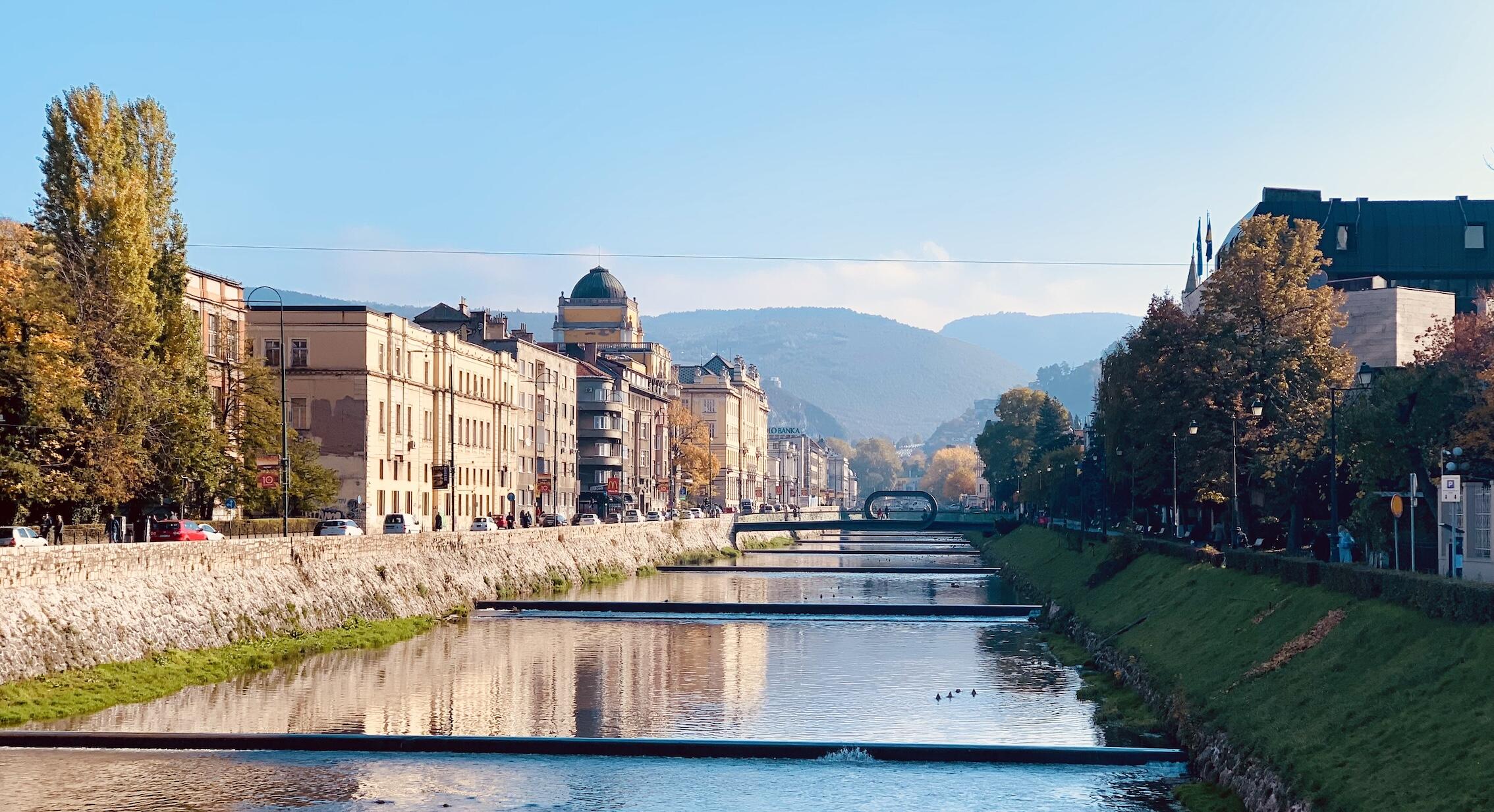
Sarajevo: The Miljacka River Walk.
October 2021.
In my last article I wrote about Sarajevo’s Old Bazaar and what an essential experience it is, no matter how short of time one might be when visiting the Bosnian capital. While we clearly enjoyed exploring the bazaar, our self-guided walks along the handsome Miljacka River just about stole its thunder.

Sarajevo: The Miljacka River Walk.
There is something quietly alluring about the Miljacka. At barely 38 kilometres long and famously shallow in places, it is not a grand waterway. Yet it traces the very spine of one of Europe’s most layered and storied capitals, and is cherished by locals.

Sarajevo: The Miljacka River Walk.
Take the name itself. Milja roughly translates as “the dear one.” I’m certainly no expert, but perhaps that nickname speaks to its standing as the ultimate survivor. The Miljacka has borne witness to the full sweep of Sarajevo’s extraordinary past: its Ottoman founding, and its years under Austro-Hungarian administration.

Sarajevo: The Miljacka River Walk.

Sladja taking it all in.
Moreover, it watched the catastrophic 1914 assassination that sent the world spiralling toward war. And it suffered the devastating siege of the 1990s, when its bridges and surrounding streets became one of Europe’s most dangerous stretches of ground.
Sarajevo: The Miljacka River Walk.

Sunset over the Miljacka.
This absorbing history, combined with the river’s genuine visual appeal, makes it such a privilege to explore. We didn’t bother with walking tours or set routes. Rather, we set off on a number of unhurried, self-directed wanderings.

Sarajevo: The Miljacka River Walk.
The mountains seem to press into the valley that the Miljacka occupies. The water itself, meanwhile, is clear and quick-moving. The riverbanks shift in character as you move through them. For a stretch it is formal and broad, lined with the confident architecture of successive eras.

An Austro-Hungarian facade overlooking the Miljacka.
One of the first I stopped to photograph was the Bank on the Obala, a branch of the Austro-Hungarian Bank dating back to 1913. Designed by the famed architect Rudolf Tönnies, it is a rare example of classical architectural elements with Sarajevo Secession style.
Check out its grand columns, sculpted keystones, and ornate ironwork balconies. Designated a National Monument of Bosnia and Herzegovina in 2009, today the building houses Privredna Banka Sarajevo.

Sarajevo: The Miljacka River Walk.
Next, we paused to admire the National Theatre, a Neo-Renaissance landmark built in 1897. Originally constructed as a social club, the government repurposed it as a theatre in 1922. This time the architect was a Czech by the name of Karel Pařík, a man so prolific in the Bosnian capital locals came to call him “the builder of Sarajevo.”
Sarajevo National Theatre.

Sarajevo: The Miljacka River Walk.
It wasn’t long before we came upon City Hall (Vijećnica). Easily the riverside’s grandest structure, it is a spectacular example of pseudo-Moorish architecture, and a tribute to the Muslim heritage of the city. Over the decades it has also served as a parliament house, and eventually the National University Library of Bosnia and Herzegovina.

Sarajevo: The Miljacka River Walk.
In its heyday the building housed around 1.2 million books, though only an estimated 10–15 percent survived the siege of 1992. Painstakingly restored from old photographs and architectural plans, it reopened in 2014; its terracotta and cream striped façade, horseshoe arches and ornate atrium once again the pride of the city. Walk up to the entrance steps and you’ll find a stark plaque that references the siege directly.

Sarajevo: The Miljacka River Walk.
The building truly comes into its own after dark when it is floodlit against the night sky, its arches reflected in the Miljacka below. In fact, Sladja and I made a point of returning one evening just to see it in night mode.

Sarajevo’s City Hall by night.

Sarajevo: The Miljacka River Walk.
Another beauty worth stopping for is the Faculty of Law, one of numerous buildings belonging to the University of Sarajevo. Founded in 1946, it originally served as the Austro-Hungarian Palace of Justice. It has a suitably imposing facade, a mix of warm ochre and terracotta, along with classical Corinthian columns and a lead-grey dome.
Sarajevo: The Miljacka River Walk.

Law of Faculty.
Among its most famous alumni is none other than Alija Izetbegović, who earned his law degree here in 1956 prior to becoming the first Chairman of the Presidency of an independent Bosnia and Herzegovina.

Sarajevo: The Miljacka River Walk.
Soon after, we came upon the striking Academy of Fine Arts, which at first glance can easily be mistaken for a cathedral. That’s because it was actually constructed as a cathedral back in 1899. Built in a Romanesque-Byzantine style, this was the first and only Evangelical church throughout Sarajevo’s Austro-Hungarian era.

Academy of Fine Arts.
It has been home to the Fine Arts Academy since 1981. Today, there are statues and sculptures peppered around the building and art installations hanging over the river. Definitely one of the Miljacka’s most eye-catching spots.

Sarajevo: The Miljacka River Walk.

Sarajevo: The Miljacka River Walk.
It’s well worth seeking out one particular statue in order to take in an extraordinary life story. The statue in question honours Mica Todorović, the renowned Bosnian painter whose works covered socially engaged realism and renaissance, as well as vivid colourist painting. Known as “the first lady of Bosnian and Herzegovinian painting,” she enrolled in the Academy of Fine Arts in 1920, the only woman in her class.
Mica Todorović.

Sarajevo: The Miljacka River Walk.
After graduation, she studied renaissance art in Italy. During WWII the Nazis imprisoned her in the Stara Gradiška Concentration Camp, before sending her off to forced labour in Germany. In 1945 she was the only artist to testify at the State Commission for the Establishment of War Crimes in Belgrade. What’s more, her series of drawings The Last Victims of Jasenovac and Gradiška, depicting life in the concentration camps, were used as evidence.

Mica Todorović (1900–1981).
Of the many handsome townhouses that line the river, a special mention goes to the so-called Madame’s House (Gospođicina). Its northern facade is a delight: decorated with a number of gorgeous sgraffito frescoes that have somehow managed to survive two world wars in addition to the 1990’s siege.

Sarajevo: The Miljacka River Walk.
According to local historians, this one-storey Austro-Hungarian villa once belonged to an elegant young woman who left the house each morning in a different fancy dress and hat. Interest in the pretty young lady became so great that the writer Ivo Andrić drew on her reputation for his novel Gospođica (The Woman from Sarajevo).

Damage from the Siege of Sarajevo still visible on the facade of Madame’s House.
As for the most peaceful riverside spot, top marks go to a lovely green space known locally as At Mejdan. Also referred to as Mejdan Park and Horse Square Park, its story begins in the 15th century when the Ottomans created it as a site for public executions. Later, it became a horse market and then a hippodrome.
Sarajevo: The Miljacka River Walk.

At Mejdan.
Today it is a tranquil, shaded and unhurried corner of the city where locals come to sit, read, smoke and listen to music.

Sarajevo: The Miljacka River Walk.
If one fancies a cup of coffee, just head to the cafe housed in an historic wooden music pavilion. Designed by Josip Pospišil in 1913, the original structure unfortunately didn’t survive the Second World War. It was painstakingly rebuilt in 2004 from original drawings. Live music performances still take place here from time to time.

The cafe at Mejdan Park.
On the western edge of the park, a small archaeological garden preserves the remains of the 16th-century Bakr-Baba Mosque complex. Somewhat tucked away, it’s easy to miss, but certainly worth finding. The mosque dates back to 1544 and is one of the oldest surviving Ottoman buildings in Sarajevo.

Bakr-Baba Mosque.
Beside it sit the remains of a mekteb, the religious primary school that once served the surrounding neighbourhood. There’s a cemetery too, with dozens of weathered Ottoman headstones. The government designated it a protected archaeological area in 2015.

Sarajevo: The Miljacka River Walk.

Sladja photographing me photographing her.
Our wanderings led us to what looked like an important headstone. And so it proved. Hadži Hafiz Halid ef. Hadžimulić was a scholar, polyglot, and chief imam of Sarajevo’s Emperor’s Mosque for over thirty years. He also oversaw the restoration of the Bakr-Baba Mosque and made it his express wish to be buried within its grounds. He died in 2011, aged 95, and here he remains.
Bakr-Baba Mosque.

Sarajevo: The Miljacka River Walk.
Finally, a word on the bridges that span the Miljacka. First up is the Šeher-Ćehaja Bridge, known to locals as Šeherija, which translates as Mayor’s Bridge. Standing since 1585, mayor Hajji Husein commissioned its construction, hence the name. Today this restored four-arch beauty is Sarajevo’s oldest surviving Ottoman bridge.

Sarajevo: The Miljacka River Walk.
Sladja and I got quite the surprise when we heard there was an Eiffel’s Bridge in Sarajevo. Wait, Gustav Eiffel rocked up in Bosnia in 1893? The truth is rather more prosaic: the bridge’s official name is Skenderija, and the Eiffel nickname is nothing more than a charming local legend, entirely unverified and without a single supporting document. Locals embrace it anyway, and honestly, who can blame them.

Skenderija Bridge.
It’s easy to see why. With its delicate latticed ironwork and slim profile, it carries a distinctly Eiffelian—yes, I just made that word up—elegance that briefly teleported us to Paris. The bridge is a popular spot for couples and often strung with love-locks, which feels fitting given the romantic mythology surrounding it.

Sarajevo: The Miljacka River Walk.
In contrast to the previous bridges, there is a modern and sleek feel to Festina lente Bridge. Its name is Latin for “make haste slowly,” and the bridge lives up to that. Sitting directly alongside the Academy of Fine Arts, it was designed by three local students from the institution itself.
Sarajevo: The Miljacka River Walk.

Festina Lente Bridge.
Adnan Alagić, Amila Hrustić and Bojan Kanlić won a city competition in 2007 and saw their vision realised when the bridge opened in August 2012. At 38 metres long, it is modest in scale but radical in concept. Midway across, the walkway loops back on itself in a full circle, creating an enclosed knot with benches inside. Built from steel and clad in polished aluminium, it glows at night under white LED lighting.

Sarajevo: The Miljacka River Walk.
At this point you might be wondering: what about Sarajevo’s most famous bridge? Well, I’ve been saving it for last. The Latin Bridge was first recorded in 1541, though its current form dates from a rebuild in 1798 following flood damage. Its name comes from the Catholic quarter it once connected to the rest of the city, known in Ottoman times as the Latinluk, (Latin Quarter.)

The Latin Bridge.
On the morning of June the 28th, 1914, Archduke Franz Ferdinand and his wife Sophie were shot dead at the street corner just north of the bridge, not on the bridge itself as many assume. The killer was a 19-year-old Bosnian Serb student named Gavrilo Princip. It was the shot that triggered the First World War, and for years afterwards locals called it Princip’s Bridge.

Sarajevo: The Miljacka River Walk.
As for Princip, he died of tuberculosis in a Bohemian prison in 1918, aged just 23. He had been too young at the time of the assassination to receive the death penalty. Standing on the bridge that day, watching people stroll by and glancing over at that infamous street corner, it was hard not to feel the weight of it all.
The Latin Bridge.

A stone bench on the Latin Bridge.
A plaque on the wall of the Sarajevo 1878–1918 Museum marks the actual spot of the assassination. I’ll be covering the site itself in my roundup of Sarajevo’s excellent museums; watch this space.

Sarajevo: The Miljacka River Walk.
Like this? Don’t miss my detailed travel guide to Sarajevo, with reports from all over the city.
I’ve been living, working and traveling all over the world since 2001. So why not check out my huge library of travel reports from over 40 countries.



#/media/File:Loop_Bridge_01_(23776388375).jpg)
48 Comments
Wow. As this is a constrained river, the beauty of the river is not in the raging or placid waters, the rocky shore and lovely river bends. It is in the views along its shores and the history that surrounds it. What a marvelous collection of buildings and bridges, both new and old. I would love to stroll along its banks too. Thanks for sharing this post Leighton. Have a fabulous week. Allan
Thanks Allan, it is a peaceful and understated little river surrounded by dramatic architecture with stories to tell. Thanks for stopping by.
Such a tragedy about the library fire, and a good reminder of the importance of books and reading.
They often go for the libraries in wars, don’t they? A sad story indeed, but wonderful that the building lives on and wasn’t also lost to the ravages of the siege. Thanks for reading, Terry.
Now that plaque is a monument with a memory.
No brass bands, no cannon, no conquering hero on horseback—just a quiet wall reminding all that when people burn books, they aren’t merely burning paper. They’re taking a match to memory itself.
And yet, look at the building: still standing, still beautiful, still telling the story.
History has a wonderfully stubborn habit of outliving the people who try to erase it.
So here’s to Sarajevo: a city that remembers, a library that endured, and a plaque that politely refuses to let the ashes have the last word.
AI.
That’s a very poetic response, Sir Chuckster. Sarajevo’s survival of the 90s does much to inform its modern day character, for sure.
It is amazing how people adapt to living in strife zones, and how resilient people can be.
such an atmospheric walk leighton with bits of history on every corner. the latin bridge and its site just across the road has to go down as one of the most consequential spots in modern history. the other bridges all sing too and i can see how the eiffel nickname took hold, it definitely looks the part. the city hall is a beauty in both daylight and night and admittedly i hadn’t been familiar with mica todorović and her gripping life story. i am now left wondering how i might get a copy of the woman from sarajevo, it seems to be a rarity.
Hey Stan. The Woman from Sarajevo is a bit tricky to get hold of from what I’ve seen. Not many English translations and physical copies seem to come with a silly price tag. Glad you enjoyed these riverside wanderings!
What delightful exploration by a river with a touching name. Sarajevo becomes more enticing with every post. The sentiment is clear from the library post, but unfortunately not an uncommon tactic in wars that the perpetrator tries to destroy the history and heritage of their target; Jaffna comes to mind where the Sinhala bombed the Tamil library.
Thanks Mallee, I’m glad Sarajevo is giving you food for thought. You are quite right about war tactics and targeting the heritage and history of a country and its people. Now Jaffna is a city I would absolutely love to explore one day.
What an enjoyable walk, Leighton. I always like following a river. The sculptures by the Art Academy remind me of some in Krakow, and I love the bridges. Thanks for the history too xx
Cheers, Jo. You’ve now got me thinking about Krakow, which I’m sure must have changed quite a bit since my only visit over twenty years ago.
I’m there again for a wedding next May xx
Your photo of the library plaque reminds me of an excellent book you and Sladja might like to read … historical fiction based on this episode. Black Butterflies by Priscilla Morris. Thanks for a walk along the river, really enjoyed seeing Sarajevo through your eyes!
Mmm, we do like a book tip. Thanks Anna, I will take a look and pass it onto Sladja, the unstoppable reading machine.
Sarajevo looks like an amazing city. The Miljacka River Walk is impressive. It is so sad about the siege of 1992, and about all those destroyed books. As usual your photos are great and the information interesting.
Thanks for joining us on this walk Thomas, Sarajevo is a city with many strings to its bow. The location of next Sunday’s article is perhaps my favourite, and one I’m looking forward to sharing most of all. Cheers.
I love your description “unhurried, self-directed wanderings” and it looks like you found the perfect location for just that. There are so many beautiful buildings along the way. I particularly like the National University Library when it’s lite up at night. I also found the story of Mica Todorović particularly poignant. Great post, Leighton.
Thanks, Tricia. I’ve never been much of a fan of walking tours to be honest, free or otherwise. The concept of inside information from a local is great of course, I just don’t have the patience for shuffling around with a bunch of other people and being unable to linger at certain spots or patiently waiting for someone to get out of my way. If I ever write a book non-fiction about my travels ‘Unhurried, Self-directed Wanderings’ actually feels like a decent title.
There’s always something tranquil about being near water. Almost makes you forget all of the terrible history that happened in the area. I think it’s fun to go down a research rabbit hole on walks and making my own little walking tour. All those fall colors are making me excited for fall.
I hear you on fall anticipation, Lyssy. The daily burning temps here have been tough. Even with a fan and air con it can be a real slog. Nights have been a little restless. That contrast between the prettiness of the river, the lovely architecture and fall colours and then thoughts of what once played out across those same streets was a strange one to sit with.
The idea that a shallow little 38km river could steal the thunder from the Old Bazaar says everything about how a quiet self-guided walk sticks with you. And ‘Milja’ meaning ‘the dear one’ is perfect for a river that’s witnessed so much. Sarajevo has been on our list for ages — riverside strolls are exactly how we like to get the real feel of a city.
Thanks for the read and thoughtful comment. So glad to hear that these posts have been putting Sarajevo back on your radar. Keep your eyes peeled for this Sunday’s post, which covers perhaps my favourite day in Sarajevo.
That’s a lovely walk and with so much history attached to it! the City Hall and Fine Arts Academy buildings are beautiful, and the bridges too, especially Festina Lente 🙂
Festina Lente is such an unusual, characterful bridge. Not sure I’ve seen another quite like it. Thanks for keeping up with my Sarajevo series, Sarah.
I love a good river walk and this one seems to have a bit of everything with beautiful, quiet spots, lovely heritage buildings and all drenched in a long history. Sarajevo is really surprising me. Maggie
Glad to hear it, Maggie. I have a feeling this Sunday’s post will be right up your street too. A truly unique site that I think a lot of people don’t even know is there. Might have been my favourite day of our monthlong stay. #cliffhanger.
I think you found one of the greatest walking paths to explore and enjoy. Being the spine of so much of Europe, it even kind of has a spinal look to it with the different sections. It is amazing to think about the history this river has seen, how the city rose up around it with that beautiful architecture. It brings to mind that old idea of water having memory. Also the collection of bridges are delightful. I can see a resemblance to the the Eiffel tower, no wonder there is some confusion. I love how different the bridges are, some very modern some giving nods to times far more distant. Just walking along the river would give you a great lesson in history, art, and engineering.
Thanks Meg, appreciate the read and comment. I’d say overall the Miljacka is a little river with a big personality. 🙂
Excellent post Leighton, you have brought the river and its surrounding streets alive with some really engaging stories. I can’t help but notice the big hole in the Madame House, wouldn’t you say that it’s roughly the size of a shell? Could this have happened during the siege? The autumn colours are sublime and making me dream of an end to this gruelling summer.
You know, I had exactly the same thought and tried to track down some info on the damage and whether it was connected to the Bosnian War. Sadly nothing came up, but I’d say it’s a solid bet. Thanks for following along with the series, James.
Walking along the Miljacka River offers a unique way to explore Sarajevo, particularly the Latin Bridge, that pivotal moment when Sarajevo made history. I also loved the beautiful Moorish façade of the university library, right opposite the cable car, which offers a bird’s-eye view of the city.
Funny you should mention the Cable Car, that will feature in this Sunday’s post. Cheers for the read! 🙂
So much to see along the river, what a beautiful post bringing it all to life. It’s interesting to see such contrast between the old and new bridges – I think I prefer the old, though like the uniqueness of the new bridge and the night lighting. I love all the grand buildings along the shoreline too, it reminds me a bit of somewhere like Budapest – walking along and then boom – there’s the huge parliament building. I particularly like the City Hall – it’s such a striking blend of Moorish architecture.
Can’t go wrong with a bit of Moorish architecture eh? Thanks for reading about our walks around the Miljacka Hannah.
There’s always something nice about walking along a river or waterway. Seems like a good way to also appreciate the architecture and learn a bit more about the history of the area. The art installations hanging over the river are pretty neat. How unexpected to find a cemetery too.
You never know when you are going to come upon a cemetery in Sarajevo, though you soon realise that one is never too far away. The Art Academy area is particularly pretty, they’ve made such an effort with all their little touches. Thanks for reading, Linda.
What a scenic river walk! Looks like you can cover a lot of the sites and beautiful architecture just by strolling by the water. The bridges, both historic and modern, caught my eye, and I almost forgot that the assassination that triggered WWI occurred on one of them. Sarajevo is such an underrated city to visit, yet packed with so much history!! Thanks for sharing, Leighton 😊
Thanks, Rebecca. The bridges are all so distinctive, and a big part of the riverside district’s visual appeal. Just to clarify that the assassination didn’t happen right on the bridge itself, but just metres away across the road on the street corner where the museum is. For decades people referred to the Latin Bridge as the assassination spot and the story held for a while. In any case it’s a really atmospheric spot because you can imagine standing on the bridge that day and watching all the chaos unfold before your eyes.
Such a charming walk, and the fall colours are absolutely delightful. The architecture, bridges and history come together beautifully. Mica’s story is especially fascinating too. This is definitely somewhere I’ll look forward to visiting if I make it down to Sarajevo someday.
Thanks Amarachi, it’s always lovely to hear from you. I hope you enjoy the rest of the series and that you do get to Bosnia someday 🙂
A lovely walk
🙂
So much history. I’m glad to learn about Mica Todorović and her moving story. The City Hall is stunning, and how sad to lose that notable library.
Yes, so much tragedy in Sarajevo’s story and yet the country and its people have come through it all. I had a feeling the story of Mica Todorović would appeal to you.
I looked up her work online. Always fun to go a little deeper to find out more!