
Kovači Cemetery, Sarajevo: A Walk Among the Fallen.

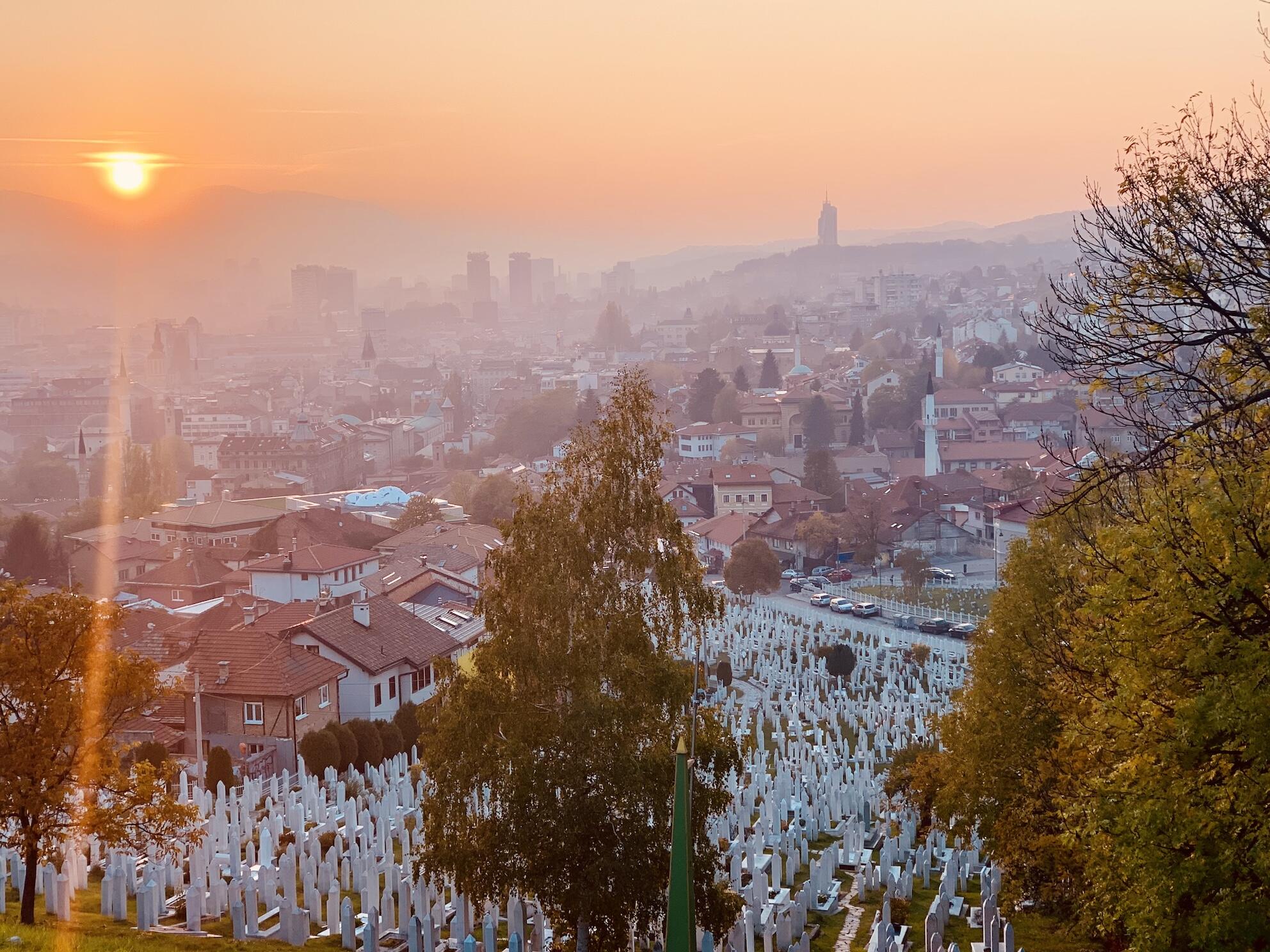
Kovači Cemetery, Sarajevo, Bosnia.
October 2021.
After three wonderful months exploring Montenegro, Sladja and I had mixed feelings about finally saying goodbye. On the one hand we were definitely going to miss it, particularly its spectacular coastline. On the other hand, we were excited about moving on to a new country.

As misfortune would have it, Sladja had to check into a private medical clinic a few days before we were due to leave for a minor but necessary procedure. Consequently, we decided it prudent to arrange a private taxi for our transfer from Budva to the Bosnian capital, Sarajevo.

Farewell Budva, greetings Sarajevo.
We knew the drive would take around five and a half hours, but certainly hadn’t anticipated just how picturesque the Bosnian countryside would be. Indeed, by the time we began rolling through Sutjeska National Park, the views were breathtaking — its valleys, mountains, rivers and hillside villages all resplendent in the rich oranges, reds, browns and yellows of autumn.

Somewhere in rural Bosnia.

Sutjeska National Park.
In fact, we were so taken by everything that flashed past our windows that we made a pact to return for some proper exploring. One day…

Kovači Cemetery, Sarajevo: A Walk Among the Fallen.

Autumn, Bosnia style.
Luckily, there were no delays to our journey and we arrived in Sarajevo on time. The driver dropped us off on our doorstep, a cosy one-bedroom Airbnb apartment in the hilly Kovači neighbourhood. Rising steeply above the old town (Baščaršija), it is one of the city’s oldest and most atmospheric hillside quarters.
Kovači Cemetery, Sarajevo: A Walk Among the Fallen.

Our street.

Our Airbnb home.

The wood pellet stove by the bed kept us nice and toasty.
Just a ten-minute walk from our apartment, a huge, sprawling cemetery sat straddling the hillside, its neat rows of white marble headstones cascading down the steep slope.

Kovači Cemetery, Sarajevo: A Walk Among the Fallen.
Bright and stark against the dark green of the surrounding cypress trees, and framed by the terracotta rooftops and minarets of the old town below, it is an arresting sight. Thus it didn’t take us long to decide that Kovači Cemetery (The Martyrs Cemetery) would be our first site to explore.

Kovači Cemetery.
Before coming to Sarajevo, we knew that a good chunk of our explorations would involve the city’s museums, galleries and graveyards dedicated to the Bosnian War, which took place between 1992 and 1995. As ever, my attitude towards such sights is that they absolutely must not be glossed over, as they are central to better understand what makes a country and its people.

Local men helping a mortar attack victim get to hospital in Sarajevo, 1992.
I’ll go into the history of the war itself in a later article. For now, I want to focus on the cemetery itself, which has its roots in the 15th century, during the days of Ottoman rule. On arrival, we noticed some of those ancient graves immediately, as they stand in such contrast to the white marble headstones of fallen Bosnian War soldiers.
Understanding Sarajevo.

Kovači Cemetery.
The weathered grey stone is called nišani. Wonderfully atmospheric, their surfaces have been worn smooth by centuries of wind and rain. A few have carved turbans at their crowns, thought to denote the rank or religious standing of those who lie beneath.

Kovači Cemetery.
A great deal of the original Ottoman graves had not survived the centuries, and by the early 1990s much of the grassy slope lay empty. This made it a natural choice as the primary burial site for soldiers of the Bosnian Army killed during the Siege of Sarajevo.

Kovači Cemetery.
According to records, around 11,600 residents lost their lives at the hands of the Army of Republika Srpska, the Bosnian Serb military force — among them approximately 1,500 children. Today, some 2,500 white nišani from that period stand in silent testimony across the hillside.

Kovači Cemetery.

One of my favourite shots of the day — the vivid green of the lawn, the deep red of the roses, the stark white marble of the nišani, and the warm orange of the tiled rooftops.
It was incredibly peaceful, not another person in sight, and we soon realised that the vast majority of the fallen had been aged between 21 and 40.

Kovači Cemetery.
That was the case with Salčin Ramiz, born 1954, died 1992 — one of the earliest casualties of the siege, taken at 38 years old. The inscription at the base reads: “His wife Suada and sons Mirza and Adnan raised this stone.”
Kovači Cemetery.

Salčin Ramiz (1954, died 1992).
Eventually, we came upon the cemetery’s central feature, an open-sided dome of latticed stone, beneath which lies a modest obelisk.

Kovači Cemetery.
Here stands the grave of Alija Izetbegović, Bosnia’s first president and the man who led the country through the war. He reportedly chose to be buried here among his martyrs, rather than in any grander or more separate setting — a gesture that says much about the man.

Kovači Cemetery.
Izetbegović was a lawyer, Islamic philosopher and author who became one of the defining figures of Balkan history. Yugoslav authorities imprisoned him twice for his political and religious beliefs, first in 1946 for three years, and again in 1983 for fourteen years (later reduced).

Izetbegović’s resting place in Kovači Cemetery.
Released in 1988, he founded the Party of Democratic Action prior to his election as Bosnia’s first president in 1990. When the war came, he led the defence of Bosnia throughout the four-year siege. He frequently visited front-line units throughout the conflict, even while the Presidency building itself was under bombardment.
Alija Izetbegović (1925-2003).

Photo courtesy of Helene C. Stikkel.
He went on to sign the Dayton Agreement in 1995 — a peace he famously described as “not a just peace, but more just than a continuation of the war.” His legacy remains complex — revered by Bosniaks as the father of their nation, yet viewed critically by Bosnian Serbs and Serbian nationalists.

Izetbegović (wearing glasses, looking down) sat between Serbian president Slobodan Milošević and Croatian president Franjo Tuđman during the signing of the Dayton Agreement, 21 November 1995.
Photo courtesy of Brian Schlumbohm.
A short distance from the dome, a sign bearing his words and signature is mounted on one of the cemetery’s old stone walls. It reads:
“In the difficult days of 1991–1995, when a great darkness had descended over much of the Balkans, some light still reached out from this martyred city. Sarajevo will recognise that privilege as an obligation for the future. Naturally, an obligation to the pledge of democracy.”

Kovači Cemetery.
From there we made our way to the long memorial wall, its surface clad entirely in carved marble tablets, each bearing a name. Given that Kovači holds just 2,500 graves, yet around 11,600 lost their lives during the Siege of Sarajevo, the wall almost certainly commemorates those laid to rest elsewhere. Most likely in the dozens of smaller cemeteries dotted across the surrounding hills — or those who were simply never found at all.

Kovači Cemetery.

Names are presented in alphabetical order.
The Ottoman graves aren’t the only ones that predate the 1990s. In fact, one striking monument commemorates members of the Young Muslims — a Bosnian Islamic youth organisation founded in 1939. Tito’s regime executed a number of their members between 1945 and 1949 during postwar communist purges. Interestingly, Alija Izetbegović himself was once a member of the group.
Kovači Cemetery.

The Young Muslims Memorial.
Another unexpected feature is a sunken open-air amphitheatre at the lower end of the site. It’s a circular space ringed by stepped stone seating that feels purpose-built for quiet contemplation.
Though I couldn’t find anything specific about it online, it strikes me as the perfect setting for remembrance ceremonies and public addresses. At its centre, inlaid into the floor, is a large eight-pointed star. A motif rooted in Islamic artistic tradition, it represents divine order and the interconnectedness of life and death.

Kovači Cemetery.
Finally, we strolled down to the onsite exhibition, only to find it locked up. Being so close to home, we found ourselves passing the cemetery regularly on our walks into the city centre. Each time, we tried our luck. At long last, towards the end of our month-long stay, we arrived to find it open. Inside was a single, darkened room — a compact but atmospheric exhibit dedicated to the Siege of Sarajevo and some of Bosnia’s most decorated wartime heroes.

Kovači Cemetery.
A series of illuminated display cases lined the walls, each holding documents, personal correspondence and personal effects. Modest in scale but quietly compelling, it would take several hours to read everything in full. So we chose instead to focus on a handful of individuals, among them Safet Hadžić, a Bosnian politician and key organiser of the resistance.
Safet Hadžić (1952-1992).

Kovači Cemetery.
Hadžić died during an attack on a weapons factory in the Bosnian town of Vogošća on 18th April 1992, just two weeks into the siege. Posthumously, he received the rank of brigadier general, along with the Order of the Hero medal, Bosnia’s highest military decoration.
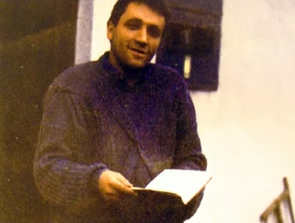
Safet Hadžić.
Kovači Cemetery was our first insight into how the Bosnian War has shaped the city of Sarajevo. Soon, we would dive much deeper into the details; a voyage of discovery that was not for the fainthearted.

Kovači Cemetery.
Like this? Don’t miss my detailed travel guide to Sarajevo, with reports from all over the city.
I’ve been living, working and traveling all over the world since 2001. So why not check out my huge library of travel reports from over 40 countries.



51 Comments
The wars in that region are so recent. When we were in Montenegro and Croatia it was hard to grasp that these beautiful places and people were so recently in bitter wars. Thanks for the post and the stories.
I agree with your sentiment about Montenegro and Croatia. In Sarajevo we immediately felt a grittier feel to the city, with shades of the war visible on just about every street. Hopefully that comes through in my posts as the series unfolds. Thanks for reading Terry and kicking off the comment thread.
We share an affinity for that part of the world, thanks for keeping it in my mind.
Cemeteries are not the typical tourist attraction, but I also find them an interesting way to learn about a place’s history. I barely know anything about the Bosnian War, so interested in learning more through these posts. Maggie
Perhaps we wouldn’t have gone out of our way to see this one if it hadn’t been on our doorstep, I’m not sure. It is such as picturesque site up on the hill overlooking the bowl that is Sarajevo city centre down below.
leighton! you have been missed on these pages finally a reprieve from best this and best that listicles and (not so) ultimate guides. you have really hit me with a curveball re bosnia I did not expect that to be the next destination though of course it makes sense when thinking about your travel trajectory in late 2021. the drive through the country looked fabulous particularly the national park. it seems you chose an authentic neighbourhood set away a little from the main action. the cemetery has a special aura to it I am both eager and anxious to read more about how the war has shaped today’s city
It’s good to be back Stanley. Sladja and I were just saying the other day that we shouldn’t forget about Sutjeska National Park; it is absolutely gorgeous. We did have a good spot in Sarajevo, even if getting up and down that hill every day was quite the workout. We walked past Kovači Cemetery countless times and there was always something new to pick out. At sunset it is incredibly pretty in the autumn.
Glad to see you back! That is a beautiful drive with all those colors. The cemetery does look fascinating and it’s a great way to learn the history of the area.
Thanks Lyssy, the blogging break was much needed in order to let other projects breathe, but it’s also great to be back. Hope you guys are doing well 🙂
Leighton, apart from the interesting read, so good to hear from you. It is a long time since we met up in Armenia. My very best wishes to you both.
Cheers, Geoff. I hope you are well and that you’ve been doing as many travels as always. There’s always a roof here for you in Serbia if you fancy a visit.
Great to have you back posting again. I look forward to this series.
Thanks Anna!
It is super to read a new “Leighton” post. This one seems very profound and bittersweet, the beauty and the suffering mixed so evenly. I felt similar pain when seeing the memorials in Belfast. Now I need to read up on the ‘troubles’ in Sarajevo as I recently studied on the ‘troubles’ elsewhere. 🕊️
Thanks, Chuckster. Have never been to Belfast, so a bit curious about that. Too many ‘troubles’ it seems across the world and we never seem to learn the lessons of history.
A poignant start to your new series Leighton. The Bosnian War is one of those I don’t know a great deal about, so I’m anticipating your upcoming posts. Your drive from Montenegro into Bosnia and Sarajevo looked like one to remember, while your apartment seemed perfectly cosy with that fire. I’m guessing temperatures took a dramatic drop from what you’d been used to in those various Montenegrin coastal towns? This is a cemetery that has been laid out with a lot of love and care. There is something meaningful about how it sits up high watching over the city centre.
Thank you James. The Bosnian War doesn’t make for fun reading, but it is an essential and unavoidable part of any trip to Sarajevo. There will be plenty more on it throughout the series. That drive into and across Bosnia was indeed dreamy, we really need to get back there one of these years to sample the national park and its scattered villages. I agree that there is an elegance to Kovači Cemetery, I’m glad that it came across.
It’s great to see you blogging again Leighton – I always enjoy your posts and often learn something from them too. I completely agree with you about not shying away from the darker sights and histories we encounter when we travel. These events have shaped the places and people, and as such deserve our attention. While I knew about (and remembered) the Bosnian War, a cemetery and monument on that scale brings home to you the extent of the suffering.
Thank you Sarah, I really appreciate that, and as I’m sure you know the feeling is mutual. I’ve had an exceptionally busy three months on many fronts, so much so that something had to give and the blog drew the short straw. Among other projects I’ve been doing a little writing for Wanderlust Magazine and also working on my novel. Two years now and the bloody thing is not approaching anything even looking like ‘finished’. And then of course there was the World Cup. Not enough hours etc. We are on the same page when it comes to sites such as Kovači Cemetery: it is so important to recognise the darker chapters of a country’s history. For me, the sites in Bosnia are every bit as harrowing as those in Cambodia, Vietnam and Poland, to name just a few. Not easy to face, but essential.
I take Wanderlust magazine but my copies have piled up recently as I’ve been busy with other things. Have you already had articles published? If so, on what and when – I’d like to look them out and read them 🙂
Ah, I had no idea! And you still get physical copies? I miss that actually, the feeling of a new National Geographic or say Q Magazine popping through the door. The last one I did was Busan, not sure what edition that was included in but here is the link to the online entry: https://www.wanderlustmagazine.com/inspiration/5-reasons-to-visit-south-koreas-second-city-busan/
Yes, I get the physical copies at the moment but I plan to stop when my subscription comes up for renewal as I don’t read them properly these days! I’ll definitely check out your article 🙂
Thanks for sharing this, Leighton. It’s important to see as many cultural parts of a place as possible to get a better understanding of the people and their history, even if it’s painful or difficult. It’s nice to see you back here again; I hope all is well with you and Sladja.
Thanks Tricia, I hope you enjoy my series on Bosnia as I’m guessing it might serve as a missing link in a region you are well-travelled in. We are well, building our lives here in Serbia and working on a number of projects that are as rewarding as they are time-consuming! See my above comment to Sarah. Do you guys have another trip planned for this year?
Great article about Busan! I wish we had visited while we were in South Korea. It sounds like you’re quite busy. We have several trips planned this autumn, both to California. One to see family and another to explore the northern coast. We’re planning another trip to Europe in the spring. How about you?
Mmm, California. One day. Where in Europe, I wonder? Or is that still up for discussion? After a year of being grounded in Serbia we are finally going on a trip in early October. Just two weeks sadly but very much looking forward to… some travel… in… Sicily.
Oh, nice, Sicily is wonderful. Yes, California is a gorgeous state. Well, we always have to spend time in France to visit friends and family, and we’re considering some eastern countries; perhaps Poland, but we’re not sure yet.
I liked the conversation with Sarah. Sorry about your novel. Life just does get in the way, but where would we be without it? I’ll read as long as you post xx
Aw, thank you Jo. I keep dreaming of retirement, that would really allow me to get the damn thing done. But at 48 I’ve still got some way to go. I appreciate your readership, cheers!
A very sobering introduction to Bosnia but, as you said, important to understand. I know very little about this topic so I’ll be interested to learn more in your upcoming posts.
Thanks, Diana. Don’t worry, it won’t all be doom and gloom ha ha. Sarajevo is an amazing city but shades of the 90s war are never far away no matter where you go.
Cemeteries tell a lot about the past and your point about those killed between the ages of 21-40 reveals how treacherous the war was on the community. I can imagine how you both felt after passing through this graveyard.
Lovely to hear from you, Mallee. That first walk was definitely a heavy one, though I guess each daily walk up and down the hill felt lighter. I’ll be doing another cemetery post towards the end of a series, though that one has an altogether different atmosphere to it. Thanks for reading, as always.
Moving piece Leighton. This area carries so much history and hurt but I am with you that it needs to be remembered. Those rows of white headstones are pretty set against the hillside like that. You can learn so much about people and periods from wandering through cemeteries.
Hey Meg, Sladja and I have always been those weird people who are fond of strolling around cemeteries, which I know baffles some people. Your thoughts mirror our own, plus we also get a sense of peace from it. Good for gathering one’s thoughts. I’ll actually be doing another cemetery post towards the end of the series, though it is very different from this one.
count me in as a weird person too because I really enjoy strolling through cemeteries- there is just a whole other thoughtfulness that happens in a cemetery. Looking forward to your next post
I’ve been to Bosnia and Herzegovina, but only to visit Mostar. I didn’t have enough time to visit Sarajevo, but it looks like a worthwhile one that I hope to return to the country to check out. Kovači Cemetery looks somber and a sobering experience, to remember the atrocities that happened not too long ago in time. Thanks for sharing, Leighton.
We haven’t made it to Mostar yet, which is a little scandalous considering it’s a 6.5 hour drive from where we live in Serbia. The thing is, public transport options between the cities are poor, so we are left with only a very expensive private taxi transfer. Which I’m sure we’ll eventually swallow one of these days.
A beautiful place with a difficult past. I’ll look forward to reading more. Nice to see you back and posting, Leighton.
Thank you Helen. Yes, so much beauty in Sarajevo among all the sad reminders of what has been lost. I hope you enjoy the series.
Bosnia and its neighbouring countries remain scarred by the war that tore them apart at the end of the Yugoslav era. I haven’t been everywhere yet, but Bosnia and Serbia are the two countries that seem to me to be most keen on keeping those scars visible. In Sarajevo, deep in the valley, it is terrifying to imagine being surrounded and attacked from the heights; there is nowhere to go, nowhere to hide. The cemeteries on the steep slopes, although older, add to this tragic atmosphere. I also enjoyed walking amongst the graves and playing with the angles and perspectives of all these headstones.
Hey, thanks for your elegantly put contribution to the thread. It’s clear that as someone who has been to Sarajevo you understand the special atmosphere the city has, which for me is quite unlike anything else I’ve seen across Europe. Serbia comes the closest, but there is something unique about the way Sarajevo carries its scars so openly.
In contrast, Mostar has been rebuilt and is capitalising on its bridge, which offers a striking view. I also had the chance to read the article on Busan in Wanderlust, very timely, as I’m currently planning a trip to South Korea.
We would love to see Mostar, I’m not sure why we haven’t done that seeing as we are just around the corner so to speak. As our next travel for the autumn of this year is already booked, I guess we’ll shoot for 2027. I wish you a great trip to South Korea, a country I have very fond memories of.
Sounds like it was bittersweet to leave Montenegro, but it’s always exciting to explore somewhere new. And it sounds like you wasted no time with exploring your surroundings and learning more about the history of Sarajevo. It’s unsettling to hear how many people in the cemetery were between 21 and 40. They were so young (too young).
Hey Linda. At the time we did feel a bit sad about leaving Montenegro, though three months is certainly a solid stretch of exploring ha ha. Bosnia is one of those countries that we definitely want to see more of and we really should considering it’s now on our doorstep. Plenty more to come from Bosnia over the next few months.
A country which has truly been through so much it’s unimaginable. I would really value exploring these sites for myself one day. The fact that 11,600 residents lost their lives is just so many, and to read most were 21-40, it’s just devastating. Reading all the recent news as well about the shooting rumours has been so unbelievable.
Hey Hannah, thanks for going back to check out the first post of my Sarajevo series. I guess you’re referring to the stories about people paying to go to Bosnia to take part in shootings of locals. I can only pray these accusations don’t turn out to be true. Absolutely horrific, you couldn’t make it up, could you? I hope you enjoy the posts ahead, as Sarajevo is a fantastic city and there is plenty to soak up beyond the scars of war. Although one is never too far away from that where you roam.
Such an interesting read, I knew almost nothing about the history of this area of Europe, so thank you for sharing more about it. I agree that while it can feel a bit sad, it is important to visit such places and learn about their history (including tragedies) to understand a country more!
Hey Juliette, lovely to hear from you, thanks for checking out the opening post of my Sarajevo series. The scars of the war are all over Sarajevo, there is absolutely no turning a blind eye to it. But within that it is also vibrant city with friendly people, wonderful architecture, fabulous food and some really unique sights and museums.
Looking froward to read more about it!