
Baščaršija: Exploring Sarajevo Old Bazaar.

Baščaršija: Exploring Sarajevo Old Bazaar.
October-November 2021.
For visitors with just a few days in Sarajevo, the city’s Old Bazaar, known locally as Baščaršija, is somewhere to prioritise. Immediately captivating, visually rich, and dense with five centuries of history packed into a web of cobbled streets, it rewards every hour you give it.

Baščaršija: Exploring Sarajevo Old Bazaar.
Imagine, then, the payoff for Sladja and I, who were fortunate enough to have a whole month at our disposal. Indeed I have lost count of how many times we visited the bazaar, peeling back its layers visit by visit. What’s more, it was a perfectly straight 20-minute walk from our apartment in the hilly neighbourhood of Kovači.

Kovači Street. A whole lot downhill and uphill each day. Baščaršija: Exploring Sarajevo Old Bazaar.
Heading past the striking Kovači Cemetery, Kovači Street gradually begins to reveal the city below. Soon, we would pass an ancient stone arch, a remnant of the Ottoman-era gates that once marked the boundaries between Sarajevo’s hilltop neighbourhoods and the lively market quarter below.

Still Kovači Street, on our way to Sarajevo Old Bazaar.
And then the street’s atmospheric cobblestone stretch begins. While it takes just five minutes to pass through, this is one of our favourite spots in the city. Fully pedestrianised, there are several cafes, a traditional Bosnian restaurant and a few antique stores.
Baščaršija: Exploring Sarajevo Old Bazaar.

Yes, still Kovači Street.
Historically, it was home to tombstone makers, blacksmiths and coppersmiths.

A hooded crow anticipating cafe scraps on Kovači Street.
Our cafe of choice was Ministry of Ćejf. It takes its name from the Turkish word keyif, meaning pleasure or delight. In Bosnian culture it describes something altogether more personal: a cherished ritual that makes life worth savouring. Which is exactly how we both feel about coffee.

At the bottom of Kovači Street, right on the edge of Sarajevo Old Bazaar.
Reshad Strik, an Australian actor of Bosnian heritage, opened the cafe with his Sarajevo-born wife Sabina. While the vibe is unapolagetically trendy, the coffee is fabulous and customers are encouraged to take their time. On our first visit we made sure to pick up a number of blends for our French press back in the apartment.

Ministry of Cejf.
They are clearly doing everything the right way. In fact, at the time of writing they are the number one rated coffeehouse in Sarajevo.

Baščaršija: Exploring Sarajevo Old Bazaar.
Beyond Ministry of Ćejf, Kovači begins to lose its cobblestones and peters out toward the tram line that marks the threshold between the hillside neighbourhood and Baščaršija proper.

Baščaršija tram stop.
Before you cross, there are two establishments worth pausing for. The first is Slatko i Slano (Sweet and Savoury), a buffet restaurant that’s been feeding folk since 1992. Yes, they opened their doors during the Siege of Sarajevo, when the city was enduring one of the longest urban sieges in modern history.
Sweet and Savoury.

Baščaršija: Exploring Sarajevo Old Bazaar.
The second is a traditional Bosnian barbershop, where I surrendered myself to the chair one afternoon and experienced what may be the most unhurried haircut of my life. Moreover, it came with a shave and something resembling a head massage.

The site of my first and only Bosnian haircut.
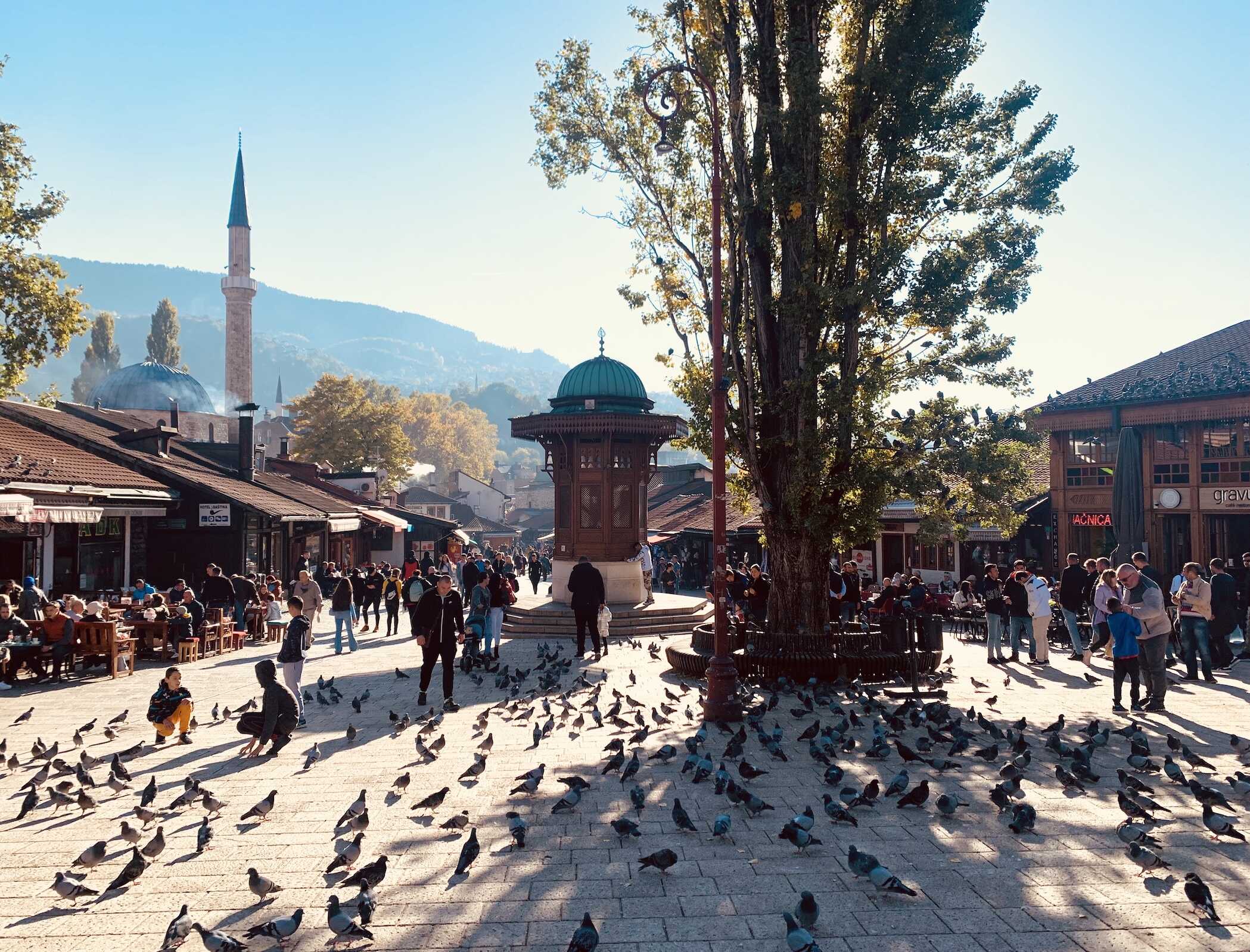
And then it’s into Baščaršija itself and the sculpted form of Sebilj Square, named after the ornate Ottoman fountain that stands at its centre.

Sarajevo Old Bazaar.
Most Sarajevans simply call it the Sebilj, while overseas visitors remember it as Pigeon Square. Both names certainly earn their keep. According to historians, the square and its surrounding lanes sprang up in the mid to late 1460s, right at the time the city itself was founded by Isa-Beg Isaković, the first governor of Bosnia.

Sebilj Square: Sarajevo Old Bazaar.
Thus Baščaršija became the city’s commercial engine right from the off, though its golden age didn’t arrive until the 16th century when a new ambitious governor, Gazi Husrev-beg, committed to developing Sarajevo into a city of international prominence. Remember his name, it’s going to come up again.
Baščaršija: Exploring Sarajevo Old Bazaar.

Sebilj Square.
The original bazaar was enormous, a fraction of which survives today. Over the centuries it has absorbed wars, fires, occupations and repeated rebuilding. Whatever was unfolding, the people just kept on going: setting up their vegetable stalls, opening their copper workshops, and brewing their coffee.

Baščaršija: Exploring Sarajevo Old Bazaar.
The pigeons are impossible to ignore, a chaotic, photogenic fixture. The scale of the bazaar’s winged population is something I hadn’t experienced since being on Trafalgar Square in London as a kid. And, years later, on St. Mark’s Square in Venice.

Residents of Sarajevo Old Bazaar.

Keeping watch over Sebilj Square.
Naturally, there are opportunistic vendors peppered around the square selling feed to tourists and locals. Many of whom clearly delight in giving the permanently peckish pigeons a bite to eat.

Baščaršija: Exploring Sarajevo Old Bazaar.
As for the fountain itself, it is both iconic and understated as the very symbol of the Old Bazaar. Originally built in 1753, its current form dates back to 1891 when the Austro-Hungarian architect Alexander Wittek rebuilt it following a fire forty years earlier.
Sebilj.

The fountain on Fountain Square.
The fountain’s name derives from the Arabic sabil, meaning public fountain, reflecting its original purpose as a source of free drinking water for travellers and locals alike.
Experts say there were once around 300 such fountains scattered across Sarajevo. However, most of them were lost to the catastrophic fire of 1697. The Sebilj that still stands in the Old Bazaar, they say, is the last.

Baščaršija: Exploring Sarajevo Old Bazaar.
Wittek designed the fountain in a pseudo-Moorish style. Carved from local wood, it is an octagonal beauty featuring perforated wooden panels and a domed coper roof.

Lovely.
On opposite sides, two horizontal spouts provide a constant flow of water into stone troughs below. And yes, the water is drinkable!

Thirsty pigeons lingering near one of the spouts.
A pleasing, albeit touristy selection of cafes, restaurants, souvenir stalls, bookstores, art galleries and antique shops line the square and its surrounding streets.

Baščaršija: Exploring Sarajevo Old Bazaar.

Worth popping one’s head into.

Always up for a bit of nostalgia.
From the Old Bazaar’s many coffee options, I’m happy to give a wholehearted thumbs up to Fabrika, where traditional Bosnian coffee culture meets the modern speciality coffee movement. They also put on art exhibitions and live music from time to time. There are four locations around the city, for the Old Bazaar shop, head to Sarači 32.
Baščaršija: Exploring Sarajevo Old Bazaar.

Our top Old Bazaar coffee pick.
If like me you have an incurable sweet tooth, you won’t find yourself short of dessert cafes, bakeries and sweet shops. We tried out quite a few of them during our stay, and soon got into the habit of taking a box of Bosnian cookies home for our evening pot of tea.

Baščaršija: Exploring Sarajevo Old Bazaar.
Among the many must-tries, a special mention goes to divit baklava, the Bosnian take on this great Ottoman sweet, typically featuring more walnuts and a lighter syrup.

Divit Baklava.
Šape meanwhile is a rounded, buttery shortbread-style walnut cookie, while kadaif is a shredded wheat pastry soaked in syrup and sometimes filled with cheese or nuts. All three sit firmly in the Ottoman-influenced sweet tradition that runs from Bosnia through to Turkey and the Middle East.

So many goodies.
Another favourite of ours is lokum, the traditional sweet known across the English-speaking world as Turkish delight. It can be found in abundance across the Old Bazaar and the wider city. We couldn’t get enough of it; partly for how delicious it is, but also because it transported us straight back to our unforgettable two-week stay in Istanbul in 2020.
Lokum!

Baščaršija: Exploring Sarajevo Old Bazaar.
My only complaint is that you really have to keep an eye on how much you order, as prices can rapidly spiral out of control.

Weighing it all up.

Heavenly lokum.
Aside from sweets, eating in the Old Bazaar is, by and large, a meat lover’s affair. The undisputed king of the menu is ćevapi: small, hand-rolled minced beef sausages grilled over charcoal and served in a soft flatbread called somun, with raw chopped onions.

Cevapi (left) in somun bread, beefsteaks (front) and a bowl of shopska salad.
Our best ćevapi came from Željo on Kundurdžiluk Street. Established in 1968, there are three locations in the city. This one, known as Željo 3, sits in the heart of the Old Bazaar. Note the football icon on the sign: the eateries take their name from FK Željezničar Sarajevo, one of the city’s two historic football clubs.

Baščaršija: Exploring Sarajevo Old Bazaar.
Another excellent Old Bazaar spot for traditional Bosnian fare is ASDŽ restaurant on Ćurčiluk mali. This kind of joint is known as an aščinica, a traditional slow-cooked canteen. It’s a wallet-friendly joint where little old local ladies come to chow down. That’s how you know it’s the real deal.

Baščaršija: Exploring Sarajevo Old Bazaar.
On our visit we went for an array of dishes, including chicken čorba (a creamy, lightly vegetable-flecked broth), japrak (grape leaves stuffed with veal and rice), and veal-stuffed peppers (punjene paprike) sitting in a braised, tomato-based meat sauce served with mashed potato.
Baščaršija: Exploring Sarajevo Old Bazaar.

ASDŽ restaurant.
Away from the main square and busier restaurant streets, our favourite Old Bazaar stretches were its oldest surviving ones. Strangely, (but entirely typical of the average tourist in my experience), these incredibly atmospheric and historic streets often sit ignored.
Baščaršija: Exploring Sarajevo Old Bazaar.
That was certainly the case with Kazandžiluk Street, better known as Copper Street. Back in Ottoman times, this is where master coppersmiths began producing kettles for the army, in addition to coffee pots, pitchers and trays for everyday city life.

Copper Street.
Records suggest the first coppersmith here dates as far back as 1489. Happily, the craft is still very much alive with a cluster of workshops, while the Bosnian government declared the street a national monument in 2009.

Baščaršija: Exploring Sarajevo Old Bazaar.
Mudželiti Veliki (Bookbinders Street) is just as atmospheric. The old bookbinders of Sarajevo started setting up shop here from around 1557. What began as a clutch of small bindery workshops blossomed, over the centuries, into a full-blown bookseller’s bazaar. This was a reflection of Sarajevo’s standing as one of the Ottoman Empire’s most prolific literary and intellectual centres. Sadly, no such shops survive today, but it still makes for a lovely short stroll.
Bookbinder’s Street.

Baščaršija: Exploring Sarajevo Old Bazaar.
Remember Gazi Husrev-beg, the ambitious governor who did so much to put Sarajevo on the map? He has an Old Bazaar lane named after him. Established in the mid 16th century, it had been known as Zlatarska (Goldsmith’s Street) until local authorities changed its name to Gazi Husrev-beg Street in 1931.

Baščaršija: Exploring Sarajevo Old Bazaar.
It runs parallel to the Bezistan, the great covered market that Husrev-beg himself commissioned in 1555. The market also bears his name, and is one of the finest surviving examples of Ottoman commercial architecture in the Balkans.

Baščaršija: Exploring Sarajevo Old Bazaar.
It didn’t take us more than a few minutes to stroll through, and in truth we found the place rather subdued. Nevertheless, it is well worth a look regardless of whether you’re in the mood for shopping, thanks to its characterful stone walls and vaulted roof.

Gazi Husrev-beg Bezistan.
By the early 1900s the building had fallen into serious disrepair. Eventually, in 1971, the government carried out a full restoration. Look out for the commemorative plaque high on one of the walls, which marks its reopening. Today it houses a modest collection of jewellery, souvenir and craft shops.
Baščaršija: Exploring Sarajevo Old Bazaar.

Gazi Husrev-beg Bezistan.
Gazi Husrev-beg is also at the centre of the Old Bazaar’s two main sights. First, one simply cannot miss the gorgeous Gazi Husrev-beg Mosque. Described by many as the beating spiritual heart of Baščaršija, this is the largest historic mosque in Bosnia and Herzegovina.

Baščaršija: Exploring Sarajevo Old Bazaar.
Built in 1531 under the patronage of Husrev-beg himself, it remains one of the finest examples of Ottoman architecture in the entire Balkans. We visited several times, both on crisp autumn mornings; the courtyard dominated by a magnificent old chestnut tree ablaze in amber and gold.

Gazi Husrev-beg Mosque.
On our first visit we’d arrived during prayer time, so decided to keep a safe distance and simply observe the comings and goings of locals.

Baščaršija: Exploring Sarajevo Old Bazaar.
What’s more, it was an opportunity to admire the spectacular šadrvan: a twelve-sided ablution fountain topped by a lead-covered dome. Its spouts feed water used for ritual washing before prayer.

Gazi Husrev-beg Mosque.
The water comes from a supply system engineered by Husrev-beg himself in 1529. Locals swear that it’s still some of the purest and freshest water in the city.
Gazi Husrev-beg Mosque.

Baščaršija: Exploring Sarajevo Old Bazaar.
To one side, an octagonal türbe (which serves as the great man’s mausoleum) marks the place where he was laid to rest in 1541. Non-Muslim visitors are welcome during designated hours for a small fee.

Gazi Husrev-beg Mausoleum.
On our second morning we timed things much better, and managed to make it inside the mosque. Even better, we had the run of the place to ourselves with ten-minutes of perfect silence in which to admire its beauty.

The main entrance portal with an islamic arch and intricately carved muqarnas.
The central space sits beneath a dome rising 26 metres. Fifty-one windows flood the prayer hall with natural light, while stalactite decorations adorn the corners. Beneath the domes, intricate arabesques cover the walls, and Quranic calligraphy runs throughout.

Baščaršija: Exploring Sarajevo Old Bazaar.
The mosque as we see it today dates from a grand restoration carried out between 2001—2002. A Bosnian calligrapher named Hazim Numanagić was responsible for many of its artistic touches. Apparently it was in a terrible state prior to the makeover, having been deliberately targeted during the Siege of Sarajevo.
Baščaršija: Exploring Sarajevo Old Bazaar.

Gazi Husrev-beg Mosque.
Last but not least, we headed just across the road from the mosque to spend a few hours at the stunning and seemingly under-the-radar Gazi Husrev Beg Museum. Yes, a compound dedicated to the life and legacy of the man who arguably did more than anyone to shape Sarajevo.

Baščaršija: Exploring Sarajevo Old Bazaar.
As we passed through the main entrance arch, it was impossible not to stop at this spectacular inscription. Sitting on a teal-green carved stone panel and framed by intricate floral and geometric arabesques, it marks the date of construction as 1531.

Gazi Husrev-beg Museum.
The compound originally served as a madrassa, the Islamic school that Husrev-beg established specifically in order to educate the local population. It has been beautifully preserved and stands as one of the Bosnian capital’s most treasured buildings.

A work of art.
Indeed, a key part of the museum experience is simply wandering its atmospheric courtyards. Silent, cool and with no other visitors around, we couldn’t help but linger.

Baščaršija: Exploring Sarajevo Old Bazaar.

Gazi Husrev-beg Museum.
Inside the main exhibition space, one of the school’s former lecture halls, the man’s life and times play out through archive photographs, historic documents and antique objects.
Gazi Husrev-beg Museum.

Baščaršija: Exploring Sarajevo Old Bazaar.
Some of the items on display are genuinely breathtaking: priceless artefacts spanning the 16th through to the 19th century. Take, for example, this stunning 18th-century Quranic manuscript.

Gazi Husrev-beg Museum.
And this fascinating Ottoman planisphere, a rotating star chart designed to show which constellations are visible in the night sky at any given date and time of year. The text is in German, with the months marked around the outer rim all visible. The constellations, meanwhile, are mapped across the dark green interior disc.

Baščaršija: Exploring Sarajevo Old Bazaar.
It’s also possible to pop your head into the Gazi Huzrev-beg Library. Although it looks quite modern from the outside, this is in fact the oldest continuously operating library in the Balkans. It has over 100,000 books, including 20,000 texts spanning Islamic sciences, philosophy, history, medicine, mathematics and astronomy.

Gazi Huzrev-beg Library.
During the Siege of Sarajevo, the manuscripts were moved eight times for safekeeping. The 500 most valuable were hidden inside the vaults of a Sarajevo bank, where they remained until the siege was lifted.
Baščaršija: Exploring Sarajevo Old Bazaar.
On our way out, there were some lovely glimpses of the Old Bazaar Clock Tower just beyond the compound’s stone walls. Completed in the early 17th century, it is the only clock tower in the world still following lunar calendar time. Its mechanism was acquired from London in 1875 and features four faces visible from all directions.

Baščaršija: Exploring Sarajevo Old Bazaar.
Like this? Don’t miss my detailed travel guide to Sarajevo, with reports from all over the city.
I’ve been living, working and traveling all over the world since 2001. So why not check out my huge library of travel reports from over 40 countries.



45 Comments
Wow, Sarajevo just leapt up my ‘must visit one day’ list! These old streets and squares really appeal to me and the food sounds delicious 🙂 Plus, the Ministry of Ćejf and Fabrika sound exactly our sort of place. Looking forward to reading more about your stay here.
Hey Sarah, I’m glad Sarajevo appeals so far. The Old Bazaar is a joy, particularly in the off season when this relatively small space is able to take a deep, post-summer breath. Ministry of Ćejf is up there with some of the best coffee I’ve had anywhere in Europe.
Welcome back Leighton. This post illustrates better than many what it is like to have the time to really get to know a place. As we get older, we are no longer interested in going to a new town every day. Best to explore the one you are in and live like a local. The coffee and sweet shops look divine and I fear if I were there, I would gain weight each time I walked down the hill. It is good to see this place at peace. Happy Sunday Leighton. Allan
Hey Allan, glad to have you back too! Yes, slow travel all the way for us. Those bakeries and dessert shops are dangerous for sure. Long may Sarajevo and Bosnia at large remain in peace, as you say. Unfortunately, I will be expanding on last week’s rather gentle introduction to the scars that Sarajevo bears from the siege of the 90s.
Such an in-depth look at this part of the city Leighton. I concur with Allan re the idea of slow travel rather than collecting countries, 24 hours here, two days there. It is such an attractive area and looks very clean and well maintained. It feels like the legacy of Gazi Huzrev Beg lives on with how the locals take care of it. Like Sarah I am salivating at the prospect of trying those meaty dishes. I don’t have much of a sweet tooth but Lisa does, I’d have my work cut out keeping her away from those bakeries. The trade streets are so atmospheric and the mosque looks magical in the autumn time. The museum at the end looks empty, like your own private palace to explore, was that the case?
Cheers, James. The museum was virtually deserted on the day of our visit, perhaps a few other visitors around, though I don’t honestly recall any. Thanks for the kind comments, I hope you enjoy the rest of the series.
What a truly delightful city. It must have been hard to leave after a month.
As much as we liked Sarajevo, a month was probably the right amount of time to do it justice. One small regret at the time was that we couldn’t do some travelling around the country. “We’ll come back!” we said, but of course that hasn’t happened over the past five years. Now that we are settled so close, I’m sure we’ll put that right at some point in the next few years. Thanks for commenting, Mallee.
I remember the siege of Sarajevo. It is a beautiful city, especially the neighborhood of Kovači. I thought the planisphere was fascinating. You took a lot of great photos and it was interesting to see and learn about Sarajevo. I’ve never been there.
Thanks Thomas, it’s lovely to hear from you again. The planisphere is a wondrous creation and a piece of art to boot. I hope you enjoy this series on Sarajevo, plenty more to come throughout August and September.
You have just put Sarajevo near the top of my list, and it was near the bottom before. I had no idea there were so many Ottoman buildings, worda and food in Sarajevo. It reminded me a lot of Bursa, a city we loved in Turkey. And good coffee makes it even more appealing. Maggie
Glad to hear it, Maggie. The city really does have a rich Ottoman heritage, there will be much more of that in my next post this Sunday. I wasn’t familiar with Bursa and just had a quick Google: looks lovely.
I first visited the town when I was seventeen on my way hitching to Istanbul. I always remembered the mosque and the river, but was litrally just passing through. I visited again a couple of years ago. Had more time but can see I missed a lot. My main memory is then driving south from the town with a steep river valley to the right. I stopped to take a photo slipped over the side grasping a tree to srop me falling further. In doing so car keys, camera and glasses. Took ages to find them and finally climb to the top. Here, my woeful story. You would probably recognise the place and road. https://geoffbrown250533044.wordpress.com/2022/10/20/in-bosnia-never-too-late-to-learn/
I remember bits of your story about this grand trip. Thanks for sharing Geoff and yes, I certainly do recognise some of the spots from your post.
Thanks for the wonderful pictures and in-depth tour. When we visited the country 10 years ago there were still many scars from the war and you could tell from talking to people that wounds were far from healed. I wonder if that’s still the case.
Stay safe,
Steve
Hi Steven, thanks for reading and leaving a comment. I think it will take people a very long time to move on from the horrors of the 90s, but time will help in that regard as generations pass and memory turns into something kids read about second-hand. Later in the series I’ll be doing a piece on the museums: those exhibits are incredibly moving and will keep the stories of resilience and survival alive for the next generations of Bosnians.
I really wanted to visit Sarajevo but we didn’t have time on our last Balkan trip. Mostar was amazing but I would definitely like to come back and explore Sarajevo and more!
We really want to visit Mostar, but the lack of public transport options from where we live makes it complicated and expensive, so we keep putting a trip there on the back-burner. I’m sure we’ll get round to it eventually.
That hill is quite the workout, balances out all those sweets! It’s nice when you can be in one place for a while and really get a feel for the spots. So many gems to see and delicious food to eat. I think I’d eat a lot of Cevapi.
Ćevapi is where it’s at, Lyssy. We have it here in Serbia too, so I can grab it from time to time and get my fix. Never disappoints.
The ‘most unhurried haircut of my life,’ complete with shave and head massage, might be my favourite kind of travel detail. And Sebilj as Pigeon Square made me grin — our kids would happily blow the whole souvenir budget on feed for those birds. That note about the clock tower still keeping lunar time is the sort of thing I’ll be repeating to people for weeks. A full month to peel back the layers of Sarajevo sounds like the dream.
Hey, thanks for reading and leaving a comment. It was indeed a privilege to spend a month in Sarajevo and get to know the city as well as we did. Cheers!
It all sounds so wonderful. After getting my hair cut in Howth Ireland in 2025, I decided to make it a travel tradition and do the same in Switzerland in 2026…no such luck. I came home with a shaggy top, the shops all required appointments, or were not open on Sundays. My itinerary did not allow enough time to make an appointment. I would definitely want to hang out at Ministry of Ćejf and other coffee shops and people watch, the market town seems so ideal for enjoying Java and sights.
Ha, I had a haircut travel tradition for a while. But like you I ran into trouble in several locations when I couldn’t find a no-nonsense barber who allowed walk-ins. And closed on Mondays was always a tedious affair. I agree that one does not have time to be scheduling haircut appointments while exploring a new place. Thanks for stopping by Chuckster, meet you at Ministry of Ćejf.
What a thrill that you had a month to explore this beautiful region. It does seem perfect for wandering between a wealth of interesting history and photogenic spots. Sarajevo is somewhere I didn’t know nearly enough about considering my dad lived there for awhile. So it was great to follow along with you and learn about it and see pieces of it with you. I would say that it all looks lovely except for the pigeons, and squares of pigeons especially, would be a hard pass no for me. Being swarmed by dirty birds looking for food is not on my list
Hey Meg, I’m very curious and have to ask, what was your dad doing in Sarajevo? Is that something you mentioned before? If so forgive me but I can’t recall. Pigeon disdain is fairly common I think among folk, though I can’t say they’ve ever bothered me too much. Luckily they more or less keep to the main square, leaving the rest of the lanes pigeon-free.
He was there with the military both during the war and then after it as they were rebuilding. Probably why he doesn’t talk about it much since he was there at such a terrible chapter
Thanks for confirming, I did have a feeling it was something like that. I’m not surprised he doesn’t talk about it much, he must have seen some terrible things.
It’s always nice to explore a place at a leisurely pace, and it sounds like you were able to do just that. Love your photos, particularly the one of the clock tower with the autumn leaves in the foreground. The bazaar looks interesting and inviting as well. And the swarms of pigeons; wow! Like Meg mentioned, I’m not sure about them. Wonderful post, Leighton!
“Stop that pigeon!” Have you ever watched Dick Dastardly and Muttley? Thanks Tricia for touring Sarajevo’s old bazaar with me, I felt like autumn was the perfect time of year to go, though I also imagine it must be quite beautiful on snow-capped winter’s afternoon.
I haven’t seen that show, but I’ll see if I can find it.
a splendid post leighton. i enjoyed very much the story of gazi huzrev beg and how he’s the spine connecting the mosque, market, school and a bunch of the lanes. and oh my word the buffet joint that opened mid-siege. once you know that fact it’s hard not to imagine how things must have played out for the staff and customers. is there a plaque or something on the building? the ottoman architecture and art is wonderful and what truly makes the old town such a special place.
Thanks, Stan. Yes, Gazi Huzrev Beg was/is pretty much Mr. Sarajevo; it’s amazing to see just how much influence one man can have on a place. They certainly haven’t forgotten him, have they? There isn’t a plaque on the Sweet and Savoury eatery, I just realised that its opening date was right in the middle of those grim times. I can’t help but admire the founders’ determination and bravery in getting the place upon and running during such dangerous times.
A lovely introduction to the Bazaar district, which covers just a small area of Sarajevo but is full of such striking sights. My guesthouse was there, at the foot of one of the neighbourhood’s small mosques; I was spoilt for choice when it came to buying baklava, but I soon knew where to find the best ones.
It seems you also had a good location while in Sarajevo. Ah Baklava, I used to be able to put away quite a lot of that stuff, but the older I grow the less tolerant I’m getting with very sweet desserts and the quantity I’m able to consume. Sounds like you also have a sweet tooth.
How absolutely amazing to have this just a 20 minute walk from your door. The Old Bazaar is atmospheric and beautiful and soaking it up over multiple visits sounds magical. I love the Ottoman architecture – Bosnia really is a mix of west and east coming together in it’s own unique form.
Absolutely, Hannah. I am also a sucker for Ottoman architecture; it was fascinating to see how that heritage informs much of the Old Bazaar. There will be plenty more of this in Sunday’s post on Sarajevo’s riverside trails where there are more architectural gems.
A beautiful city! Sarajevo is a place I’ve yet to step foot in, but its history and culture is fascinating, considering the blend of ethnic and religious groups throughout the country. I tried ćevapi during my short trip to Mostar, and it was a delicious, hearty meal– the meat was so tender! Also love how the sweets are similar to the Turks’, and that divit baklava is calling out to me…thanks for sharing more of your adventures in Bosnia and Herzegovina with us, Leighton!
Thanks Rebecca. Baklava and ćevapi are two of the great joys of Bosnia. Absolutely delicious, but lord not a place to come for anyone on a diet. Next up, arguably the city’s greatest architectural gems across the riverside neighbourhoods.
It’s nice that you were able to visit the Old Bazaar so often when staying in Sarajevo for a month to really get a feel for the place. I’m a big fan of fully pedestrianized areas too, maybe not all the pigeons though! Naturally my interest piqued at the mention of sweets and desserts. Mmm that divot baklava looks amaaaazing and the other treats you mentioned have my mouth watering. The Gazi Husrev-beg Museum sounds super interesting.
Thanks, Linda. Sladja and I often think about how much better cities around the world would be if it had more fully pedestrianised zones away from cars, traffic and bloody motorbikes, our biggest pet peeve of all. Thanks for checking out my piece on Sarajevo’s Old Bazaar!
It looks wonderful. I haven’t visited it yet
Hope you make it there someday.
I can see why this became a regular haunt for you in your time there. The mosque is quite a treasure. It always baffled me why certain streets or areas attract like businesses or craftpeople that you might think would be rivals, like the copper and bookbinder streets.
Mm, I agree. In the case of Sarajevo’s Old Bazaar, I imagine the prestige of having one’s business within that protected historic district probably trumps all. But otherwise, I’d definitely want my business away from all the other guys who are offering the same thing.