
Memory and Resilience: The Museums of Sarajevo.

Memory and Resilience: The Museums of Sarajevo.
October–November 2021.
As my Sarajevo series eases into its fifth instalment, I’d say it’s time for something a bit different. Sarajevo isn’t the first city that springs to mind when you think of Europe’s great museums. However, spend even a few days here and that assumption soon falls apart.
For a capital of its size, Sarajevo punches well above its weight, home to a clutch of small but deeply affecting collections that rank among the most powerful I’ve encountered anywhere. Over the course of a month living in the city, we made it our mission to seek them out.

Memory and Resilience: The Museums of Sarajevo.
Let’s kick things off with what is easily the most fun and lighthearted collection we visited: the Sarajevo Winter Olympics Museum. Dedicated to the XIV Winter Games the city hosted in 1984, the museum lives inside one of the loveliest buildings in the centre. Villa Mandić is an elegant house that has watched over the Mejtaš neighbourhood from its slope for more than a century.

Memory and Resilience: The Museums of Sarajevo.
Completed in 1903 for Nikola Mandić, a prominent Sarajevo lawyer, it was designed by the Czech architect Karel Pařík, one of the figures most responsible for giving the Bosnian capital its graceful Austro-Hungarian face. The villa lived several lives before the Olympics found it, serving at various points as the American consulate and later as a seat of the city’s communist committee.
Memory and Resilience: The Museums of Sarajevo.

Sarajevo Winter Olympics Museum.
Its Olympic chapter began on the 8th of February 1984, when the museum opened its doors on the very day the Games themselves began. The aim was to gather the memory of those seventeen days under one roof. Today, more than 42 years later, the museum presents the stories of the 84′ Games alongside some wonderful objects that have survived the decades.

Memory and Resilience: The Museums of Sarajevo.

I’ve always been amused by sporting event mascots. Thus I was tickled to meet Vučko, a cheerful little wolf who remains one of the most beloved characters in Olympic history.
He was dreamed up by the Slovenian painter Jože Trobec, who took the wolf, long cast as a symbol of winter’s menace in Balkan folklore, and reinvented him as something warm and mischievous. Grinning out from posters, pin badges and postage stamps, he gave the Sarajevo Games a face that Bosnians still remember with real affection.

Memory and Resilience: The Museums of Sarajevo.
As a lifelong Cool Runnings fan, I was always going to love the corner devoted to the bobsleigh events. It was also the perfect accompaniment to one of our favourite Sarajevo days hiking the abandoned Olympic bobsleigh track on Trebević Mountain.

“Bosnia, we got a bobsleigh team!”
One name recurs throughout the museum: Juan Antonio Samaranch. The Spaniard who ran the International Olympic Committee from 1980 to 2001 was the most powerful figure in world sport. And it was he who opened this very museum on 8 February 1984, the day the Games began.
Juan Antonio Samaranch (1920-2010).

Juan Antonio Samaranch: you can never have enough microphones.
His presidency hauled the Olympics into the modern era of professional athletes and global sponsorship. This made his personal blessing of Sarajevo’s Games, delivered in the rooms of Villa Mandić, all the more meaningful. In fact, the museum’s planners even felt moved to put the jacket he wore during the opening ceremony on display.

Memory and Resilience: The Museums of Sarajevo.
The exhibition showcases a haul of medals from across the various competitions that year. According to the attached blurb, there were 222 medals for participants spread across 17 countries. SSSR topped the list with 25. Elsewhere, those Olympic stalwarts the East Germans won the most gold medals.

That’s a lot of bling.
Above all, we loved all the artwork connected to the event. From branded mugs, stamps and stationery, to outfits, commissioned paintings and even the striking logo itself.

Memory and Resilience: The Museums of Sarajevo.

Proper 80’s swank.

Several artists from across The Balkans exhibit their artwork in the museum.
At first glance the emblem reads as a simple snowflake beneath the Olympic rings. But actually its geometry comes from the traditional embroidery of the Sarajevo region. Stitching local heritage into a global symbol, it remains one of the most striking marks the Winter Games has ever produced. I liked it so much I had it printed onto a t-shirt in one of the workshops in the old town.
Memory and Resilience: The Museums of Sarajevo.

Memory and Resilience: The Museums of Sarajevo.
If you like your museums smaller, more intimate and with a chance of not encountering anyone, look no further than the fascinating Despić House. This building is one of very few Orthodox merchant homes to survive from the Ottoman period more or less fully intact.

Despić House.
It belonged to the Despićs, a wealthy Serb trading family whose business reached from Sarajevo to Istanbul, Vienna and well beyond. Moreover, several generations of the family lived within these walls spanning an impressive one hundred and fifty years.

Memory and Resilience: The Museums of Sarajevo.
The family’s most towering figure was Maksim Despić. It was he, together with his brother Mićo, who gave the house its enduring claim to fame. In the mid-nineteenth century the two founded the Theatre of the Despić Brothers, the first home-grown theatre anywhere in Sarajevo or Bosnia and Herzegovina.

Maksim Despić: enjoyed a ciggy between plays.
Performances took place in the grand front room of the ground floor, with an invitation from the host your only way through the door. Mićo himself was the company’s leading actor, while the bill leaned on comedies by renowned Balkan writers. The parties that followed each show turned the house into a gathering place for Sarajevo’s elite.
Despić House.

Memory and Resilience: The Museums of Sarajevo.
When the last of the Sarajevo Despićs left the city at the end of the 1960s, the house became a museum on the condition that it keeps telling the story of an old Serbian merchant family. As we explored, it was worth slowing down for the details, because the family’s taste is written into every surface.

Despić House.
The ceilings bloom with gilded acanthus scrolls curling around painted medallions. What’s more, there are hand-painted garlands of white blossom and green leaf run on warm terracotta.

Original artistic flourishes.

Memory and Resilience: The Museums of Sarajevo.
Magnificent green-glazed ceramic stoves embossed with Art Nouveau flowers inhabit several rooms. Add to that family paintings, and leaded-glass lamps with little metal turrets that glow like hanging fortresses.

Despić House.

A little Despić: Perhaps not thrilled by the prospect of watching yet another play.
If you want to double up on another small and intimate experience, the Museum of Literature and Performing Arts is just around the corner from Despić House, literally one-minute on foot. We didn’t get around to exploring this one, but from what I can see it has decent reviews.
Memory and Resilience: The Museums of Sarajevo.

Museum of Literature and Performing Arts.
For those of you with good memories, a few weeks back I briefly mentioned the main branch of the Museum of Sarajevo 18781-1918 that sits just across the road from the Latin Bridge. One afternoon we made sure to pop our heads into this small but absorbing collection.

Museum of Sarajevo 1878–1918.
Prior to entering, we spotted the engraved section of wall that marks what is arguably Sarajevo’s most historic spot. Yes, it was right here (more or less) on the 28th of June 1914 that Gavrilo Princip fired the shots that killed the Archduke Franz Ferdinand, heir to the Austro-Hungarian throne. His wife Sophie, the Duchess of Hohenberg, also died in the attack.

Memory and Resilience: The Museums of Sarajevo.
The museum occupies the former Schiller delicatessen. Back in 1914 its workers and customers witnessed first-hand the two pistol cracks that set the First World War in motion. While the museum traces the four decades of Bosnia’s Austro-Hungarian rule, much of the exhibit deals squarely with the events of Ferdinand’s fateful visit to Sarajevo.

Memory and Resilience: The Museums of Sarajevo.
There is a panel showing Franz Ferdinand’s movements during his Sarajevo stay, as well as mugshots of the young conspirators. Princip’s trousers and bag, both apparently worn on the day, sit somewhat mournfully in a glass display case.

The couple leaving Sarajevo Town Hall (Vijećnica) minutes before their deaths.

Museum of Sarajevo 1878–1918.
They also have the gun that Princip used for the assassination, and the uniform and firearm of a policeman who was one of the first responders.
Museum of Sarajevo 1878–1918.

Doesn’t much look like a police officer’s uniform.
Away from the assassination, there are some fascinating relics. Of these, I particularly enjoyed seeing the Proclamation of the annexation of Bosnia (1908) and one of the city’s first magazines, The Bosnian Fairy (Bosanska vila). First published in Serbian Cyrillic 1885, it ran stories on education, literature and entertainment for three decades until the Austro-Hungarian administration eventually shut it down.

Memory and Resilience: The Museums of Sarajevo.
In terms of Sarajevo’s big-hitters, one should definitely try to set aside an hour or two for the History Museum of Bosnia and Herzegovina. The local government founded it in November 1945 as the Museum of National Liberation, to preserve the memory of the peoples’ struggle against fascism.

Memory and Resilience: The Museums of Sarajevo.
It has since cycled through several titles, including the Museum of the Revolution, before settling on its present name in 1993. The building itself is a real showstopper. Chosen through a competition held in 1957 and designed by a trio of Zagreb-based architects, it is a titan of the Yugoslav modernist movement.

Dinosaur sculpture created for the United Nations Development Programme (UNDP) global campaign ‘Don’t Choose Extinction’.
Effectively a giant stone-clad box, it is nicknamed Kocka (the Cube) and appears to float above a glass-walled entrance pavilion, carried on little more than a row of slender steel columns.
Memory and Resilience: The Museums of Sarajevo.

History Museum of Bosnia and Herzegovina.

‘Bosnia’, a mosaic by Mladen Sbrinovic, made for the museum in 1966. The skulls are a symbol of war and death. The flowers represent peace, life and love. The red lines symbolise recovery, blossoming, desire and ability.
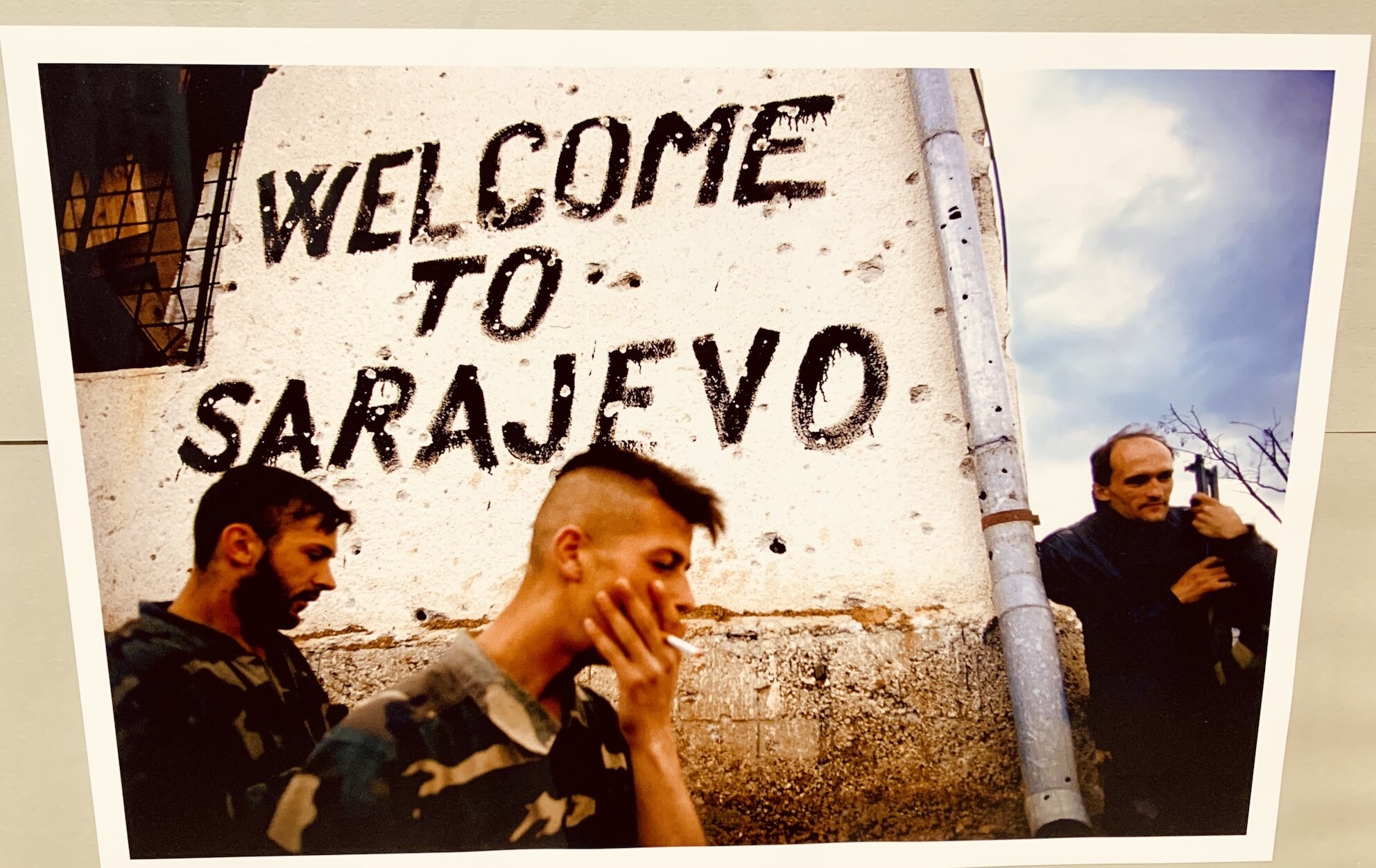
Many of the museum’s exhibits deal squarely with war, and we soon found ourselves lost in (and more than a touch terrified by) the Besieged Sarajevo exhibition. A permanent display since 2003, it confronts the city’s darkest modern chapter: the siege of 1992 to 1995. Lasting 1,425 days, it was the longest siege endured by a capital city in modern warfare.

Memory and Resilience: The Museums of Sarajevo.
Rather than dwelling on front lines, generals or political manoeuvring, the exhibition fixes its gaze on the everyday experience of living under siege. It is a story of resilience and resourcefulness; of how Sarajevans endured years without electricity, running water or heating.

People hiding from snipers firing into the crowd present at a peace rally in 1992 (photo by Ron Haviv).

Members of the French peacekeeping forces protecting Sarajevans while crossing an intersection, spring of 1994 (photo by Ron Haviv).
Some of the stories and images are incredibly harrowing. The most upsetting have been put aside in a section called the Black Room. A sign informs visitors before entering that they should consider whether they are ready to face what lies within.

Memory and Resilience: The Museums of Sarajevo.
One of the stories that stayed with me the most was that of a seven-year-old boy called Nermin Divović. A familiar presence on the streets of Sarajevo during the siege, he struck up a friendship with the Spanish war photographer Enric Martí.
History Museum of Bosnia and Herzegovina.

Nermin Divović.

Martí throwing snowballs with Nermin. Pictured by the journalist Gervasio Sanchez.
Nermin died on the 18th of November 1994, shot by a sniper as he walked home with his family. The same bullet first struck his mother, Dženana, who was pregnant at the time. She survived but lost her unborn child, while Nermin’s sister Dženita escaped unharmed. It was Martí himself who captured the aftermath in a series of photographs that would travel the world. The museum displays a number of these images, along with the small sweater that Nermin wore almost every day.

Memory and Resilience: The Museums of Sarajevo.
Following our visit to the History Museum of Bosnia and Herzegovina, we leaned even heavier into the darkness of the wider Bosnian War. A short walk from The Old Bazaar, the Museum of Crimes Against Humanity and Genocide 1992–1995 approaches its subject directly through the civilians who lived it.

Memory and Resilience: The Museums of Sarajevo.
Its displays are built around personal testimony and everyday objects. An improvised stove… a survivor’s worn clothing… a family keepsake… each placed beside a first-person account of the life it belonged to.
Memory and Resilience: The Museums of Sarajevo.

Harrowing stories that once read, you are unlikely to forget.

‘A Man Who Waited in Line for Bread’ by Mensud Kečo, a life-size figure built from bread, remembering the 26 civilians killed when a shell struck a Sarajevo bakery queue on the 27th of May, 1992.
The museum asks you to meet the people behind the numbers one at a time. What’s more, it presents details of the international courts’ rulings, including their finding that the mass killings at Srebrenica constituted genocide. Serbia, for its part, has never officially recognised that classification.

Museum Of Crimes Against Humanity And Genocide 1992-1995.
In truth, Sladja and I were left a little frazzled by the stories we read and the images we saw. We could have been forgiven, then, for passing on the chance to visit another of the city’s memorial spaces, the Srebrenica Exhibition at Gallery 11/07/95. Somehow, though, we felt compelled to see it.

Memory and Resilience: The Museums of Sarajevo.
Unfortunately for our nerves, this proved to be the hardest-hitting exhibition of all. Opened in the summer of 2012, the gallery focuses entirely on the grisly events that took place in and around the town of Srebrenica in July 1995.

Gallery 11/07/95.
Founded by the Bosnian photographer Tarik Samarah, the space features hundreds of black-and-white photographs taken by Samarah himself in the aftermath of the mass killings.
Gallery 11/07/95.

Memory and Resilience: The Museums of Sarajevo.
He photographed the emptied landscapes where the crimes took place. He also captured the exhumation of mass graves and the survivors, mostly women and children, in the years that followed.

Gallery 11/07/95.
Elsewhere, there are discarded objects, chilling graffiti, maps, audio testimonies and a memorial wall commemorating the 8,372 people whose lives ended in Srebrenica that long-ago summer.

Memory and Resilience: The Museums of Sarajevo.

Gallery 11/07/95.
After everything else, the War Childhood Museum felt quite hopeful. Tucked along Logavina street in the old town, this small but remarkable place grew out of a project by Jasminko Halilović, himself a child of the siege.

Memory and Resilience: The Museums of Sarajevo.

Jasminko Halilović.
In 2010 he began asking his own generation a single question: what was a war childhood for you? The flood of answers became a successful book, and then, in early 2017, a museum. A year later it won the coveted Council of Europe Museum Prize.
Memory and Resilience: The Museums of Sarajevo.

The museum’s method is disarmingly simple. Each exhibit is a single object, set alone in a clean glass case or mounted on a plain white wall, beside a short printed story written by the person who donated it. That is the whole design, and it’s exactly what makes it work.

War Childhood Museum.
For the most part you are looking at an ordinary thing accompanied by a bittersweet story of what it was like to grow up in wartime. Gradually moving from case to case, we leaned in, read, and lost ourselves in the stories of people rebuilding their childhoods from a single keepsake.

Memory and Resilience: The Museums of Sarajevo.
Take Amira, who recalls the days she and her toddler sister spent cooped up at home without electricity. And how she used her toy duck to perform puppet shows from behind an armchair to keep the little one entertained.

War Childhood Museum.
Lejla, meanwhile, writes about a humanitarian aid package that reached the children of Cazin in 1994. She opened it to find a decorated shoebox holding toiletries, stationery, sweets, a photo and a letter from a British girl named Astrid. Lejla kept the comb and mirror in her makeup bag, but never used the coloured pencils, afraid of running them down before the war ended.
War Childhood Museum.

Memory and Resilience: The Museums of Sarajevo.
This feels like a good place to wrap up my post on Sarajevo’s museums. I’ll leave you with a selection of some of my favourite collected war childhood memories.


Like this? Don’t miss my detailed travel guide to Sarajevo, with reports from all over the city.
I’ve been living, working and traveling all over the world since 2001. So why not check out my huge library of travel reports from over 40 countries.



39 Comments
what a post leighton. there is a great deal to ponder here from the 18th century theatrical family and the fluffy olympic wolf represnting the city’s 1984 high point to the gruesome realities of life in wartime. the last museum stayed with me the most it is very very powerful and more than a little heartbreaking. i can’t help but think of all those people buying cold cuts and bread on an ordinary morning with no idea what they were about to witness. who would be an archduke i wonder? the black room in the history museum might have been too much for me.
Hey, Stanley. I hear you on the Black Room, it was extremely uncomfortable on both the eyes and the mind. I do think that my experiences seeing certain exhibitions in Cambodia, Vietnam, Poland and many other countries helped me somewhat to face it. The Despić House was a favourite, quite a unique museum and one that was a welcome respite away from the tragedy of war.
Similarly, I would’ve never guessed that Sarajevo would be home to so many great museums, especially those that show the almost-forgotten history of the country in the 1990s. Looks like the city offers a plethora of different museums to check out, from one pertaining to the 1984 Winter Olympics to the tragedies from the Bosnian War. Sad, but hopeful, these sites are well-worth a visit to learn more about this lesser-known part of Europe. Thanks for sharing, Leighton.
Thanks Rebecca, doing some of those war exhibits back-to-back was a little tiring, especially on the mind, so we were grateful for the break in tone provided by the Olympic museum and the Despić House. The War Childhood Museum was brilliantly done, with stories that although tragic were also sometimes heartwarming.
Wow. Sarajevo has long been in the center of historic events. This post was a real education Leighton. Love the Olympic Museum with the 1984 ski wear fashions and colours. I recall having a cheap ski suit just like that. Those were the happy times, before it all went crazy. I do hope the museums of conflict and war give everyone pause as to the benefit of learning to solve their problems in another way. Have a wonderful week. Allan
Thanks, Allan. Please tell me that there is a photo somewhere of you in such a suit. And if there is, could it make its way into a blog post? The Olympic Museum was a lot of fun, and boy was it needed to balance out the tone of what happened to the city and its people during the 90s.
These types of museums could be just about anywhere, unfortunately. Thanks for the coverage of so many. The last museum you mention shows that there is still hope in a child’s eye through his/her toy.
Hey Cath, thanks for reading and taking the time to leave a comment. You’re right that there’s hardly a country left that couldn’t fill a museum like these. Having seen many of them around the world, what I’d say is that each one is rooted in specific stories and lives, and that’s what makes them unique. I’m glad the War Childhood Museum landed; it’s a special approach, and some of the stories stayed with me for months afterwards.
Lots of interesting museums and great photos. The Sarajevo Winter Olympics Museum would have been interesting for me to see. Sweden got a bunch of medals, especially in skiing. Speaking of …. Juan Antonio Samaranch is believed to in Sweden to have changed the rules for skiing to specifically make the Swedish skier Ingemar Stenmark win less. Ingemar Stenmark was very good at slalom and kept winning gold medals, so Juan Antonio Samaranch changed the importance of slalom in combination sports. I don’t know if that is true but it is a rumor.
Ha, what a fun rumour, I will have a dig into that to see how valid the story actually is. Thanks for reading Thomas, Sarajevo is a city with a fantastic museum scene, even if the subject matter of a lit of them can be hard to absorb.
I’m a self-proclaimed Olympics junkie so that would be my musuem of choice. And I think I said this before, but Cool Runnings took place in my home town 😊 Maggie
I think I remember that, yes. A great claim to fame I’d say.
Such a fascinating range of museums. It’s great that you were able to visit all of them while living in Sarajevo for a month. I couldn’t help but laugh at how you described yourself as a lifelong Cool Runnings fan. Yes! It’s such a fantastic movie! It must have been tough to learn about some of the darker days in Sarajevo’s history, especially since many of the museums put a personalized touch to the exhibits and helped bring some of the stories to life.
Never trust someone who doesn’t think Cool Runnings is a great movie, ha ha. Thanks for joining us on this tour of Sarajevo museums, Linda.
The War Childhood Museum’s approach – one object, one story, told by the person it belonged to – is such a quietly devastating design choice. Lejla saving the coloured pencils because she was afraid of using them up before the war ended is a detail I won’t shake. Thank you for writing about these places carefully rather than briskly.
AI.
Thanks for leaving a comment! 🙂
Thanks, Leighton, for this excellent tour of Sarajevo’s museums. As difficult and disturbing it is to witness, it’s important to document the horrors of war for future generations. Even though similar atrocities continue, we can only hope at some point they will stop. The wide variety of museums seems to provide some balance. Thanks for sharing.
Thanks Tricia, I think it’s to the city’s credit that they didn’t let the war completely saturate the museum scene. As you say, there is a decent balance to suit all tastes. Hope all is well with you two, I cannot wait for this burning summer to end, and of course for our upcoming adventure in Sicily.
I hope it cools off there soon. Thankfully, it’s been a rather mild summer here, but they’re predicting 34 here today. 🥵 I’m sure you’ll love Sicily!
Fascinating post Leighton. Sarajevo’s museums sound like the kind of places that don’t just preserve the history, but quietly honor the resilience of the city itself. I’d love to see it first hand.
Cheers, Chuckster!
The museums all sound fascinating in different ways. I would probably be most interested in those that tell the story of the siege and of Srebrenica, but for lighter relief I would pick the Despić House. And the Childhood War museum sounds worthy of the award it won for sure! I wonder what Astrid would say to know her letter and gifts were displayed there? Maybe she will even come across this post!
I really hope Astrid knows that the package she sent so many years ago has made it into a book and an award-winning museum. Thanks Sarah for following along with this tour of Sarajevo’s museum scene. The Despić House gets my nod for ‘best under the radar’ museum.
Such a detailed and comprehensive look at Sarajevo’s key museums, Leighton. I would personally do every one if I were in the city. The exhibits about the war look to have been so tough, have been thinking about that boy Nermin for the past few hours since reading.
Funny you should say that James, because Nermin was the one that stayed with me for a long time after visiting the museum that day. I also had the misfortune of stumbling upon a photo of him online that in all honesty I would rather not have seen. Thanks for keeping up with my Sarajevo series.
All these museums actually look really cool in their own unique way! I would definitely cry in the children’s war museum though – I can’t stand hearing about any child suffering.
We also found the War Childhood Museum the most moving of all. Thanks for reading, Anna.
Such harrowing times and stories.
Regarding the 90s war yes, most definitely. Luckily there are plenty of other museums on a variety of topics to balance things out. We were certainly glad for the contrast.
I love that there is such a wide and varied collection of museums. They seem to show so many different layers and perspectives of what the city remembers from its history. All of them look really interesting, but the one I would probably visit first would be the Olympics museum as I am such a fan of the winter Olympics.
I’m sure the Olympic Museum wouldn’t disappoint in that case, Meg. And the perfect day would be pairing it up with last week’s hike along the abandoned bobsled track. Thanks for reading!
Oof. What a selection of museums, every single one of which I would really value visiting. The Olympic Museum is always something I would enjoy. I’d also like to learn more about the history of the assassination that started the war – there’s something haunting about the photo just a few seconds before they were shot to death. The genocide and other war museums sound incredibly heavy hitting. I would really struggle with the images, somehow they are always the worst bit to me. Thank you for telling the story of teh exhibits so respectfully.
Thanks, Hannah. It was tricky finding the right words to present some of these, especially the harrowing Srebrenica Gallery. Thanks for keeping up with my Sarajevo series, just a few posts left.
This is such a powerful post.The War Childhood Museum really stayed with me. Those simple childhood objects carrying such powerful stories are heartbreaking. I only wish that no child ever has to experience war.
Thanks for reading Angela, the War Childhood Museum is my pick too for the most powerful exhibit we saw in Sarajevo.
I can understand why. It sounds like a place that really stays with you.
That last museum is hard going especially as it was not that long ago. I remember that international bodies were silent for a long time and suspect that they were not overly concerned that it was Muslims being slaughtered.
Yes, it did strike me that many of the people who wrote many of these War Childhood entries and donated their old items were most likely still around and wandering the streets of Sarajevo at the same time we were there.