
The Art Nouveau Wonders of Subotica.

The Art Nouveau Wonders of Subotica.
June 2021.
It was a warm late afternoon when Sladja and I arrived in the Serbian city of Subotica. The bus from Belgrade took just under three hours, while from the station we immediately set off on a walking route to find our Airbnb apartment. I’d read that Subotica is a wonderfully green city, but oh boy, this was surely one of the lushest residential streets I’d ever have the pleasure of passing through.

Braće Radića Street, Subotica.
“Is this our street?” asked Sladja hopefully. I glanced back at my phone, squinting a bit from the sun. “No, it’s a few roads down” I answered. “Unfortunately”. Not that we were disappointed when we got there. In fact, Oleg’s Place looked charming and was easy to spot with its rambling wall ivy, eruption of pink roses and tiled welcome sign.

The Art Nouveau Wonders of Subotica.
Inside, our host Oleg swiftly greeted us in flawless English before leading us to a tiny but cosy room with ensuite shower/toilet. Overlooking a pretty garden set away from the main road, a good night’s sleep was surely guaranteed. Touch wood.
Not wanting to waste a precious second of our weekend we thanked Oleg, gave the gorgeous house cat a few strokes and headed off to grab dinner in the old town.
The Art Nouveau Wonders of Subotica.

Catticus Subotica.

The lovely little garden at Oleg’s Place.
Making our way towards Liberty Square, we drank in Subotica’s envious, ever-present greenery. And how the city seemed so calm and pedestrian-friendly. Indeed with a population of just over one hundred thousand, this is merely Serbia’s ninth largest city.

The Art Nouveau Wonders of Subotica.
The afternoon light was already beginning to ebb away as we passed through the dramatic expanse of Liberty Square.

The Art Nouveau Wonders of Subotica.
We wouldn’t take a closer look until the next day, though that evening I did momentarily stop to grab a shot of the National Theatre. It’s a fine neoclassical style structure that dates back to… uh… 2007.
The original theatre here opened in 1854 as the city’s very first monumental public building. But local authorities razed the historic edifice, despite public outrage, to move forward with the new theatre. “But we rebuilt it faithfully in the style of the old one!” countered those responsible. Scandalous.

National Theatre.
With food and drinks at the forefront of our minds, we pressed on through the city centre to our eatery of choice. Along the way, we passed countless cafes, bars and restaurants where tables and chairs spilled out onto the street. Many of these operated out of historic townhouses.
Exploring Subotica.

The Art Nouveau Wonders of Subotica.
As lovely as these places were we definitely didn’t have any regrets over our dinner spot that evening. Before long we reached Matije Korvina, a gorgeous pedestrian street where a number of elegant establishments sit snugly under a canopy of leafy branches.

Matije Korvina Street.
From the numerous choices on offer we plumped for Caffe Boss, a Subotica institution that has been a favourite with locals and visitors since 1986. Thus we grabbed a table, ordered a pair of large Hoegaardens and eagerly scanned the menu to pick out our dishes.

The Art Nouveau Wonders of Subotica.
Boss began life as a pizzeria, but has expanded its menu over the years to include traditional Serbian dishes in addition to pastas, steaks and Asian fusion.
I’m usually sceptical of restaurants that offer a broad range of cuisines, but on this occasion I was happy to take a risk. Luckily, it worked out fantastically as our pizza, noodles and chicken & cashew stir fry were all flawless. Totally “boss” as today’s cool kids might say.

Our dinner at Caffe Boss.
The next morning, bright and early, we began exploring Subotica in earnest. Top of the agenda was to seek out the city’s incredible Art Nouveau architecture. Now I’m not just talking about any old run of the mill Art Nouveau, but some of the very best in Europe according to historians.
The Art Nouveau Wonders of Subotica.

City Hall.
These architectural gems can be traced back to the late 19th century when Subotica was under Austro-Hungarian rule. At this time Art Nouveau was exploding across Europe and Subotica was one of the biggest and most important cities of the region. Hence it was very much a case of: geez we better pull our finger out and get with the times.

The Art Nouveau Wonders of Subotica.
Our Art Nouveau journey started back at Liberty Square and its grandiose City Hall. Built between 1908 and 1910, this 6000 m² complex is like something out of a Hungarian fairytale with ceramic floral tiles, wrought ironwork, stained glass windows and a 76-metre clock tower.

City Hall.
Today it houses municipal offices, exhibition spaces and a grand hall used for cultural events, concerts and weddings. We popped our heads inside the ground floor where there was a sobering exhibit on Jasenovac Concentration Camp.

The Art Nouveau Wonders of Subotica.
Established during World War II in the Croatian village of Jasenovac, the camp oversaw the extermination of approximately one hundred thousand people including Serbs, Jews, Roma, Croats and Bosnian Muslims.
City Hall.

Jasenovac Concentration Camp Exhibition.

In truth the focus of the exhibition had caught us by surprise. As a result, our mood had somewhat soured as we exited and strolled into the gorgeous park that runs off City Hall’s north side. Liberty Park, as it’s loosely known by locals. It was just what we needed, an uplifting scene where pockets of cheerful locals chatted together in a mishmash of tongues.

Liberty Park.
You see, Subotica is also famous for being Serbia’s most multicultural city. Located just 38 kilometres from the Hungarian border, there are more Hungarians than actual Serbs as well as a sizeable Croat population.

The Art Nouveau Wonders of Subotica.
Happily, we found our second Art Nouveau masterpiece in the park. Lo and behold the delightful Blue Fountain, created in 2001 as the park’s centrepiece and a bold new addition to the city’s Art Nouveau creations.

The Art Nouveau Wonders of Subotica.
It is a prime example of Zsolnay Ceramics, a handmade porcelain manufacturer based in the Hungarian city of Pécs. However, though many see the fountain as the pearl of Liberty Square, the piece has also been subject to considerable criticism.

Blue Fountain.
First came the scandal of how much the fountain cost to produce, a matter compounded by the fact that the official figure given has been disputed by some critics.

Feeling blue?
Moreover, the fountain’s fragility means that it is covered with a tarpaulin for virtually half the year in order to protect it from the elements. Which, some say, turns this part of the park into a bit of an eyesore.
The Art Nouveau Wonders of Subotica.

Blue Fountain.
From the fountain we embarked on a tour of the old town to cross off some more Art Nouveau wonders. And what better place to start than the seemingly sugar-spun Subotica Savings Bank Palace. Constructed in 1907, at the time it was the first bank in Korzo the city’s main pedestrian street.

The Art Nouveau Wonders of Subotica.
You certainly can’t miss it with its pale yellow colour and charming embellishments of ceramic and carved stone. All these symbols represent the values of good character, hard work and saving. They include determined housewives and beehives (representing frugality), a squirrel (diligence apparently) and an owl (wisdom).

Subotica Savings Bank Palace.
Next we made our way to the avocado-green Golden Lamb Hotel. Originally built in 1857, it is a sublime showcase of Jugendstil, a German brand of Art Nouveau established in Munich.

The Art Nouveau Wonders of Subotica.
Sadly the building fell into such a sorry state that the local council tore it down in the mid 1980s and rebuilt it from scratch. Today it hosts a number of private apartments.

The Golden Lamb Hotel.
From the Golden Lamb it’s just a 3-minute walk to the former Hotel Adolfa Halbrora. This one first opened its doors in 1897, and yes the original building still stands after numerous restorations. As with many of these fabulous buildings finding clear historic information is hard work, whether you search in English or Serbian.
The Art Nouveau Wonders of Subotica.

Hotel Adolfa Halbrora.
It was definitely time for lunch. With our stomachs rumbling we found ourselves tempted into a gorgeous Art Nouveau cafe garden where the sound of clinking spoons and the smell of coffee punctuated the air. However, what we didn’t initially realise is that this is a second location belonging to Caffe Boss!

The Art Nouveau Wonders of Subotica.
Packed with pruned trees, hedges, plants, flower beds and charming sculptures, the garden proved an idyllic spot from which to rest our feet and soak up more of Subotica’s laid-back vibe.

The sculpture garden at Caffe Boss.
Some of the sculptures pay homage to the region’s folktales and notable locals. Others celebrate the city’s love of jazz music. Right enough there are numerous jazz bars across Subotica and several annual festivals such as Jazziré.

The Art Nouveau Wonders of Subotica.
The most significant piece stands outside the garden’s entrance arch. The statue represents Matthias Corvinus, the formidable king of Hungary and Croatia between 1458 and 1490. Remembered for, among many things, transforming Hungary into a European superpower and raising taxes to extraordinary levels.

“There’s one for you, nineteen for me. Cause I’m the taxman… yeaaaaah, I’m the taxman”.
It’s a wonderful collection of art. Above all though our Caffe Boss brunch really hit the spot. We went for cappuccinos and a pair of giant croissants that came with little dip bowls of chocolate spread and jam (apricot and blueberry).
Back at Boss.

Caffe Boss.
After lunch it was time to return to our architectural mission. What’s more, we’d now be heading to what most people agree are the two jewels in Subotica’s Art Nouveau crown.
First up was the incredible Subotica Synagogue (1908), Europe’s second largest synagogue. Widely championed as one of the finest expressions of religious Art Nouveau architecture in the world, imagine our disappointment when we arrived to find the place closed. Noooooo!

The Art Nouveau Wonders of Subotica.
In fact, so gutted were we that we hung around outside for a while in disbelief. All we could do was gaze at the old joint from across the road with some local art students as they sat sketching the place. And there we stood glumly, praying for a miracle.

The Art Nouveau Wonders of Subotica.
Moments later said miracle arrived in the form of a local man who opened the gates but then promptly locked them behind him. Jogging over to enquire if we could go inside, the man explained that the synagogue was actually closed for a few days and could we come back on Monday?

“Could we…?”
When I told him we were leaving on Monday morning, he said “let me see what I can do” and inside he went. A few minutes later he returned before ushering us inside, saying “You’ve got ten minutes”.
The Art Nouveau Wonders of Subotica.

Inside Subotica Synagogue.
We were DELIGHTED to have talked our way into the interior. Enraptured by its beauty, we covered as much of the place as we could in our all-too-brief allotted time. It was like touring a giant lavish birthday cake, its painted hearts, tulips and peacock feathers staples of Hungarian Secession Art Nouveau.

The Art Nouveau Wonders of Subotica.

Subotica Synagogue.
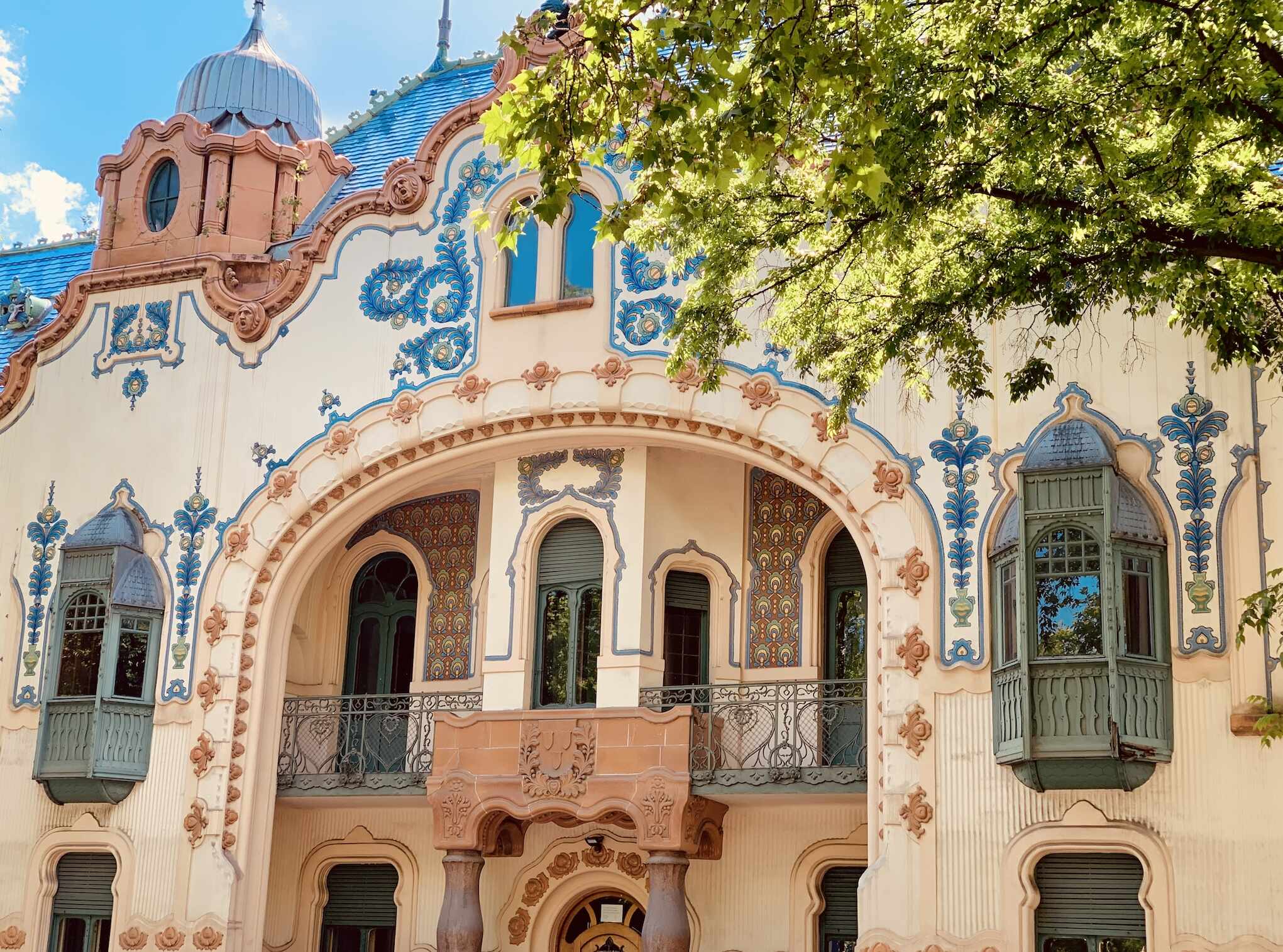
Finally, our last Art Nouveau stop of the day came at the tremendous Raichle’s Palace. Completed in 1904, this was once the opulent family home of the Serbian-Hungarian architect Ferenc Raichle. A man who, as it happened, constructed a handful of the city’s most impressive Art Nouveau structures.

The Art Nouveau Wonders of Subotica.
Within a year of opening, Raichle’s Palace had forged a reputation as one of the region’s most luxurious private residences and a wild party spot for the rich and famous.

Raichle’s Palace.
Indeed on any given day there were drinking competitions playing out in the smoking lounge and informal classical concerts unfolding in the massive courtyard garden. Furthermore, it was common for staff members to find some of Subotica’s most prominent businessmen passed out on the pink marble floor of its many corridors.
Raichle’s Palace.

The Art Nouveau Wonders of Subotica.
Such a state of affairs couldn’t last forever of course and in 1908 Raichle declared himself bankrupt. He therefore lost his dream palace along with many of his prized possessions which were sold off at auction. Today the building serves as Subotica’s quite magnificent Modern Art Gallery.

Raichle’s Palace.
It had been a fantastic day hunting down Subotica’s many Art Nouveau wonders. But we weren’t done yet with the city’s charms. There was still much more to see and do, not least with a memorable afternoon at one of Serbia’s prettiest lakes.

Like this? Check out my many articles from across Serbia.
I’ve been living, working and traveling all over the world since 2001. So why not check out my huge library of travel reports from over 40 countries.



56 Comments
Leighton this is some special architecture from a city that honestly (blush blush) I had never heard of before reading. So many gems throughout the post and then you go and (arguably) leave the best for last with raichle’s palace. Though I also have a soft spot for the golden lamb and the spectacular interior of the synagogue. Cafe Boss literally looks “boss” (Jenny uses this word to describe just about anything she approves of) both architecturally and with its fantastic looking dishes. 10/10 as always.
Cheers James. I also really like the Golden Lamb Hotel, even if it a much more understated building compared to many of the others. As for Raichle’s Palace, boy would I love to have been a fly on the wall for some of those epic parties back in its heyday. I have never seen a synagogue like the one in Subotica, it is like something out of Alice in Wonderland.
I have never heard of Subotica before. It looks to be a Serbian gem. The interior of the synagogue is wonderfully bizarre, but mostly I love all the trees. Maggie
Thanks Maggie, I’m really happy to have introduced Subotica to you. I hadn’t heard of the place either before relocating to Serbia.
Arrived at the synagogue only to find it closed. Nothing new there. Talked your way in for an exclusive ten minutes tour. Now that is a first, I believe. Truly great architecture everywhere, so colorful, like icing on cakes. Loved the whimsical statues in the Caffe Boss’ courtyard, especially the clown playing the violin. Although I must say the name of the Subotica Savings Bank Palace struck me as somewhat an oxymoron. It certainly looks palatial but I think I’d want my savings bank to look more frugal. Look forward to more in this delightful city.
Ha, you make the point about the savings bank very artfully Memo. I was over the moon that we blagged our way into the synagogue, I really wouldn’t have wanted to miss out on that. Just one more article on Subotica to come, see you same time same place next Sunday.
I’m really taken with Subotica, it looks so beautiful. The palace and the synagogue in particular are stunning. Pair that with a giant croissant with chocolate and jam dips, and I’m booking a flight!! 🙂
Thanks for reading about Subotica Han, it’s a city that definitely deserves a bit more online love. I could devour one of those giant croissants right now if truth be told.
Now those are PROPER leafy streets, they look so enticing. Your synagogue man was a superstar, wasn’t he. Top man. Great collection of superbly ornate Art Deco buildings, makes a city which I’m embarrassed to say I’ve never heard of, look so worth a tour. And diligent? Well I may never look at squirrels in the same way again.
Yes, diligent squirrels, I’m still trying to wrap my head around that. I guess that comes from the nut gathering? Thanks for checking out my article on Subotica 🙂
I have not heard of Subotica, but wow! Now I’ll need to check out this place should I make it to Serbia some day. Art Nouveau is such a pretty architectural style, and you certainly got lucky with getting into the Subotica Synagogue, even if for just 10 minutes! Adding this to my list of places to visit one day. Thanks for sharing, Leighton!
So glad you are taken by Subotica Rebecca, it is such a pretty place to wander and explore. 🙂
That is a lot of beautiful architecture and as you say it is a very green city. The Subotica Synagogue was quite impressive and beautiful. Your photos are gorgeous.
Thanks Thomas, it’s always fun and a privilege to be able to write about these places that are a bit off the beaten track when it comes to mass tourism.
Subotica looks like a special place! I love all the architecture, especially the synagogue. So happy you got to go in!! I need to explore this region next time I go visit Croatia.
I think tagging some of Serbia onto a Croatia trip is a great idea and one that not that many travellers eem to do. Subotica is just lovely and I’m also excited to share three more locations over the coming weeks that I believe represent the very best of the country. Cheers Anna!
Like most of your readers, I must also confess that I have never heard of Subotica. It certainly is a tremendously beautiful city. How fortunate that you were able to see the interior of the synagogue, which is spectacular. The blue pews and pastel highlights are very calming. The food looks delicious too. I’m looking forward to reading your post about the lake.
Calming is spot on Tricia, a stroll through Subotica’s mostly pedestrianised old quarter is just the ticket for a peaceful day of urban exploring. Thanks for reading about my time in this underrated corner of Europe.
A new one on me had to look that place up.
Outside of Serbia I doubt there are many who know what or where Subotica is.
The most beautiful city I have never heard of. What a gem, with its lush leafy green streets, its beautiful Art Nouveau buildings and many options for dining. Great job talking your way into the synagogue Leighton. It was so gorgeous. In 1984, we arrived at Versailles to find it closed due to a Public Workers strike. I used my best high school French to try to talk my way in, but to no avail. It was not until our 2007 trip we managed to see it. Thanks for sharing your visit with us. Happy Monday. Allan
Oh lord, you must have been absolutely gutted on that first attempt to see Versailles. The French and their strikes eh? I’m sure your 2007 experience more than made it up for it though?
I agree with Allan, what a beautiful city! The streets look so peaceful and lush. Glad you could talk your way into the synagogue so I could see it. I am not smooth like that, I get too nervous haha
I guess I was just refusing to accept defeat ha ha. Luckily it worked out this time. Thanks for reading Lyssy 🙂
Like you guys, we also love it a city with gardens (or tree-lined streets) – Subotica is a beautiful city … oh, and one I’ve never heard of! The Blue Fountain an eyesore? Oh, but I like it (though I usually prefer the more ancient looking fountains). The buildings are really beautiful – I like the colourful synagogue (but I wonder about the avocado colour hotel – couldn’t they find any other colour to paint it)? Now I’m ready to enjoy a late afternoon croissant (while I’m wondering whether you only enjoyed one of those “small” beers) …
I’m not gonna lie Corna, I love it that so many people had never heard of Subotica. I think they were saying that the blue fountain was only an eyesore with the ugly winter tarpaulin thrown over it, otherwise it is undeniably pretty. Ha I think the Golden Lamb is really cute, but I totally get it that the colour might not be for everyone. Yes, just one of those “small” beers for me. Another one and I’d have been dancing with the sculptures 😉
I am wowed with the architecture and culture of this small city. What a delight. I could spend hours in the Synagogue alone, it looks a truly inspirational place. It is well that you finally were able to see the interior, fortunate for you to meet the warden. Thanks for sharing this terrific visit.
Cheers Chuckster! Subotica certainly is one of those delightful finds. Tucked away in a somewhat unfashionable country in most traveller’s eyes and then well down the pecking order behind the likes of Belgrade and Novi Sad.
Your airbnb has some lovely details, the cat being the loveliest of all. The city of Subotica is a magical place with beautiful architecture and leafy streets. Raichle’s Palace is a gorgeous building, a perfect place to host an art museum. I also love the synagogue interior with its pastel hues. I enjoyed reading your article, Leighton, as always. Hope you are enjoying the summer!
Helena, it’s great to have you back! 🙂 Our guesthouse room was just perfect for our needs and a lovely kitty is always welcomed enthusiastically no matter where we stay. I’m glad you enjoyed reading about Subotica.
Wow, this is really unique! I love the pastel colors of the buildings. It’s too bad some of them are reconstructions rather than originals. Nonetheless, they’re impressive.
Yes, I agree. When I first read up on them and realised they weren’t originals I was quite disappointed. Then again, I think these reconstructions compliment the original buildings and are essential in giving Subotica the overall look it has. Thanks for checking out this underrated Serbian city Diana 🙂
Gorgeous! Serbia seems like such an underrated destination 😊
It definitely is underrated, even if there are some solid reasons why many don’t think to (or want to) visit the country. Thanks for reading and commenting! 🙂
How wonderful to have the synagogue just for yourself? Although for 10 min only lol
Subotica looks like a hidden gem, a quaint little city.
Yes ten minutes was not quite enough. But infinitely better than zero minutes which I was starting to fear would be our fate. Thanks for reading about our visit to Subotica Christie 🙂
The Art Nouveau architecture is stunning. Good thing you visited in the summer to enjoy all the greenery and see the Blue Fountain operational (instead of being hidden under a tarp). Talk about having fantastic luck at the Subotica Synagogue! The inside is gorgeous.
Thanks Linda. Yes, as luck goes we really hit the jackpot with the synagogue. Truly that guy stepped up for us and we’ll always look back at that moment as a highlight of our visit.
Oh be still my architecture loving heart! I can’t get over these beautiful buildings and their graceful and effortless appeal. The synagogue interior is absolutely stunning! Also I’m glad you happened to be there when you could actually see that fantastic blue fountain without the tarp over it. With the exception of the sad exhibit on the concentration camp- it seems like an all around great day full of beautiful places. 🙂
Ah so glad you appreciate the Subotica vibe Meg. I’m trying to picture the fountain with the tarp and can only feel grateful I’ll probably never get to find out for real. It was indeed a great day, one of those experiences where you go in knowing next to nothing and the place delivers beyond all expectations.
an architectural tour de force leighton. indeed another of the city’s “wonders” is that so few people know about it. you have done a sterling job of weaving the day’s narrative through these marvellous buildings and beyond. another wonderful read
Thanks Stan, I get a huge kick out of visiting places like this, especially when they turn out to be so beautiful. The word “underrated” often gets thrown out willy nilly but Subotica is definitely a city that fits the bill.
I’m delighted that Art Nouveau is back in favour and being promoted more and more everywhere, after being overshadowed far too quickly by Art Deco. However, I am still surprised that it spread so quickly in Europe, particularly among the elite, who adopted it rather than reproducing the same styles as previous generations.
Hey, thanks for your contribution. I am far from being an architectural expert but I’d say Art Nouveau is perhaps my favourite style. I’m surprised Subotica isn’t a little more well known, not only for its buildings but with its lovely lake featured in my next post.
Like some others, I’d never heard of Subotica before AND we’ve traveled to Serbia – shame on me! Thanks for the great introduction to such a lovely city.
Thank you so much Annie. I remember that you travelled to Serbia many moons ago and I can’t help but wonder what Subotica was like back then before its regeneration project.
This is really great
Uh huh, thanks for your comment.
Thank you for sharing. I am always here to support a fellow blogger and read their work.
Thank you
Thanks Tyrone, I appreciate the read and comment. Feel free to let me know what you liked about the article, or any observations you have. It’s always interesting to discover what people think in the comment threads. 🙂
It had never entered my head to visit Subotica but I just changed my mind in a flash. What a stunning looking city. I don’t ever remember seeing so many wonderful examples of Art Nouveau in one place. An absolute gem. Thanks for the tour 🤗🩵
Aw I’m so glad you enjoyed this article so much Jo. I also don’t believe I’ve ever seen so much Art Nouveau stuffed into such a compact space as Subotica’s old quarter. Thanks for contributing to the thread, it’s always appreciated.
What a wonderful post. Art Nouveau is one of my favourite styles and I’ve never seen so many examples in one place. It all looks beautiful.
Hey, great to hear from you Louise Jayne! Yup, if Art Nouveau is something that pulls your chain then Subotica is definitely the place to go. Thanks for reading and commenting 🙂
The art nouveau architecture is wonderful and so colorful! A stroke of luck to get inside the synagogue. It looks so whimsical, unusual for a place of worship.
It is such a delightfully odd synagogue isn’t it. Those colours and shapes could work well in a Wes Andersen flick. Cheers Ruth.