
Mediana: The Roman Ruins of Niš.

Mediana: The Roman Ruins of Niš.
December 2023.
“What have the Romans ever done for us?” I’m not sure how popular Monty Python is in Serbia, but somehow I feel this is a question the average Nišian would be unlikely to ask. After all, it was the Romans, or rather one Roman in particular, who has been largely responsible for putting the city of Niš on the map.

“What have the Romans ever done for us?”
You see, Niš is where Constantine The Great was born, though back in c. 272 the city was known as Naissus. Moreover, it was in the city that he constructed a grand complex of luxury villas, banquet rooms and gardens fit for a man of his magnitude.

Constantine the Great: Not amused by my Monty Python opening.
Archaeologists excavated precious remains of this once vast compound in the 1970s, which led to the site’s protection as a cultural treasure in 1979. Today visitors can rock up at the site, located on the outskirts of the city centre, and pay a negligible 500 RSD (just under $5 per person) for entry.

Mediana: The Roman Ruins of Niš.
It was a crisp Christmas Eve afternoon when we arrived. Initially at least there was nobody around as we paused at the start of the gravel path that leads to the archaeological site. This quietness, along with the day’s blue sky and mountain views, made for a really lovely moment.
Mediana: The Roman Ruins of Niš.

Niš is surrounded by mountains, these are the foothills of the Nišava Valley.
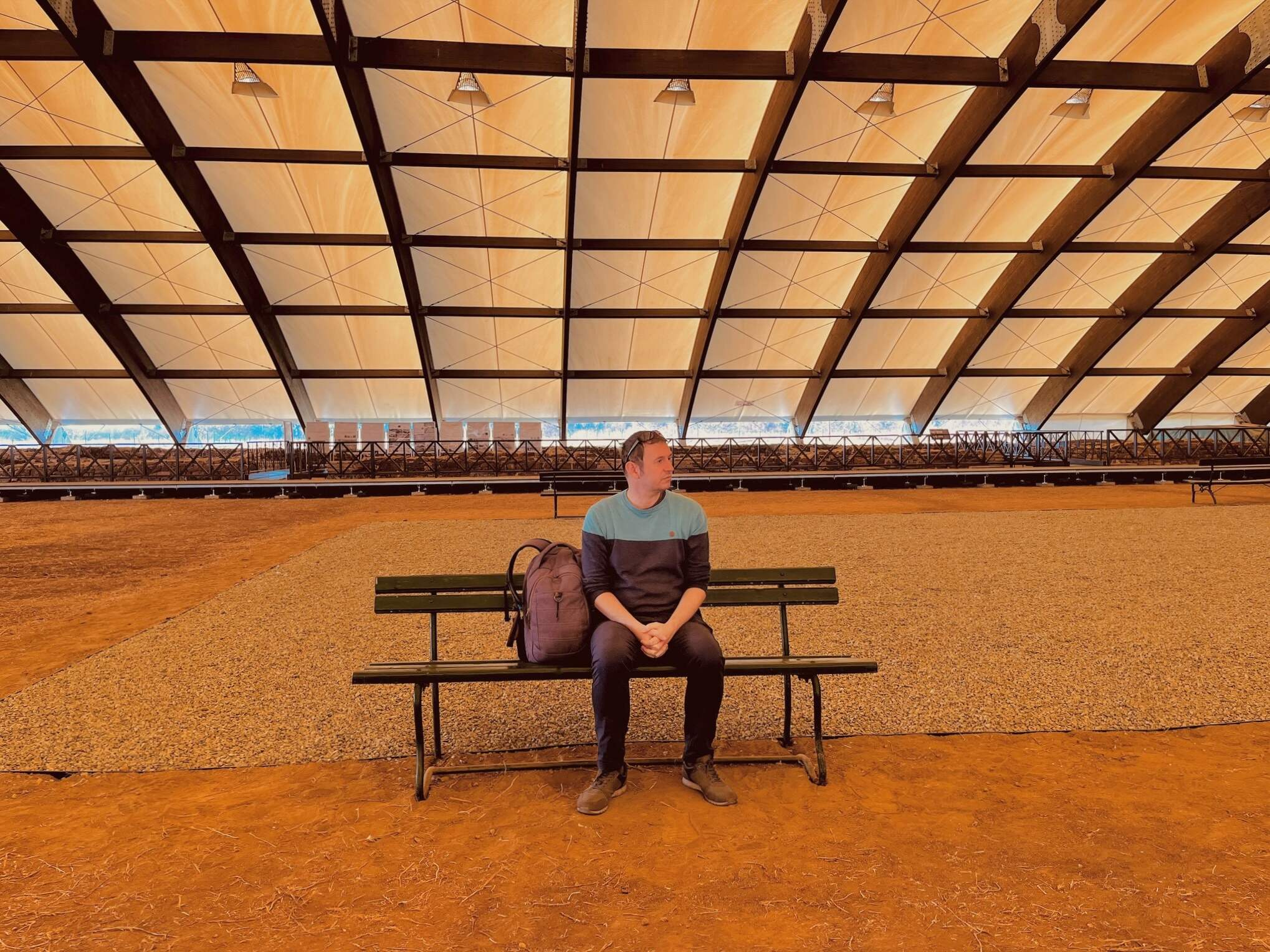
Sheltered under a flying saucer like structure, Mediana contains the remains of a grand palace, forum, church, thermal baths and storage buildings most likely used for grains. Its name derives from the latin word medius, which loosely translates as middle or central. According to historians, this suggests the emperor’s compound was a city within a city; a key Roman stronghold in the region.

Mediana: The Roman Ruins of Niš.
I’m gonna level with you dear readers, there isn’t much of a wow factor as you enter the excavation site. Rather, we found ourselves face to face with a modest expanse of ruins that only reveals its true beauty once you get up close and personal to seek out the details.

Mediana: The Roman Ruins of Niš.
What’s more, there is very little info onsite to give you a sense of what you’re looking at. Thus we resorted to Googling so that we could get a feel for what it might have been like back in its heyday. To read up on ol’ Constantine and get to know the man who once lived here.

Mediana: The Roman Ruins of Niš.
Flavius Constantinus (his birth name) was 34 when he became emperor. He reigned for 31 years until his death in 337, the natural result of a cocktail of health complaints. He was 65 years old at the time of his passing.
Constantine the Great
(27 February c. 272 – 22 May 337).

Mediana: The Roman Ruins of Niš.
As legacies go, Constantine the Great certainly left his mark in the history books. He was the first Roman Empire to convert to Christianity, after which he set about decriminalising the religion and promoting Christian practices in Rome. Furthermore, in 313, he issued the Edict of Milan in which he made Christianity equal to other religions of the Roman Empire.

Mediana: The Roman Ruins of Niš.
He also established the city of Constantinople, before declaring it the capital of the empire. This was a status the city went on to enjoy for over a thousand years.

Mediana: The Roman Ruins of Niš.
Ambitiously, he restructured the entire the government, separating the military from civil bodies. And it was he who established a brand new gold coin called the solidus, which became the standard Byzantine and European currency for the next millennium.

Mediana: The Roman Ruins of Niš.
Historians reckon Constantine built his grand villa in Niš as a summer residence. They also believe he came here throughout the year for state events and lavish feasts for high profile guests. Written evidence meanwhile suggests he passed some minor laws while here in the years 315, 319, 324 and 334.
Mediana: The Roman Ruins of Niš.

Mediana: The Roman Ruins of Niš.
Following his death, two of Constantine’s sons, Constantius II and Constans continued to use the compound and stay in the villa. The stronghold eventually met its end in 442 when Attila the Hun’s murderous hordes demolished the place during their devastating attack on Naissus.

Mediana: The Roman Ruins of Niš.
The highlight of our visit to Mediana was definitely its outstanding collection of mosaics. In fact, archaeologists discovered around one thousand square metres of tiles. Much of which served as flooring in the main villa, peristyle and banquet rooms.

Mediana: The Roman Ruins of Niš.
The mosaics were made from small, colourful pieces of stone, glass, and ceramic known as tessera. Primarily floral and geometric in design, they are exceptional examples of late Roman period decoration. Elements of Constantine’s beloved Christian symbology is also evident in places.

Mediana: The Roman Ruins of Niš.
We saw plenty of plants, flowers, fruits and animals, common symbols of abundance and prosperity in the Late Roman era.

Flowers!
One of the most impressive was this depiction of a river deity. An example, historians claim, of the blending of pagan and Christian iconography that was blossoming at the time.
The Mosaics of Naissus.

Don’t mess with the river god!
A somewhat startling discovery came in the form of this swastika mosaic. This, I had not necessarily been expecting. But of course the symbol was not uncommon at the time, as the Romans considered it a representation of sunshine, good fortune, prosperity and well-being.

Mediana: The Roman Ruins of Niš.
The site includes a tiny museum at the back of the complex loosely designed to look like a Roman temple.

Mediana: The Roman Ruins of Niš.

The onsite museum.
Built above the remains of a large banquet room, the exhibit inside has actual information (!). It also displays a section of mosaic specific to what they call Banquet Room A. Evidence suggests Constantine the Great enjoyed a particularly opulent feast here on August the 25th 334 to celebrate thirty years of rule.

Mediana: The Roman Ruins of Niš.
Records also state that Constantine had renovation works carried out on his villa and indeed guest villas ahead of the event.

The mosaic floor of Banquet Room A.
The museum’s highlight though is a handful of marble sculptures believed to have decorated the halls and bedrooms of the emperor’s personal villa. Or maybe even in his private baths. One is this fabulous Head of Venus, which archaeologists say likely belonged to a life-size statue.
Mediana: The Roman Ruins of Niš.

Venus!
Another is this Head of Satyr, a lustful, drunken woodland god from Greek mythology. In Roman representations it usually had goat’s ears, legs, a tail and horns. The Romans saw it as a symbol of nature, fertility and indulgence.

Mediana: The Roman Ruins of Niš.
Outside the museum we saw what was left of another banquet floor mosaic, the imaginatively named Banquet Room B. I do love the idea that only B-list guests could eat here, with only perhaps a fleeting cameo appearance from the emperor towards the end of the evening.

Mediana: The Roman Ruins of Niš.
Overall, I was glad we took the time to come and see Mediana. The entrance fee is reasonable and there are some stunning relics on display, I just think those who manage the place could do a bit more in terms of onsite information and presentation.

Mediana: The Roman Ruins of Niš.
When in Niš, I’d say it’s a no-brainer to come and see the place where Constantine the Great once ruled the roost. Where he ate, slept, partied, bathed and passed a few laws. Where it was unlikely that a group of rebellious goons ever came to shout: “What did the Romans ever do for us?!?”

Like this? Check out my many articles from across Serbia.
I’ve been living, working and traveling all over the world since 2001. So why not check out my huge library of travel reports from over 40 countries.



45 Comments
your nish series has been building up to this leighton so it feels like a fitting bookend to the collection. having a roman emperor born in the city is a stellar claim to fame especially for a city as unknown as nish. the site itself while modest is fascinating and i enjoyed learning about constantine of whom i knew virtually nothing. i agree that the mosaics are the main draw i am quite in awe of the river god!
Thanks Stan, I’m glad Mediana comes across as a worthwhile site to visit and write about. The river deity is indeed the pick of the mosaics I’d say. 🙂
I’d want to pay for several days and just stay there for a week. I imagine the ambiance changes throughout the day. Those mosaics are impressive one a time. To consider the entire scope is a bit mind boggling. It would take an army of artisans to create something on that scale. It must have been really eye-opening to get that close to something so “monumental” as the grounds where Constantine walked. Another post without Sladja but we did get her shadow this time.
Your enthusiasm is infectious Memo. I can imagine people entering the space and initially shrugging their shoulders. But there is definitely a magic to the site when one considers what once played out here and all the stories that must have died with that era. Ideally there would be more artefacts but what they do have is very cool, particularly the mosaics. Your comment about ambience has me imagining what a night visit would be like.
This is WAY cool! Stirs up many thoughts! One I have is how, as emperor of the big super power, he thinks enough of his humble origins to build a summer home in such a bucolic lovely founding place. “Props to the place I came from.”
A second thought is; Christian peoples may have been more ideal for an emperor to ‘manage’ politically. The obedient, penitent subjects beholden to one supreme god would fall in place significantly meeker than the chaotic traditional deities associated with Roman and Greek cultures. It may have been very astute of him to recognize this and use it to cement his empire.
Thanks for another great post and fascinating fotos!
Chuckster! You make some really interesting points, I had never considered the decision to bring Christianity into play as a tactical one. But what you say makes perfect sense and I wouldn’t rule out that being a part of Constantine’s motives. You are also right that he certainly wouldn’t have been under any obligation to build a grand compound in lil’ old Niš, which indeed suggests he had a lot of affection for the place.
Ah, Monty Python, the comedy that men love and women hate. Loved this show. The Roman Ruins of Niš are truly impressive, even if you just consider the mosaic tile floors. We saw some of these floors in our visit to the Roman ruins at Lyon. Unlike the museum here, they had a great deal of information to consume. Glad they have preserved the site and hopefully, they will add descriptions one day. Thanks for sharing Leighton. Happy Sunday. Allan
No surprise to hear that they have their act together in Lyon. As for Niš it just feels like laziness to me and no real excuse for it. But hey, I can be a world class grump when I want to. Your summary of Monty Python’s appeal is for the most part on the money, I wonder why that is.
The Romans were certainly advanced engineers! We have visited Roman ruins throughout Europe, and are always amazed at their longevity. Mediana is quite impressive as well, the tile work is stunning. I love how you wove Monty Python into your post. An entertaining and educational post; thanks Leighton!
Thanks Tricia, I’m sure you guys have seen some absolute powerhouse Roman ruins over the years. We’ve seen our fair share too and never fail to get caught up in the magic of the history.
Nice post 🌺🌺
Thanks. 🌺🌺
Welcome dear friend 🌺🌺
It’s an interesting site, with so few remains a whole part of ancient history can be brought to life. It’s a shame that there isn’t more information both on site and outside. I completely missed it when I was planning my trip to Serbia, and was hesitant to stop off in Nis.
I don’t think I could make a convincing case for coming to Niš just to see Mediana. Well, not unless you are some kind of Roman ruins fanatic. But of course the city itself as a bundle of sights is well worth a few days.
That was interesting history about Constantine The Great and Niš. I learned in one of your previous previous posts that, as you said above, Niš is where Constantine The Great was born. I find that a fascinating fact. As usual your photos are great.
Thanks Thomas, it’s amazing to me that the city isn’t just a little more on the map in terms of international tourism. And even more amazing that they can’t be bothered to create a proper exhibition onsite about the history of the area and indeed Constantine’s life.
Impressive! I had no idea that Constantine the Great was from Niš, but all the same, a visit to Mediana shows the greatness of the Roman Empire and those who ruled it. I agree that perhaps having placards or more information on the sites inside would better the experience, I’m sure that whatever you saw and admired left a lot to the imagination of what the Romans had done back in the day. Thanks for sharing, Leighton!
Thanks Rebecca. It is quite the claim to fame that Niš has and more than a bit baffling that locally they haven’t done much to bring everything to life. I’m sure at some point in the future they will re-think the site.
How fascinating! So much to see here. Just a shame you can see it but not really learn about it. It seems like it could have used with some signage or maybe the follow along audio guide things.
While I’m generally not a fan of awkward audio guides you are absolutely right. If ever a place was crying out for an audio guide or guided tour option. Thanks for checking in Anna!
Great piece Leighton. It seems that by writing this article you have provided a far better presentation than the folk who manage Mediana. Perhaps they could just print your work out and stick it on a board by the river lord mosaic.
Ha, I’d be open to that proposal if it ever came my way. I’m sure one of these years they’ll put a team together and create a proper exhibition that does Constantine and the associated history proud. Thanks for your comment James.
I’ve always been fascinated by the Roman Empire. I’d enjoy seeing the ruins even with the lack of intimation they provide. The flying saucer like cover is pretty neat too.
It’s funny how both this place and the archaeological recreation at Lepenski Vir are both housed in this space-age structures. I guess it kinda works, a modern almost extraterrestrial home for ancient relics. One for the conspiracy theorists.
It would be worth it to see all of those mosaic floors. They’ve become one of my favourite parts in Roman ruins. Constantinople was quite the forward thinking leader, but not too imaginative with his sons’ names. 😊 Maggie
Ha, If only he had been brave enough to randomly name one of them Englebert or something. I also find myself on the lookout for the nearest mosaic whenever I visit these kinds of sites.
Beautiful photo of Niš at the beginning of your post with the mountains in the background. Without your narration, the Roman Ruins would have been rather bland and uninteresting. But thanks to your research (googling), you treated us to good snippets of information. I’m a fan of mosaics – I remember how many beautiful floor mosaics from the Roman era we saw in Malta – and these at Niš is just as beautiful.
Thanks Corna. The ruins sit on the edge of the city near the surrounding mountains and it is indeed very pretty. It would have been nice to have done some hiking but alas time didn’t allow for it. I can imagine the Roman ruins in Malta are quite impressive, we saw some very cool sites on the Greek island of Naxos.
Pretty stunning examples of Roman mosaics here…there’s plenty of examples around the former Empire territory but Nis obviously boasts some fine examples. Wait a minute though….aren’t you just a little bit too young to know Monty Python, Leighton? Something your Dad told you about I suspect 😂
Glad you enjoyed the mosaics Phil. I don’t think my dad has ever been much of a Monty Python fan. As for being too young… err… it’s amazing, I also know all about The Beatles, JFK, Mohammed Ali, Shakespeare etc 😉
😂
It seems one of those places that is more important by what was there instead of what is there. It could probably be easily overlooked unless you actually get up close and dive into the history and then you realize what a power punch of history kind of place it is. Loved reading more on Constantine. And the fact that so many of those mosaics are so well preserved is incredible! Also any Monty Python reference makes for a great day 🙂
Cheers Meg, it is totally on those who run the place to do more with the site and create a situation where, when people enter, there is much more of a visual impact. The last thing visitors should be doing is shuffling around with uncertainty trying to figure out what’s what. Dare I say they could greatly benefit from a Smithsonian team coming in to advise.
That would be amazing to have such a site mixed with the know how of the Smithsonian team!
It’s too bad there wasn’t much information to tell you about the history of this place or the significance of some of these ruins. Good thing you’re a top-notch researcher though! The mosaics are quite beautiful.
Thanks for reading!
The elaborate mosaics are beautiful, and so detailed!
Thanks Allie! 🙂
Well I never knew this was where Constantine was born. And I love a good Roman mosaic, it’s amazing the quality they could produce without modern day tools. Turns out those Romans really did do quite a lot for us…
Maybe they should have added “mosaics” to the script in that scene in The Life of Brian. Thanks for your contribution Han.
Looks like Constantine left his mark in some ways there, although certainly not as much as in Constantinople. The mosiacs seem to be well preserved enough to be worth your trip.
It was definitely the mosaics that stole the show. The site has an incredible history, just a shame those that manage it can’t bring a bit more pizzazz to the presentation.
The mosaics are beautiful and seem very well preserved. The on site museum is a bit… well, I can see what someone was going for but it doesn’t quite hit the mark? As for what the Romans did for us, they gave the world the inspiration for Gladiator! What more could we ask?
Yes I agree about the museum, it just looks a bit cheap and tacky I think. Ah Gladiator, the Romans certainly did a lot for Russell Crowe. Thanks for checking in Helen!