
Snippets of Tianjin.

Snippets of Tianjin, China.
July 2009.
Around seventeen months ago I started publishing my short story series Challenged in China. Comprised of 18 tales from my first year in China (2009-2010), the collection documents my experiences living and teaching in Beijing in addition to the many travels I undertook across the country.

Old man in the isolated Chinese village of Zhujiayu in Shandong Province.
Now, at long last, I feel it’s time to add all those villages, towns and cities to my location reports library. Those of you who read the short stories when they were published may recall some of the places featured in this new series. Fear not though, there will also be additional photos and memories from those travels not included the first time around.

Snippets of Tianjin.
All the upcoming posts will be snippets articles. Which, as longtime readers know, means I don’t have many photos from those days and what shots I do have are not the best quality.
Back then my photos lay stored on an external hard drive. One fateful day I accidentally knocked it off a table, after which its contents could only be saved after a recovery process carried out by a specialist in Beijing. Sadly those rescued images are grainy thumbnails. #facepalm. Thanks to iCloud (launched two years later), such a disaster could never befall me today.
Travelling Around China 2009-2010.

“Please… save my photos!”
In any case, where better to kick off this new series than with a look at the very first location I travelled to on my maiden cross-country adventure in China. So without further ado let’s dive into my Snippets of Tianjin.

The port city of Tianjin, pictured in July 2023.
Photo courtesy of Kang Tyngrwey.
You see the above and below photos? That’s NOT how Tianjin looked when I arrived in the summer of 2009. Today it is nothing short of a megacity, a metropolis home to just under 14 million people that stands as China’s most important manufacturing centre. Oh, and Northeast China’s largest port to boot.

Tianjin’s Central Business District.
Photo courtesy of Kang Tyngrwey.
In 2009 Tianjin stood as something of an ugly duckling to nearby Beijing, which is where I arrived from by bullet train. The trip took around an hour, these days they’ve shaved it down to a clean 30.

Chinese schoolboys on the train to Tianjin.
On arrival I was met by a modest city that clearly had big plans and was very much in transition. Particularly in the central business district where the river came framed by a steel-and-glass backdrop of skeletal high-rises and angular cranes.
Snippets of Tianjin.

A city going places.
I stayed at the crappy Tianjin City Youth Hostel. This was the first of many shady lodgings I suffered in China. For the full lowdown on just how rubbish it was, I refer you to the short story link at the end of the article. From what I can see the hostel probably shut down in 2013 as there are no TripAdvisor reviews from 2014 onwards. I wouldn’t have thought many (if any) people mourned its passing.

I had no plan for Tianjin. Rather, it was just a case of walk, see and breathe it all in. The city was a convenient stop off on the way to Shandong Province where the bulk of those July travels played out. I’d been in China for less than a week, thus it was very much a case of acclimatising and greedily lapping up those first impressions of the country.

A cute girl playing in People’s Park. Crazy to think that she’ll be around 18 years old at the time of writing.
It’s hard to overstate just how darn excited I was. Everything felt so fresh and delightfully alien. That unique excitement that can only come from being young, impressionable and travelling a new country for the first time. I remember with fondness my first taste of Fanqie Chao Dan, a Chinese egg and tomato dish that is literally to die for.

Snippets of Tianjin.
Nor could I ever forget the restaurant I had it in. This was my first sighting of a framed Chairman Mao portrait and that first sensation of having a spotlight fall over me as everyone in the room sat staring in open-mouthed fascination.
Snippets of Tianjin.

“You’re not from these here parts are ya?”
Soon after, in the business district, I had my first experience of people stopping me to ask for a photograph. The father was nothing short of over the moon when he found out I was from London. It was a lovely moment, but of course I had no idea that this was little more than a novelty that would very quickly wear off.

Snippets of Tianjin.
Tianjin was also the city that first enlightened me to the great contrasts of travelling around China. Of how in any given street there would be Armani-bag carrying fashionistas striding past grubby street food vendors dressed in little more than rags.
On one road there would be piles of trash and the most foul-smelling sewer imaginable. On the next boulevard, an absolutely spotless sidewalk thanks to the ongoing attention of an ever-present street cleaner.

Snippets of Tianjin.
Reading about today’s city centre attractions in Tianjin, I see a bunch of stuff that didn’t even exist back in 2009. However, one landmark that was around during my visit is the towering 180-tonne Century Clock. Built specifically for the turn of the millennium, this metal giant first rang its bell at midnight to welcome the year 2000.

Snippets of Tianjin.
Twelve sculptures representing the signs of the zodiac surround the quartz clock face. Every morning it plays the song Dongfanghong (The East is Red), China’s unofficial national anthem at the height of The Cultural Revolution.
The Century Clock.

Snippets of Tianjin.
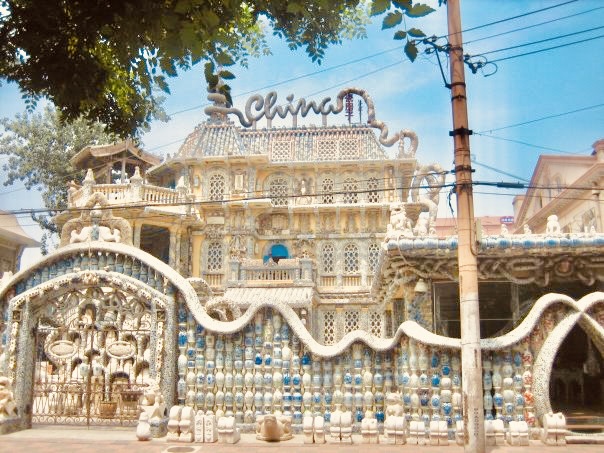
Another structure that certainly catches the eye is Porcelain House, an art museum with a focus on pottery and antiques. Originally an old colonial building, the eccentric artist Zhang Lianzhi purchased it in the late 1990s. Then set about transforming it into today’s visual extravaganza using damaged porcelain.

Porcelain House.
Visitors can wander through the house for a modest 60 RMB entrance fee (around $8.50). The centre showcases some of the region’s most impressive porcelain, old and new, in addition to antique furniture and art.

Snippets of Tianjin.
For the most part Tianjin felt like an unapologetically modern beast. A city where traditional buildings and hutongs were rapidly giving way to a mushrooming sprawl of malls, office blocks and shiny skyscrapers.

Snippets of Tianjin.
Photo courtesy of Kang Tyngrwey.
Still, there were a few surprises here and there. Such as the Roman Catholic St. Joseph Cathedral, completed in 1916. Apparently all the bricks were shipped over from France. And what sturdy bricks they were when you bear in mind the cathedral managed to survive the devastating 1976 Tangshan Earthquake.

Snippets of Tianjin.
Moreover, I got to sample the city’s last standing collection of traditional Qing buildings (although many were replicas) on the pedestrianised Guwenhua Jie (Ancient Culture Street).
Snippets of Tianjin.

Ancient Culture Street.
While not as authentic as some of the stunning traditional architecture I would see across my later travels, it was definitely a happening street packed with craft shops, food stalls and upmarket lantern boutiques.

Snippets of Tianjin.
Much of that Tianjin stay played out getting to grips with the local food scene. After the resounding egg and tomato success I also paid a visit to Goubuli Restaurant, a renowned Tianjin eatery with a history of serving customers since 1858.

Snippets of Tianjin.
It still makes me chuckle to think of just how raised my eyebrows had become while leafing through Goubuli’s menu. Figuring there would be time to get adventurous later, I settled on a round of the house speciality, Baozi.
The steamed buns that arrived a short time later came individually served in beautifully presented wooden containers. One was filled with soft juicy pork, another with tender flavourful beef, a couple stuffed with crunchy mixed veg and herbs.

Goubuli!
Further culinary delights awaited at Nanshi Food Street. an indoor arcade where over 100 establishments offer just about every manner of Chinese cuisine imaginable.
Snippets of Tianjin.

Nanshi Food Street.
It was here, in a restaurant whose name has long been lost to the vaults of time, that I tried my very first fiery Kung Pao Chicken.

Kung Pao Chicken.
And where I was introduced to Mahua, a sweet dough twist deep-fried in peanut oil.

Mahua.
That experience in Nanshi Food Street was a memorable one, albeit not always for the right reasons. To find out more about my time in Tianjin and the culture shock of my early travels in China, check out my short story Give Me Money!
Like this? Tap into my vast library of location reports from all across China.
I’ve also written a short story series called Challenged in China!
I’ve been living, working and traveling all over the world since 2001. So why not check out my huge library of travel reports from over 40 countries.



59 Comments
Fascinating Snippets of Tianjin indeed! Thanks for sharing…
Thanks for reading Chuckster!
Such a shame your photos were damaged, but you still give us a good sense of how the city was back then. I particularly enjoyed your description of the meals you ate – the baozi look and sound especially delicious!
The loss of those photos haunted me for years ha ha. Seriously. Glad you enjoyed this brief look at Tianjin Sarah. I feel the food is always a highlight wherever you are in China and Tianjin was a lovely early voyage of discovery in that regard.
I remember the day of the hard drive incident well. A tragic moment that shamed our family. Crazy to see how the world has changed in such a short time. Travelling around, Lonely Planet book in hand, seems like retro stuff now.
Yes, I would like to take that one step further and suggest the loss of those photos was also a dark moment in modern history. In many ways the British economy has never truly recovered. It is almost incomprehensible how the nuts and bolts of travel and indeed daily life have changed beyond recognition in just fifteen years. I loved those LP guides, now I’d just view them as unnecessary weight in my baggage.
I remember reading your stories from China, very entertaining – and the poor accommodation stories, I remember those too! You obviously caught Tianjin at the start of its rebirth by the sound of it.
Very much so Phil. Friends have told me that the Tianjin I knew is pretty much gone. I rarely go back to the same place but if I ever return to China I might feel tempted to include the city on a new travel route. Especially as it’s so close to Beijing.
Another great visit to this part of the world. I can imagine the differences between good and bad areas would be pretty pronounced as the great March forward moves on to modernity. Nice that that crappy hostel is gone. I always salute the demise of the crap places we have been stuck with. We experienced a similar version photo novelty when we toured Japan in 1982 and 1984. In some cases, many kids had never seen blond people before. Everyone wanted a photo and to try out their English. Thanks for sharing and have a great day Leighton. Allan
Ha, blonde hair is something I remember several Chinese friends being fascinated by too. Blue eyes, being fairly tall, the size of noses in the west, these were equally popular attributes in the eyes of many I have worked with. Yes, we should all celebrate the deaths of the shitholes that were so consistently crap the reaper finally came for them. Cheers Allan.
Excellent post 🌺🌺
Thank you 🌺🌺
Welcome dear friend 🌺🌺
An interesting sounding city, but has gone like many of these Chinese cities, into modern centres. Too bad about your pictures, I remember reading about them. But you have a good memory without them. Maggie
I did consider dropping this series, but I’m too much of a completist, ha. Yes, China’s drive into the future, often with communities who are not quite ready for it, remains relentless. Thanks for checking in Maggie.
You were lucky enough to witness the beginning of China’s radical transformation, at least in its urban planning. If I went back to Beijing, I probably wouldn’t recognise much of the traditional districts I’d passed through. One thing that hasn’t changed is the Chinese cuisine, which is still the same.
I think I can live with that, as for the most part I love the food in China. Yeah, so many of Beijing’s traditional neighbourhoods and hutongs have long been reduced to dust. Every time I go back I see how much it has changed. My last visit was 2018 so I’m guessing the next time will be the biggest contrast of all.
Welcome back. This post serves as an excellent before and after example of your travels in China. I loved the picture of the smiling old man sitting on the wall when I first saw it and still do today. So glad you were able to incorporate food from the beginning. It’s a universal experience that never gets old. Looking forward to more.
You’re a real trooper Memo as I think you saw this particular series of location reports in their initial (crappy) versions some years back. Then of course there’s the crossover with the short stories. I promise that you’ll be rewarded with some 2014-2015 and 2017-2019 China articles one of these years.
Tianjin seems to have changed dramatically since your time there. I enjoyed reading about your time there and seeing your photos. The food looks fabulous. That’s a bummer about your photos, I imagine you had some great shots. Unfortunately, I can relate. When my daughter was in Bangladesh, she also had locals wanting photos with her; her red hair seemed to fascinate people. Thanks Leighton, I always enjoy your post.
Thanks Tricia. I’m sure Bangladesh was an incredible adventure, did she go for work or travel? You never really hear of people going to explore Bangladesh.
You’re correct, Bangladesh isn’t exactly a tourist destination. Our niece and her husband worked there for a while; he is an infectious disease physician and our niece is a project manager for an international humanitarian organization. They invited Alexis to spend time with them and assist them each in their work. It was a great experience for her.
A fantastic experience indeed!
Nice to hear about your time in China back in the day once more! Tianjin is a place I haven’t been to before, but it looks lovely and I appreciate this post on a slice of daily life in the city. The photos look pretty good, despite the nearly 20 years, and I look forward to more recounts of China from you!
Thanks Rebecca, with the end of this series I shall finally have 2009-2010 fully blogged. It’s been a long road.
Ahh back to the China posts! Always fun stories to tell from there!
Cheers Anna!
It is amazing to see how Tianjin has developed. From that obscure little city in your photo to a city with lots of big skyscrapers and14 million people. You tried dishes I’ve never heard of but I find it amusing that you tried your very first fiery Kung Pao Chicken at that restaurant you forgot the name of. I’ve been eating Kung Pao chicken, some fiery, all over the US and Germany for three decades. Anyway, it was another very interesting travel blog post.
Kung Pao Chicken was one (of very few) Chinese dishes I’d eaten before coming to China. It’s a staple of so-called British-Chinese cuisine and while I had always enjoyed the dish it simply cannot be compared to anything you’d find in China. Great to know it’s something of a favourite for you Thomas, I’d like to try U.S. and German versions someday.
Considering your photographic challenges I would say you did a good job with this one Leighton. There is a certain privelege I believe in visiting a city on the cusp of an industrial boom. How special it would be to return one day and try to piece together pieces of that old puzzle.
Thanks James, it was a special time to visit the city in many ways. Even if perhaps I didn’t fully understand or appreciate that at the time.
It must be great to look back on a time when things were so much different than they are now (besides being younger, the place has also changed quite a bit). For example, I like the photo of the cute little girl who is now an 18-year-old young lady – and probably no longer as carefree as she was in the photo here. I suspect the Century Clock could be standing for years to come – imagine how people will look at it when the year 2100 arrives … They’re going to talk about “that antique clock that’s a 100-year-old”. I can see you definitely enjoyed the food – in my opinion, the most fun part when exploring a new city.
Hey Corna, I’m glad you also see the ‘magic’ of the little girl shot. It’s mind-blowing to me to think about how generations have grown up (and indeed passed on) in what is such a relatively short passage of time in the grand scheme of things. In just fifteen years Tianjin seems both “just like yesterday” but also a lifetime ago.
It’s amazing how much the city has changed! I am very glad for modern technology allowing us to take and store as many pictures as our hearts desire. I bet all that food was incredible.
Like you I treasure tings like iCloud, I so wish that had been around back in 2009. We really miss authentic Chinese food and have only managed to find two restaurants offering the real thing in the last 5 years of travel together. Thanks for dropping by Lyssy!
Interesting read Leighton, thank you! We are looking into ALOT of ideas for places to visit next year, Tianjin looks like it has made the list. 😊📌
That’s great to hear, thanks for reading and commenting!
Agh for your hard drive to fall and be so damaged is frustrating. Your voyages in China look such a world away from today’s modern technology, it’s nice seeing it in a quieter time without everyone with phones in their hands!
Thanks Han. You’re right, it was a whole other world and just a short time ago really. Makes you wonder where we’ll be with it all in fifteen years now from now. Thanks for reading about my time in Tianjin!
Ugh, sorry to hear about your hard drive. I had a similar experience, except it was with my laptop. Most of my travel pictures were fine, but I lost a lot of family pictures. Now I seem to be more than making up for not taking enough pictures during my earlier years of travelling! Even without all your pictures, I’m sure it was fun to take a trip down memory lane and remember your earlier days of living and working abroad. The Porcelain House looks lovely.
Oh no, losing family photos must have been heartbreaking. Yes, we are like you in that we often tell ourselves we need to tone it down a bit on the photo taking front. Every time I get round to doing one of my blogs I have a gargantuan photo editing task in front of me. But hey, it’s also good to have a vast array of shits to choose from. Thanks Linda 🙂
Ah, the joys of first exploring in a new place… The food arcade sounds like a treasure trove, and the bun, so beautifully presented, reminds me of (just a hint of) Japanese food presentations. A shame about the photos, but you’ve recovered enough to tell the story.
Thanks Ruth, I am glad that I’m managing to push this series through despite my initial doubts.
This seems like an exciting modern city to explore, and the Porcelain House is stunning. Also, the cuisine looks delicious and fresh!
Thanks Allie, the Porcelain house is definitely one of those unique sights that stops you in your tracks.
Good to be accompanying you back to China again! I had a photo disaster too. Back in those days it was rolls of film. I was on my last travelling day in Arequipa before returning to my base in Lima. I guess I relaxed a little too early for someone whipped my bag full of dirty clothes and my rolls of film. I was left with only an artisan teapot and cups I bought for my girlfriend. Although I don’t now have the girlfriend (who indeed became my wife), I still have the tea-cups.
What a tale Geoff, at least you still have mementos from that time, which I’m sure you treasure.
bravo leighton for getting this series off the ground in the face of such photographic limitations. like rebecca i think the photos you have shared stand up well. the image of the little girl is priceless and the pervading nostalgia that you do so well exudes warmth throughout. the porcelain house is absolutely intriguing and i imagine stop most people in their tracks.
Thanks Stan, the Porcelain House is a helluva creation, wish I’d taken the time to tour the interior. Next time, etc. Cheers for the read and comment, it’s always appreciated!
That ferris wheel over the river looks so cool!
Glad you like it, these ferris wheels seem to be all the rage these days for any self respecting city that wants to put itself on the map.
What a great first impression of a new country. I really love the Century Clock- it looks like it would fit perfectly as the scene of a time travel series. And the porcelain house is beautiful. I love when people take old and broken things and turn it into something so beautiful. Proof that there is beauty in the imperfect. And of course the food looks amazing. Great tour around Tianjin 🙂
The Century Clock definitely has a steampunk quality to it, I can actually picture it in a Dr. Who episode somewhere, that’s a good call Meg. Thanks for joining this new series! 🙂
It is amazing how much you remember all of your first impressions and details of trips from quite some time ago! Do you write everything down in a journal of sorts? This seems like a very impressive city – especially with all the contrasts you talk about, and I can’t imagine how different it must be now compared to 15 years ago!
Hey Juliette, thanks for checking in at the start of this new series. I have never kept an actual journey but rather jotted down photo notes that have helped to jog the memory. In truth this journey feels like it was yesterday and at the same time like several lifetimes ago. Thanks for reading my Snippets of Tianjin!
Your journey through Tianjin in 2009 offers a vivid glimpse into a city in transition, blending old-world charm with the rapid modernization that defines much of urban China. The anecdotes about navigating the local food scene, from the simplicity of Fanqie Chao Dan to the refined baozi at Goubuli Restaurant, highlight the culinary richness of Tianjin. Nanshi Food Street sounds like a feast for the senses, offering a first taste of fiery Kung Pao Chicken and sweet Mahua twists.
Your descriptions of Tianjin’s landmarks, like the towering Century Clock, the porcelain-encrusted Porcelain House, and the pedestrian-friendly Ancient Culture Street, paint a picture of a city balancing its historical roots with ambitious development. The contrasts between sleek skyscrapers and bustling traditional streets reflect the dynamic character of Tianjin during that era.
Your reflections on early culture shock and the excitement of those first travels through China add a personal and relatable touch. It’s fascinating to think how much the city has transformed since your visit, but your memories capture a unique moment in time. For anyone curious about China’s evolving cities, your experience in Tianjin is both insightful and engaging.
Wow… this certainly isn’t your average blog comment. If I take it at face value I should say thank you very much for the kind words and for taking so much from the article. If I’m being a touch cynical (and I have been known to do that) I would cheekily ask… are you AI? Just in case you’re not, thanks again for the read and comment, it is much appreciated.
I can sense your excitement and wanderlust in this article that chronicles the beginning of your travel in China. I do believe that 2009 was an amazing year to visit China that was standing on the brink of modernisation and opening up to the world, a society in transition. Tianjin sounds like a fascinating city with lot of distinct influences melded together. The shot from the restaurant with Mao’s portrait is pure gold. A vanished world, perhaps?
Thanks so much Helena, your positivity is infectious! It was a special time to be in China I think, though that’s something that only became clear in retrospect. A vanished world? In part yes, and certainly within Tianjin’s own context.