
Beijing’s Forbidden City: Where Emperors Walked.

Beijing’s Forbidden City: Where Emperors Walked.
April 2010.
Sorry to tear you away from Montenegro folks, but as I reach the halfway point of that series I figure it might be a good time to hit the pause button and return to my China (2009-2010) files.
Time flies, faster and faster as we get older, and somehow I see it’s been over seven months since I published my cross country travels in Tianjin and around the many cities, towns and villages of Shandong Province in the summer of 2009.

At The Confucius Temple in Qufu.
Between September 2009 and May 2010, I taught English at a private language school in Beijing. As some of you may recall, I chronicled those teaching experiences in my short story collection Challenged in China. Now it’s time to tackle the next piece of the puzzle: a cluster of location reports on my time exploring the Chinese capital.

With my Chinese co-workers Kevin and Nini.
It only feels right to kick off with what is arguably Beijing’s biggest draw. Indeed The Forbidden City offers visitors a rare and fascinating glimpse into the beauty and grandeur of imperial China. Once the exclusive domain of emperors and their chosen ones, its vast courtyards, ornate halls, and intricate carvings evoke centuries of dynastic power and ceremony.

Beijing’s Forbidden City: Where Emperors Walked.
Moreover, this is the world’s largest palace complex. It stands not only as a UNESCO World Heritage Site, but also as a symbol of Chinese identity, tradition, and architectural mastery—making it a quintessential stop for anyone seeking to understand China’s history.
Beijing’s Forbidden City: Where Emperors Walked.

A protruding wing of The Forbidden City’s Meridian Gate.
Photo courtesy of Haluk Comertel.
I’ll admit, there was a definite thrill in joining the long queue outside the main entrance—The Gate of Heavenly Peace. This, after all, is where Mao Zedong proclaimed the founding of the People’s Republic of China in 1949.
As if that moment in history didn’t carry enough weight, I could feel the eyes of Mao himself—looming from his iconic portrait—joined by a very real, very stern security guard. I figured I’d better be on my best behaviour.

Beijing’s Forbidden City: Where Emperors Walked.
I had no illusions about how intense visiting The Forbidden City would be. I knew the place is packed almost every day of the year, swarming with tourists. Most are Chinese, travelling from all corners of the country to experience what many see as the symbolic heart of their nation.

The Gate of Supreme Harmony.
I’ve never done well in crowds, so I quickly set off in search of a quiet corner—somewhere I could soak up the history, observe the melee, and discreetly snap shots of my fellow visitors.

Deep in thought.

Finding his place within the throng.
Built between 1406 and 1420, it was the Ming Dynasty era Yongle Emperor who announced the construction of the compound. According to historians, no less than one million workers helped build the palace.
Over the centuries, the city-within-a-city grew and grew as the lavish home of 24 emperors. The last of those, Puyi, abdicated in 1912 following the Xinhai Revolution.
The Yongle Emperor.

Yongle: “There are ONE MILLION of you. Is this palace ready yet?”
Upon completion, the emperor’s centrepiece structure was the dazzling Hall of Supreme Harmony. It was also the largest building in the compound, and remained so throughout history. Containing a large throne room, this is where Ming and Qing dynasty emperors performed the rituals of state. We’re talking coronations, birthday bashes, wedding announcements and Chinese New Year ceremonies.

Beijing’s Forbidden City: Where Emperors Walked.
Let’s be clear, the Hall of Supreme Harmony was not a place of day-to-day governance. Rather, it served as a stage for power, designed to awe and inspire. And that is certainly the effect it had on many of the visitors that day as they pushed and scrapped for photo opportunities through several open doors.

Crikey.
Luckily, I managed to get a shot of my own. It took some nerve, plenty of patience and a bit of luck as suddenly some space cleared and I took my chance. It was cool to see the famous Dragon Throne where, emperors like Xuande, Zhengtong and Jingtai once ruled the roost.

Beijing’s Forbidden City: Where Emperors Walked.
Those last two emperors I mentioned were central players in one of the spiciest chapters of The Forbidden City’s history – a real dynastic soap opera. Let’s start with Emperor Zhengtong, who took the throne in 1435 aged… wait for it… 8 years old. For the following decade he relied heavily on advisers, but was just starting to become his own man when, aged 22 in 1449, disaster struck.
Beijing’s Forbidden City: Where Emperors Walked.

The Zhengtong Emperor.
This was when he led a failed military campaign against Mongol forces that resulted in him being captured at the Battle of Tumu. With the emperor taken hostage, the Ming court back in Beijing found itself thrown into chaos. Ministers panicked at the thought of the Mongols using the emperor as leverage to invade.

Beijing’s Forbidden City: Where Emperors Walked.
Eventually, they decided to simply depose Zhengtong and install his younger brother Jingtai in his place! So technically there were two emperors, what a hoot. Jingtai, who ruled for the next eight years, didn’t do too bad a job, showing strong civil governance and generally stabilising the Ming Dynasty.

A Ming Dynasty soap opera.
However, in 1457 the Mongols released Zhengtong, who promptly staged a dramatic coup. With the help of loyalists, he slipped into the Forbidden City under cover of night, overthrew his brother Jingtai, and reclaimed the throne—this time under a new reign title: Tianshun. As for Jingtai, he died shortly after of a convenient “illness,” though most historians suspect foul play. Would make a great Netflix series.

Beijing’s Forbidden City: Where Emperors Walked.
Among today’s approximately 980 surviving buildings, the Palace of Heavenly Purity is another big draw. Originally used as the emperor’s living quarters, it later became a sort of day office or reception area during the Qing Dynasty years.
Palace of Heavenly Purity.

Beijing’s Forbidden City: Where Emperors Walked.
There is a dragon throne here too, though this one was more functional rather than ceremonial and therefore used for acts of official governance. The sign that hangs above it translates as upright and honest, or just and open, a reference to how the emperor should rule.

Beijing’s Forbidden City: Where Emperors Walked.
There’s more than a little irony behind this bold proclamation. Because just behind the plaque, a succession of Qing emperors hid a sealed box containing the name of their chosen heir.
The tradition was introduced by the Yongzheng Emperor in the early 1730s, part of a secretive protocol designed to prevent power struggles. One can’t help but smile at the thought of the empire’s most closely guarded secret tucked behind a declaration of transparency and honesty.

Beijing’s Forbidden City: Where Emperors Walked.
As I made my way between the various courtyards and halls that day, I witnessed the curious sight of locals reaching out to make contact with some of the many giant bronze water vats on display. These massive cauldrons were fire prevention vessels filled with water in order to extinguish any fires that might break out. Regarding the touching, many Chinese tourists believe physical contact with a vat can bring good luck and wealth.
Water Vat (水缸, shuǐgāng).

Beijing’s Forbidden City: Where Emperors Walked.
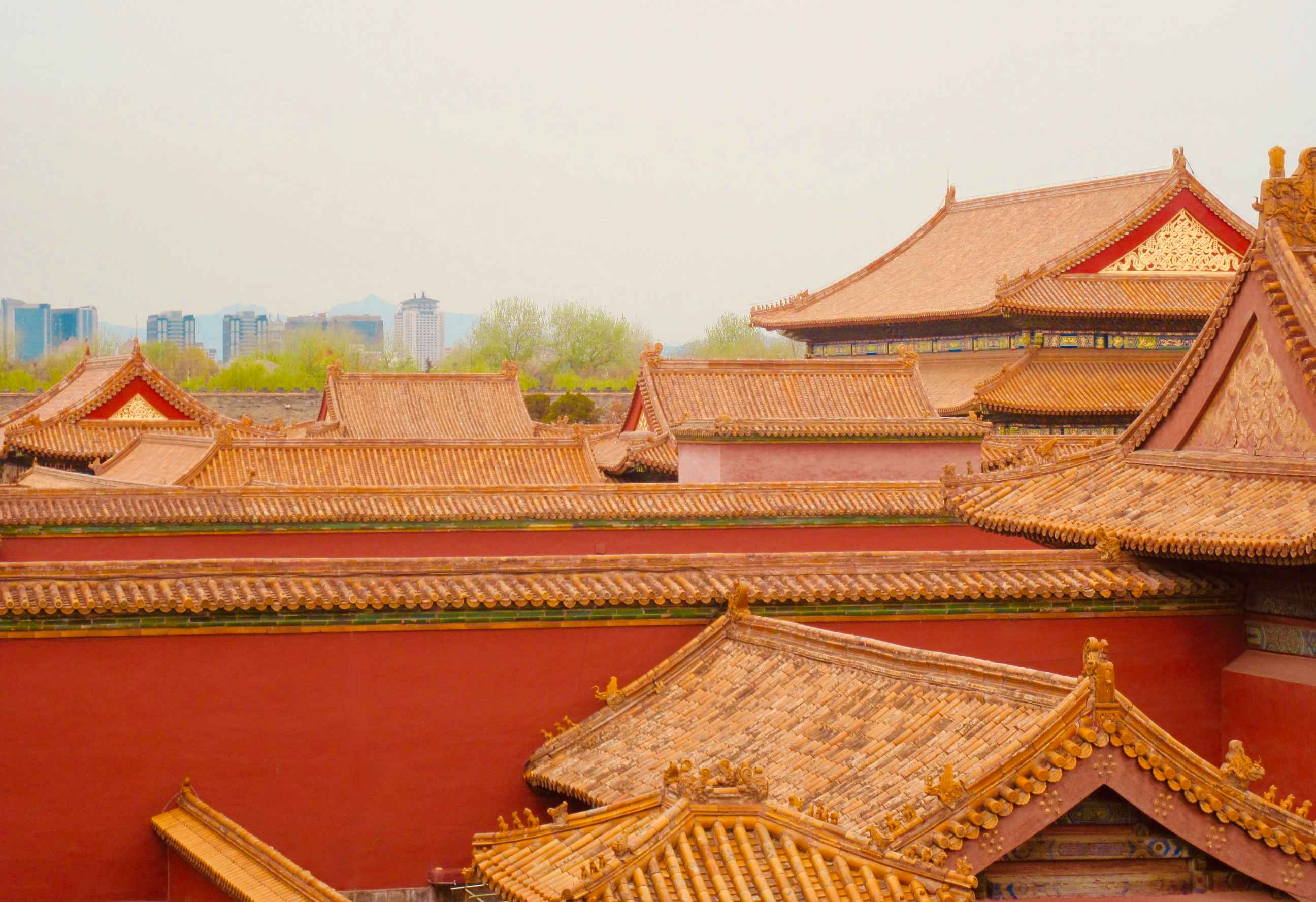
As impressive as the courtyards, halls, thrones and bronze vats were, my favourite moments came from simply admiring framed angles of the Forbidden City’s vermillion walls and golden-orange rooftops.
For that, we can again thank the Yongle Emperor, who envisioned the palace as a reflection of cosmic order—an earthly mirror of heaven that reinforced the emperor’s divine status as the son of heaven. The vivid red symbolises happiness, good fortune, and imperial authority, while the glazed yellow tiles represent the centre of the universe in traditional Chinese cosmology.

A magical skyline.
Finally, my wanderings took me into The Imperial Garden at the northernmost end of the city. Oh my god, if I had thought it was busy before, the garden served up some next level chaos that initially left me startled. Ironically, this would have been the emperor’s oasis of tranquility back when it opened in 1417.

Beijing’s Forbidden City: Where Emperors Walked.
Conceived as a symbolic microcosm of harmony between man and nature, I can’t help but conclude that the emperors would have been disgusted by the prospect of giant tour groups and their flag-waving, loudspeaker-wielding guides.
Beijing’s Forbidden City: Where Emperors Walked.

The Imperial Garden.
Covering around 12,000 square metres, the garden is a carefully curated landscape of ancient cypress trees (some of them curiously deformed), ornamental rockeries, flowerbeds, and winding pebble pathways. Unfortunately, exploring it (and indeed appreciating it in any way) became an impossible task due to the noise and lack of space. A good time, I decided, to cut my losses and exit the compound in search of some dinner.

Beijing’s Forbidden City: Where Emperors Walked.
Like this? Check out more of my location reports from across Beijing.
To travel further afield, why not have a read of my travel articles from all around China.
I’ve also written a collection of short stories called Challenged in China.



.jpg)
43 Comments
Good on you for sticking it out in that throng. We often think we have been to popular, crowded places, but even during your 2009 visit, you have them all beat. I have been on several tours with people from China and it seems they react the same in many less crowded situations. Their delicate suggestion you have held the photography spot too long is a hand on your shoulder pulling you out of the way. The place is gorgeous as any Emperor would require from his 1,000,000 construction minions. I wonder if they got wages for their endeavours or were simply allowed to live. Thanks for taking me to a place I will never get to see. Happy Sunday Leighton. Allan
Ha, I have seen such “delicate suggestions” but luckily have never been on the receiving end of one. I’m not holding out much hope for the conditions of those poor souls who had to build the Forbidden City. Tough gig. Thanks for kicking off the comment thread Allan, I’m glad you enjoyed your ‘visit’.
Lovely shots
Thanks 🙂
I really enjoyed this post and the accompanying photos are stunning. As someone who has explored Beijing and The Forbidden City, this line really stood out to me “I had no illusions about how intense visiting The Forbidden City would be.” It is such an intense place to visit and unfortunately, I don’t think tourists truly understand that before visiting!
Ha, thanks for the quote back, I’m glad you enjoyed the read and that the intensity of the experience resonated with you. I appreciate your contribution to the comment thread!
I have visited the Forbidden City twice, on two different trips to Beijing. Maybe it was the crowds, or the heat, maybe it was because all the buildings were closed and it was difficult to see inside, but I’ve never really enjoyed the site. I see you had as many tours visiting as I remember. It must be non-stop tours. Sorry, for being so negative 😊 Maggie
Ha, no worries Maggie, you’ve gotta keep it real. I agree that the “experience” leaves a lot to be desired. It’s a pity, because the compound is fabulous in terms of the architecture, art, scale and preserved history. Imagine getting to stroll through the joint by yourself, that would be a beautiful (and impossible) experience.
Nostalgia…Christmas Day, 2006, with my daughters. Have just hooked up an old portable hard disc with the photos……. ahhhhhhh!
Glad to have brought back some memories Geoff.
What an amazing place and what interesting history and as usual the photos are great. I do remember that you taught English at a private language school in Beijing, and I vaguely remember your previous posts. I did not know that the Forbidden City is the world’s largest palace complex, but it does not surprise me. One million workers building the palace is pretty impressive. I’ve never been to China but my younger son used to have a Chinese girlfriend and he visited the Forbidden City with her. Her parents had an apartment in a circle, what ever that meant. I think it was the second circle, but I am not sure.
Hi Thomas, I’m glad you find the Forbidden City such a fascinating place. Did your son live in China for a while? I think you might be referencing ‘The circle’, which talks about the central neighbourhoods within Beijing’s iconic ring roads, a dizzying network of concentric highways encircling the city. I think there are seven rings in total! The Forbidden City surely must be within the first circle, but I’d have to double check that. I lived a bit far out, somewhere between the fifth and sixth rings, in an inconsequential neighbourhood called Shangdi. It would take me well over an hour to get to the Forbidden City by subway.
It’s a shame about the crowds, but you managed to get some great photos. The history is quite intriguing though, particularly about the young emperors, and the untimely demise of the younger one. I experienced several of the “delicate suggestions” that kagould17 mentioned years ago on a visit to Hong Kong. It was quite a surprise at the time. Wonderful post, Leighton. I’m looking forward to more on Montenegro.
The crowds in Beijing, the crowds in Beijing, my lord, the crowds in Beijing. I will never forget the first time I had to squeeze myself into a subway carriage at rush hour. Absolute mayhem. Curious that you experienced the delicate suggestion in Hong Kong of all places, as that city felt to me like something totally separate from China. I’m guessing your molesters may have been from the mainland, chuckle. I feel bad for abandoning Montenegro like this ha, ha. But it’ll be back before too long. Five more from China and then back to the second half of our three months in Montenegro. Cheers, Tricia.
My delicate suggestion happened at baggage claim, right after I arrived. It was quite a surprise! I’m looking forward to more on Montenegro, but all your posts are compelling. I hope you have a lovely day!
An amazing place, but intensely people-y. As I read to you exploring the gardens I thought this might be where you find a tranquil corner. Not so much!
Hey Helen, yeah the garden was the worst of all. I remember telling a Chinese colleague that I would like to go back at a quieter time and if she had any suggestions. “Just give up” she said. Thanks for reading!
Great post Leighton. If I ever make it to China the Forbidden City is top of my list. As with many people, this is one of the places in China I know the most about as it is so popular. But for all I thought I knew, your post taught me some more. Hopefully one day I can go and see it for myself 🙂
Glad to have introduced a few deeper layers Meg. Sladja has never been, so who knows, maybe I’ll find myself back there one day. Meet you at the Gate of Heavenly Peace.
Amazing, what a thrill! Thanks for sharing this with us. I imagine your adventures far exceed my mischievous ones, they seem so exotic to me.
One important thing missed in this adventure, No Sladja. 😔 I am concluding that she was not part of this period in your life. Which begs the question; what was she up to during this same time? Was she on some travel adventure of her own? I somehow doubt her love of travel was completely dormant pre-Leighton. Maybe it’s time to slip in a Sladja guest post sometime! She can lay out one of her Leighton-less escapades! 🤣 Cheers Leighton!
Cheers Chuckster! Yes, in 2009 Sladja and I didn’t know each other and were in fact ten years away from our first meeting. In 2009 she was in Serbia, a year away from graduating from uni. I have proposed the idea of a guest post on LT, but she has laughed it off. Guess you’ll have to wait for me to return to my Montenegro series 😉 Thanks for reading and commenting.
It’s going to be good to hear more about your time in China 🙂 You have some great photos of your fellow tourists here! Like you I was most fascinated by the roofs in the Forbidden Palace, possibly in part because it’s possible to photograph them without crowds in the way!
Thanks Sarah, I remember a few of your own Forbidden City images, I just love those colours. I’ll be doing four posts from Beijing this time around from my limited 2009-2010 photographs. But a later series too at some point from another yearlong stay in 2014-2015 and a visit in 2018. Cheers!
I’ll look forward to those!
I visited The Forbidden City just a year after you, so alas, we didn’t cross paths! Indeed, the complex is HUGE and overwhelming, not just in the sheer number of rooms and courtyards, but also in the crowds. Battling it out with Chinese tourists is a whole other ball game, as they will literally push and shove trying to get the “best” shot. The Forbidden City definitely is a marvel to admire, and despite the crowds, you saw a great deal during your visit there! Thanks for sharing, Leighton 🙂
Thanks Rebecca, sounds like the intensity of my experience resonated with you. I hope you enjoy my upcoming Beijing files; I’ve been meaning to put these out for years.
With a name like Forbidden City, naturally people would want to visit. It’s too bad about the crowds, which sounded like it took away from the experience. It was fascinating to learn about the history of the place though. I can’t imagine the amount of pressure that young emperor must have been under.
Hey Linda, thanks for checking in. Yes, I couldn’t say that the life of a Chinese emperor appeals in any way. Then again, I guess I’d rather have been him than one of the one million workers forced to build The Forbidden City. Grim times, I imagine.
Wow those crowds of people taking photos is crazy!! Despite the hoards, it looks absolutely fascinating and I would love to visit. It looks like a huge area with so much to explore and learn. Fascinating.
Glad you enjoyed the read Han, thanks for stopping by 🙂
How did you survive the crowds ( and noise)?
Not sure to be honest. Maybe it was a cocktail of youth, elbow grease and a fascination for the history and beauty of the place.
I had no idea the history of the forbidden city. Thank you for the overview!
Glad you enjoyed it Diana, thanks for the feedback! 🙂
We visited the Forbidden City in 2013 following a Trans Siberian train trip across Russia, Mongolia, and finally ending in Beijing. Fortunately, I don’t remember the insane crowds you experienced. Appreciate the thorough recap of interesting.
Ah the Trans Siberian, now that’s something I would love to have done, but not so sure I’ll ever get round to. How wonderful that you didn’t have the crowds to contend with Annie, that’s quite rare from what I understand. Thanks for reading, say hi to Steven for me!
great article leighton and a fine opener to this new beijing series. i thought i knew a lot about the forbidden city but you have introduced plenty of new details i especially love the scandals of the young emperors Zhengtong and Jingtai. netlfix indeed! such an historic and pretty place just a pity about the mayhem. i suppose covid would have been the time to come and explore.
Thanks Stan! I also thought I knew most of it when it came to the Forbidden City, but definitely uncovered some cool stories while doing research for this post. Cheers 🙂
The weight of history. I love the colours and the distinctive curves of the roofs and tiles. The one with the modern tower blocks poking up out of the background is particularly great. You captured those elderly visitors beautifully too, I can feel the moment in their faces and eyes.
Thanks for the kind words James. I’m particularly delighted with the people shots I got here, especially after the poor quality of the photos that came out of my travels around China in the summer of 2009.
It’s interesting to read your account of the Forbidden City; so much has happened there. I went there several times during my stay in Beijing. My hotel was nearby, so I went once with a guide and then on my own, wandering through the courtyards and halls. It’s true that you really feel like you’re facing a thousand years of history.
How lovely to have been able to make several visits, I imagine that helped you to further understand its many layers. New angles and perspectives, etc. Thanks for reading my piece on The Forbidden City, I have just published my experiences at The Summer Palace, I imagine you made it there too?
wonderful place