
The Ancient Petroglyphs of Gobustan.

The Ancient Petroglyphs of Gobustan, Azerbaijan.
December 2024.
*Recently I collaborated with Bag Baku, one of Azerbaijan’s leading tour companies. The project was to experience some of Azerbaijan’s greatest natural, historical and cultural treasures before writing up honest, detailed accounts of my experiences. Thanks to Bag Baku co-founder Sabina Gasimova for the opportunity*

Azerbaijan’s captivating Gobustan desert brims with wonders for the adventurous traveler. After exploring the fascinating Mud Volcano Complex and tracking down isolated mountaintop mud volcanoes, we eagerly embarked on the next chapter of our journey.

The Ancient Petroglyphs of Gobustan.
With Emin a picture of calm behind the wheel and Rajab animatedly outlining what lay ahead, we approached Gobustan State Historical and Cultural Reserve. The rocky expanse of the Boyukdash and Kicikdash mountains loomed ever closer, their weathered slopes casting long shadows under the afternoon sun.

The Ancient Petroglyphs of Gobustan.
Spread across thirteen hundred acres of desert, the reserve is home to some of Azerbaijan’s most treasured archaeological discoveries. Moreover, its many caves, boulders and stone shelters contain no less than six thousand rock carvings and petroglyphs. Some of which date as far back as forty thousand years.
The Ancient Petroglyphs of Gobustan.

Gobustan National Park.
The discovery of the ancient art came about quite by accident in 1939. In fact, it was a group of quarry workers who noticed that some of the stones they were extracting had faded images on them.

The Ancient Petroglyphs of Gobustan.
Their bounty sparked much fervour within the country and indeed abroad. As a result, a team of Azerbaijani archaeologists spent years sealing off, protecting and studying the site throughout the 1940s. Piece by piece, they unearthed dozens of artefacts and uncovered thousands of rock drawings.

The Ancient Petroglyphs of Gobustan.
By the 1960s their work was largely done. Consequently, the Azerbaijani government declared the area a national landmark and work began to transform the site into a public attraction. Up sprang marked trails, signs, info boards, toilets, a visitor’s centre, a car park and a massive Dunkin’ Donuts. Just kidding about that last part.

The Ancient Petroglyphs of Gobustan.
But it wasn’t until 2007 that international visitors began flooding in thanks to UNESCO adding the reserve to their prestigious list of World Heritage Sites.

The Ancient Petroglyphs of Gobustan.
Before reaching the first set of caves, Rajab drew our attention to a giant white rock known as Gavaldash. Loosely translated as tambourine stone, historians reckon it was almost certainly used as a musical instrument in the Neolithic Era (8,000–6,000 BCE). When struck with a small rock it emits clear resonant sounds that are not too distant from that of a tambourine or drum.
The Musical Rock.

“Hey Mr. Tambourine rock, play a song for me”.
“There is some skill to playing it” Rajab laughed, explaining that the sounds vary depending on where and how hard you hit it.

Rajab, our Bag Baku guide.
The rock is rich in high iron and has hollow cavities, both of which contribute to its unique acoustic qualities. According to experts, the ancient folk who once lived here would incorporate the instrument into their rituals, celebratory dances and funerals. Naturally, Sladja and I had a go at spinning a tune of our own.
With a wide variety of images on display from a range of historic periods, it can be tricky to make sense of the reserve’s spectacular rock art. Yes, there are accompanying info boards, but I’d say Rajab did a fine job of providing more clarity.

A depiction of a now extinct breed of ox known as an auroch.
Generally, the oldest images (Upper Paleolithic Period, 40,000–12,000 BCE) depict animals such as bulls, goats, deer and other game beasts.

The Ancient Petroglyphs of Gobustan.
Stylistically the carvings are incredibly simple, chiefly created to show how critical the animals were to the hunter-gatherer societies of the time.

It’s a goat (allegedly).

Giant bull, tiny horse.
The Mesolithic Period followed the Upper Palaeolithic era, spanning 12,000–8,000 BCE. This is when the region’s rock art began to show human figures, particularly group hunting scenes.
Hunters be Hunting.

The Ancient Petroglyphs of Gobustan.
One of the site’s most impressive images from this period shows a group of men dancing in formation. There are 12 figures in total, some of whom hold hands as they perform Yalli, Azerbaijan’s oldest known traditional dance.

The Ancient Petroglyphs of Gobustan.
Performed prior to hunting ceremonies and during celebratory events, participants typically formed a circle and moved to the beat of thumping drums.

Yalli.
A diorama depicting the dance can be found in the reserve’s excellent museum, along with video segments of modern Azerbaijani dances that contain elements of Yalli.

The Petroglyph Museum.
Next, we came across a series of fascinating carvings depicting women. One of these, the so-called Tattooed Woman, shows a female covered in curious flesh markings. Several historians have suggested such a woman would have had a special spiritual or societal role within the community.

The Ancient Petroglyphs of Gobustan.
Equally interesting, albeit much more puzzling, are those that show pregnant women. Rajab really had to help us out with these ones, as we struggled to recognise these surrealistic forms as female human beings.
Made with rounded forms, exaggerated curves and with minimalistic (or sometimes completely absent!) heads, one explanation is that they were actually meant to be deities of fertility rather than pregnant members of the community.
The Ancient Petroglyphs of Gobustan.

Pregnant women?
In truth many of the carvings we saw that afternoon were difficult, if not impossible to decipher. Over thousands of years, the elements have eroded them, leaving their original meaning obscured or altogether lost.

Uh….?

Answers on a postcard.

Hmm, a thin-bodied snake thing with a giant head?
Imagine our delight then, when we suddenly came across this carving of a man gleefully riding a horse. Without a doubt it was the clearest image of the day. So clear, in fact, that Sladja suspected it might have been created just a few months ago by a mischievous visitor.

The Ancient Petroglyphs of Gobustan.
You can find the carving at the entrance to the Ana Zaga Shelter. Archaeologists believe this cave shelter is where numerous communities lived from the end of the Upper Paleolithic era till the Medieval Era. After carrying out a dig, archaeologists found over 3000 objects such as stone hunting tools, shell-made pendants and ornamental ceramics.

The Ancient Petroglyphs of Gobustan.
Most exciting of all, they found the remains of a human child. The name Ana Zaga meanwhile loosely translates as mother goddess, a reference to the belief that those who lived here also used the cave as a ceremonial space. Possibly for rituals related to fertility.
The Ana Zaga Shelter.

The Ancient Petroglyphs of Gobustan.

The cave skylight at the Ana Zaga Shelter.
Another fascinating part of the tour came when we happened upon these large, curious holes in the ground. Or cup marks, as the accompanying info calls them. Ancient folk began digging these holes at the end of the Mesolithic era, primarily in order to gather rainwater.

The Ancient Petroglyphs of Gobustan.
They were also handy as pots to prepare and cook food. Furthermore, a number were kept aside for sacrificial purposes. Yup, a spot in which they could slaughter an animal and drain its blood. Check out the carved channels running to the hole.

Cup marks.
From here we took a short walk to the edge of the reserve where quite fabulous views of the desert stretch out as far as the eye can see. As an added bonus, this was our clearest look yet at the calm waters of the Caspian Sea beyond.

The Ancient Petroglyphs of Gobustan.

Gobustan desert & Caspian Sea.
Breaking the silence that had descended over us, Rajab was keen to point out the importance of a nearby formation known as Hunter’s Rock.
The Ancient Petroglyphs of Gobustan.

Hunter’s Rock.
Typically, hunters would lure animals onto the edge of the rock before sending them hurtling toward their death. Sometimes by shooting them with bows and arrows or stabbing them with spears. Or even physically shoving them over the edge.

There is a small section of the Petroglyph Museum dedicated to Hanging Rock.

Beware cows, bull, horses, anything edible.
The best desert views came from the onsite pavilion, accessed via set of stairs.

The Ancient Petroglyphs of Gobustan.
Before heading up, we paused to check out some impressive 16th century gravestones. Beautifully carved and well-preserved, they belong to a range of people who lived in the Gobustan area, including a clergyman and a soldier.

More fabulous carvings.
In the pavilion we had five lovely minutes to ourselves to enjoy the views, until a large group of Indian tourists arrived in a hailstorm of noisy chatter and relentless selfies and group photos. Amid it all came an amusing moment when one man asked, with much confusion, “Where are the mud volcanoes?”
The Ancient Petroglyphs of Gobustan.

The look of a man who knows where the mud volcanoes are.
It was almost time to head off for the next part of the day’s adventures. Before getting back in the car, we made sure to do one last loop of the complex. To seek out some of the site’s most arresting rock formations.

The Ancient Petroglyphs of Gobustan.

This place rocks!
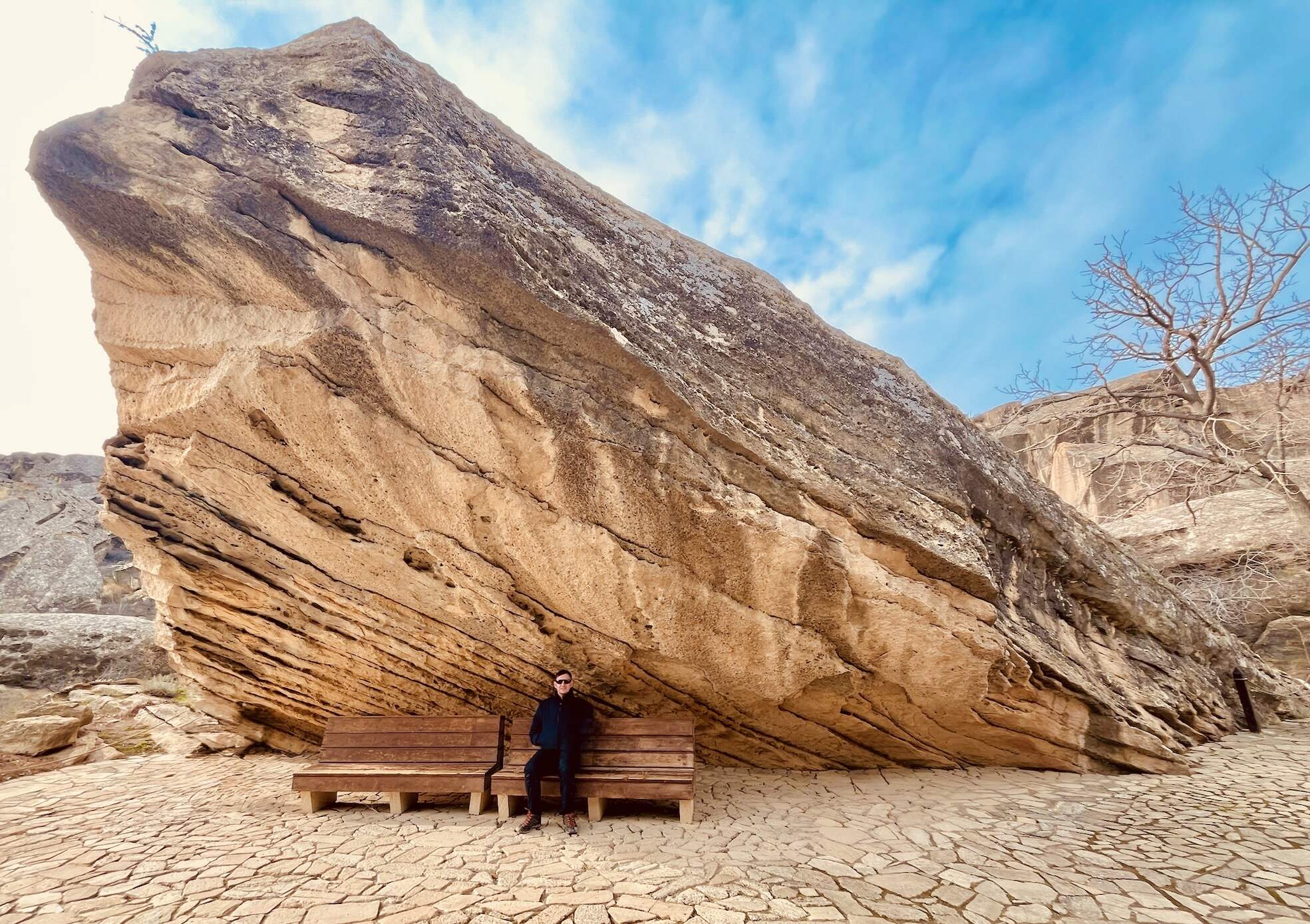
Some of the unique erosional patterns are outstanding. Exposed to centuries of wind and rainfall, much of the limestone and sandstone has twisted into fascinating shapes. The below photo is an example of honeycomb weathering. The honeycomb-like holes form because of salt crystallising in the pores. It then expands and breaks the stone apart.

Honeycomb weathering.
As Rajab had explained earlier in the day, the entire Gobustan region is something of a black hole when it comes to plant growth. Therefore it was a real joy when he showed us a skeletal tree that had somehow managed to produce a cluster of bright red pomegranates. Indeed it was the only such splash of natural colour we saw in the reserve that afternoon.
The Ancient Petroglyphs of Gobustan.

The Ancient Petroglyphs of Gobustan.
With one last look at the striking desert views, we made our way back to the car where an ever-patient Emin was waking up from a nap. It was time to leave the desert for the bright lights of Baku where two more cultural treasures lay in wait.
*This experience was part of Bag Baku’s private full day tour of the Gobustan Mud Volcanoes, Gobustan petroglyphs, Fire Temple and Burning Mountain*.

Gobustan National Park.
Like this? Check out more of my adventures across Azerbaijan.
I’ve been living, working and traveling all over the world since 2001. So why not check out my huge library of travel reports from over 40 countries.



53 Comments
I always find fascinating how as humans we’ve always seem to have felt this need of leaving a mark, telling a story, of making sure others will know someone alike was there… even if we can barely distinguish the figures anymore. It gives me some solace though, to know that storytelling and some sort of artistic expression seems to have always been such a need for us, even when you couldn’t just get your food at the grocery shop! Thanks so much for sharing this adventure with us.
I think deep down most of us have that need to leave something behind. I know this is one of the main reasons I write. I’m never gonna have kids, so my writing will be my legacy in many ways; a record of who I was, where I went, what I did and the people I loved and lost along the way. I am now trying to imagine my life story as a series of petroglyphs, ha! Thanks for checking in Nic, it’s always nice to have you on the comment thread.
What a great adventure Leighton. So nice you went with a group that knew the site. I can see why the area was such a great find and why it must be preserved. I wonder how much of today’s civilization’s leavings will survive as long. Civilization obviously existed here for a long time. Was there any indication if the area was more hospitable when these folks lived there and then they left as desertification took place? The tympanic rock was pretty neat too. You guys rock. Happy Sunday Leighton. Allan
I guess the moment technology fails, as it someday will, most of our records will be lost in a buzz. I was thinking the other day how long my blog might stay online for after I’m gone. I mean, I have a business account so there is a subscription to be renewed. Someday nobody’s gonna be around to keep that renewed and my life travels and experiences will be gone. The same with my entire photo library which is on my Mac and iCloud. Yikes. Maybe I’d have been better off carving my short stories and travel reports into the walls of a cave! Thanks for your contribution Allan, we are sending happy Sunday vibes your way from the freezing cold Midlands of England.
bravo leighton i cannot believe these recent posts cover just a single day. as i understand it there is even more to follow from this tour? loved the video of the musical rock and was left wishing there were more of it. the bob dylan reference made me laugh cleverley done. i am also fond of the description — honeycomb weathering — it perfectly suits the visual. the cup marks show just how clever and resourceful they had to be to find solutions to complex problems. but i still have a question where are the mud volcanoes?????
Ha ha. Um… the mud volcanoes are… that-a-way (points to a large rock in the distance). Yes, all these articles and indeed next week’s concluding part are from the same day tour. There was just so much to take in that day that I knew it all needed to be split up into digestible posts. The musical rock was a charming experience for sure and like you I smiled at the aptly-named honeycomb weathering. Thanks, Stanley.
Fascinating! Some of them are obviously difficult to make out, so good to have your guide. The musical rock is fun, imagine what they thought about it thousands of years ago. I’m excited to see it all! Maggie
And before too long you will be seeing it all I guess? Even if one is underwhelmed by the petroglyphs (some are from what I’ve read on various blogs) I think the landscape alone makes it worth the trip. And yeah, the musical rock was an unexpected bonus. Looking back, I think we should have tried to play The Flintstones theme on it. Thanks for following along with the series Maggie.
The Flintstones would have been hilarious!
Very fascinating stuff! Here in the US, we also have deserts with petroglyphs (especially in the Southwest), which I’ve yet to explore, but I’m intrigued by them– who knows if they were made as forms of communication (or for preserving stories)? The musical rock looks like a real treat as well, and overall, another enriching excursion in Azerbaijan! Thanks for sharing, Leighton 🙂
Hey Rebecca. I have long wanted to see the petroglyphs in New Mexico for example, that is one of the zillion things on my U.S. list should I ever make it back. Thanks for keeping up with this Gobustan series!
This is some serious history, amazing to walk among something so old. Thank god for your guide to make a bit more sense of what you are looking at. The earliest humans. The look of a man who knows where the Mud Volcanoes are tickled me. Something about the honeycomb weathering made me feel uncomfortable.
Serious history indeed, you can feel the weight of it thick in the air. That photos shows my amusement at the question I think, of that guy being there and not really understanding where he was and where the other thing was. People, eh.
great post! I agree with your thoughts of leaving your mark behind. My posts are to record our travels and photographs of sights we saw along the way.
I think that’s what most of us travel bloggers do. Our posts are little time capsule records of a certain place and time; both geographically and within the context of our own life journey. Thanks for reading and leaving a comment.
What a great experience. That pathway in between the rocks had me hooked. I could make Canadian connections with two of the park’s treasures—there’s a place in Newfoundland with holes in the rocks like Azerbaijan, but the Dorset-Paleo Inuit hollowed out the soapstone and shaped it into bowls and other items they used and traded. Then the hunter’s rock reminded me of Alberta, where there’a a place called Head Smashed in Buffalo Jump that I just had to see as the First Nation Planes Peoples used exactly the same hunting technique. I had imagined a huge cliff, but it turned out a lot smaller, but enough to kill the buffalo as they tumbled over. Neither places are as ancient as the sites you and Sladja visited.
Thanks so much Mallee for sharing your experiences of similar sites in Canada. How curious that several elements of the Azerbaijan reserve matched up with those in Alberta and Newfoundland. I agree with you about the path, indeed we were walking down it full of anticipation.
A godfather of history site, no surprise that UNESCO came running for this one. I have learned so much about Azerbaijan from your recent posts Leighton having begun reading with a largely blank canvas. That carving with the little guy whooping on the horse is SO MUCH clearer than the others I’m not at all survived that Sladja felt suspicious. If that is truly also from prehistoric times then… just WOW.
“Godfather of history” ha, I like it. I guess back in the day tribal leaders would “make him a petroglyph he can’t refuse”. Yes, there is something weird about that horse rider. On the one hand we were blown away by it, on the other we were like: hmm. In any case it was an exciting moment when Sladja found it. Cheers James.
A fantastic place to visit! I think seeing Paleolithic petroglyphs is a remarkable experience. To think that some humans who lived 40000 years ago left their mark in the rocks and that today we can study them and hypothesize their purpose and meaning is quite amazing. The lone pomegranate tree with a few fruits hanging on its brunches is again a testament to Mother Nature and life itself that somehow always finds a way. This is a great writeup, Leighton.
Discovering the bright red of the pomegranate tree was a lovely moment and, as you say, quite life-affirming. Thanks for reading and sharing your thoughts Helena.
It’s incredible to hear just how old some of the rock carvings and petroglyphs are. Love the video of you guys making music on the Musical Rock!
It brings a new take to the idea of rock music huh? Thanks for reading about our visit to the Gobustan petroglyphs! 🙂
So the oldest petroglyphs were 40,000 years ago. I wonder if they were Homo Sapiens or Neanderthals. Very interesting information and great photos as usual.
So apparently they were Homo sapiens, with the Neanderthals having bitten the bullet some forty thousand years ago before them. I admittedly did not know this, but had to check with my friend Mr. GPT. Thanks for swinging by Thomas. 🙂
Writing and drawing on walls. So long ago yet we are still doing it! However we do not know who any of these ancient Banksy boys were. Interesting that this treasure is such a recent and accidental find.
Great point about how we are still scribbling things on walls. I’m sure there was a Banksy of the Upper Palaeolithic times. Drawing things that the powers that be would not approve of, ha. Thanks for your contribution Geoff.
It’s so interesting to try and understand the “why” when it comes to petroglyphs. Were they really created for future generations as an early day time capsule…or were they, as our guide in Malawi said, more likely to be schooling for children of the time? Whatever, it’s always amazing to see how well the drawings survive the centuries. Even if some are indeed a bit on the indecipherable side.
I think not truly knowing why is part of the fun; everyone’s got their own ideas and most seem plausible. Adds an air of mystery to such sites. Indecipherable carvings are a bit frustrating, though it makes ones like the little horseman all the more special. Thanks for checking in, hope your trip has gotten off to a good start.
This is proving an absolutely fascinating day out for your readers, almost as much as it must have been for you two! And such big numbers attached to this site – it’s hard to fathom the presence of six thousand rock carvings, some dating as far back as forty thousand years! I’m starting to think that Azerbaijan needs to move up our wish-list 😀
So glad to hear that Sarah. The great thing about the mud volcanoes, petroglyphs and the sites covered in next week’s post is that they are all so close together and can be done in a single day at a leisurely pace. Thanks for following along with the series.
Petroglyphs are so fascinating to see; they’re an early form of blogging. 😉 And the musical rock is completely amazing. I can imagine the early people gathered around it, wide-eyed with intense curiosity. Your photos have wonderfully captured the ruggedness of the area. I particularly like the one of you and your knowing look. What a great opportunity, Leighton, I’m looking forward to reading more.
Thanks Tricia, that photo came at such an amusing moment and it definitely informs the vibe of the image. Appreciate you following along Tricia, next week’s post wraps up this day tour with two more fabulous sites.
What an amazing place – thank goodness the workers noticed the faded images on the stones they were removing!! I love the one with the dancing figures 🙂
You’re right, so many of these could have just been carelessly thrown away in less observant hands. The dancing carvings is one of my favourites too and by the far biggest collection of images in the reserve.
When I read that these petroglyphs were discovered by accident, I wonder how many other petroglyphs there are on this earth that we don’t know about! How interesting is the musical rock – maybe it was the main instrument at their music festivals (ahh, just kidding … like your Dunkin’ Donuts story 😁). Looking at some of the almost unidentified figures, I’m surprised how clear the horse is on one of the rocks (and I agree with Sladja – that man sitting on the horse is almost too clear to be true). Wow, what an interesting place – your photos are beautiful and I could sense the tranquility you must have experienced there in the desert … well, until the tour group arrived that is.
You’re right Corna, there must be more as-yet undiscovered petroglyph sites. In addition to those that have been accidentally destroyed and lost forever. Thanks for watching our “rock show”, I hope you enjoyed the song. I think that (despite the cold) we were fortunate to visit in winter as the place was far less busy than it would be in the summer months. I can only imagine what it must be like in August at the height of tourist mania. I bet you wouldn’t get anywhere near that musical rock.
Such an amazing place to explore!
Absolutely, thanks for reading Anna.
I’ve been fascinated with ‘marks on walls’ for a long time. I even included some on my last post. I remember reading graffiti on underpasses while hitchhiking as a teen, and thinking of all the artists and poets out tagging the concrete while doing nomad things. It is amazing to think how that ties back 40k years. These wanderers, under the same stars, making their unique marks so far back in time!!! I somehow have always known those ancients were probably making more meaningful signs than some scruffy teen hitches…but I just don’t think I am qualified to judge. Awesome post, thanks.
Glad this article was right up your street Chuckster, I will definitely check out your post. 🙂
What a cool place! I’ve seen many petroglyphs and other remnants before, but nothing anywhere near this old. It’s amazing they’ve been preserved for so long. And it’s so interesting to me that all around the world, people carved rocks and drove animals off a cliff for hunting and just generally found similar ways to live, even in different environments.
I totally agree. All these peoples separated by oceans and who had no contact all came to the same or very similar conclusions. Thanks for reading and commenting Diana, I hope to see some more petroglyphs someday.
Perhaps not the most spectacular of traces left by previous civilizations, but always worth exploring, especially with the help of a guide.
As someone who hadn’t seen petroglyphs before this felt like a really solid introduction. Thanks for reading!
It is so incredible not just how far back these petroglyphs go, but that you can see the different eons of time carved into the rock like that. It is like a whirlwind history lesson all written in the stone. I can’t quite wrap my head around the headless pregnant women/fertility goddess…why would they not have a head? It does make you wonder though if there was some young foolish person who added the picture of the man and the horse just to be part of such a history. If that is the case, at least they kept in with the general look of the real petroglyphs and didn’t just add some profanities on the rock. Fantastic adventure to follow along with you today!
I was half thinking of carving ‘Leighton Travels’ into the rock, but then thought of better of it. 😉 Seriously though, this was just another fantastic part of the day and one we are so glad we didn’t miss. Thanks for your contribution Meg, I hope your year has gotten off to a good start.
What an amazing opportunity to see so much history embedded within the landscape!
It really was, thanks for your interest Allie!
This stop is fascinating; I would enjoy exploring this early art form, not so different from the painted images in the caves of southern France. Amazing that they could identify the auroch. I loved the dance and the tattooed women (who reminded me of a famous Picasso).
As these comments came through I was wondering if this might be the part that fascinated you the most. I see what you mean about the similarity with Picasso!
It’s amazing to think how long some of these pieces have been on Earth and similarly how long they’d gone undiscovered! It looks like an incredible experience and I imagine both of these experiences (mud volcano) too were vastly different to that in Baku. Interested to read what you get up to there but I think it’s this sort of day that would make Azerbaijan particularly appealing to visit.
Hey Jason! Yes Gobustan is whole different kettle of fish to Baku itself. Actually the last part of this day tour culminates with two Baku sight and that piece is already published (Fire Temple & Burning Mountain). Later in the year I’ll be writing up the city in full, which will be a whole other project. Not enough hours, etc. Thanks for keeping up with the series.