
The Alcazaba: Malaga’s Unmissable Fortress.

The Alcazaba: Malaga’s Unmissable Fortress.
2016-2017.
In the spring of 2016 I relocated to the Spanish city of Málaga. Renting a small apartment in the centre, I settled into a gentle routine of writing, reading, watching films and jogging down to the beach each day before turning back through the warming streets.

Calle Larios: Malaga’s main commercial street.
To keep things ticking over I picked up a little teaching work, though it left me with plenty of time to explore. Slowly, almost absent-mindedly, I worked my way through Málaga’s sights.
And when friends or family came to stay — which happened more often than I’d expected — I found myself returning to many of those same places, seeing them again through fresh eyes.

My Malaga apartment on Calle Lanuza. April 2016- April 2017.
My favourite sight was The Alcazaba, Malaga’s grand fortress, which bleeds seamlessly into the lofty ruins of Gibralfaro Castle. Over the course of my twelve months in the city, I came around a dozen times, and never grew bored of it.

Calle Alcazabilla.
In fact, I can still recall the first time I caught sight of The Alcazaba from Calle Alcazabilla during my first week in the city. The remains of an ancient Roman theatre sit snugly at the foot of the fortress by the main entrance. Discovered in 1951, historians say the theatre was built in the 1st century AD in the days of Augustus.
The Alcazaba, Malaga.

Climbing The Alcazaba.
The Alcazaba stands at the foot of Gibralfaro Hill. The Berber King Badis ibn Habus ordered its construction, which took place between 1057-1063.
Although firmly in the shadow of The Alhambra in Granada, this is actually the best preserved fortress in Spain. I was spellbound from the moment I began my ascent through those first stone walkways, flanked by fragrant bushes and orange trees.

The Alcazaba, Malaga.
In 1279 Muhammed II Ben al-Ahmar conquered Malaga and soon set about transforming the fortifications into a Nasri Kingdom palace. It really is a joy to wander through what survives, including several rectangular patios with reflecting pools, trimmed hedges, stone columns and Moorish fountains.

The Alcazaba, Malaga.
Perhaps most endearing of all is the narrow water channel that runs from the top of the mountain down to the gardens. You can follow its trickling sound as you pass under the various horseshoe arches.
Malaga Fortress.

The first set of city views.
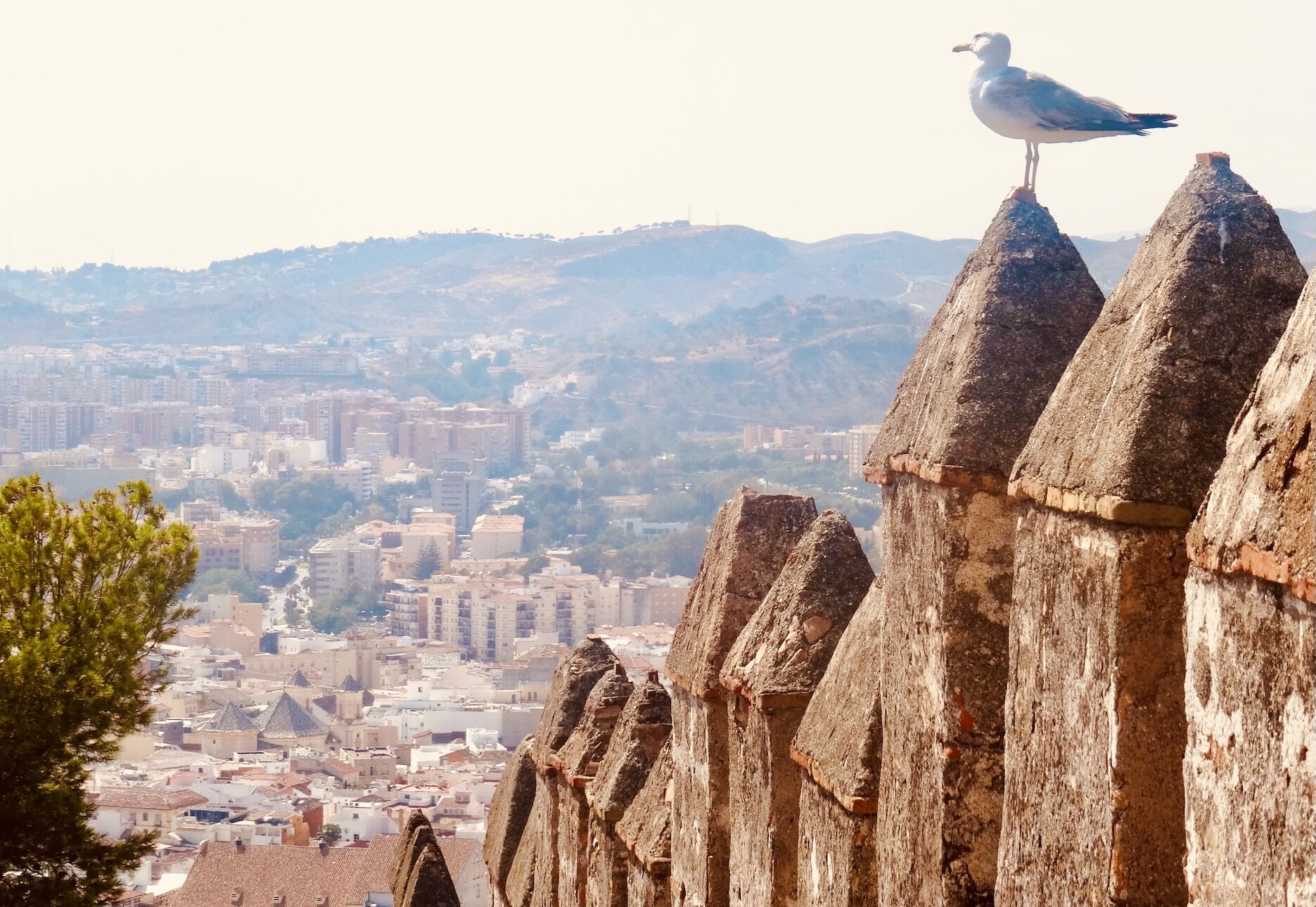
Even this early on in the hike, there are fine, ever-blossoming views of Malaga’s wondrous skyline. Like it or loathe it, people leave their mark on the stone ledges. A quick look usually reveals dates of visits, declarations of love and hasty doodles. From what I understand, local authorities clean the ledges every few months.

The Alcazaba: Malaga’s Unmissable Fortress.
Further up, the ramparts provide a clear view over the Port of Malaga, very often decorated by an anchored cruise ship. To the right of the below photo, you can also see the gorgeous Gardens of Pedro Luis Alonso, next to the handsome Ayuntamiento (City Hall).

The port of Malaga from The Alcazaba.
In order to enter Gibralfaro Castle, one has to follow the mountain path that snakes around the hill. The ruin that we see today was built by Yusuf I of Granada at the start of the 14th century.
Gibralfaro Castle.

My old travel accomplice Daryl Wonderboy.
Yusuf constructed it purely as a defence system for both The Alcazaba and indeed the city. Its name comes from a mix of Arabic (Jbel) and Greek (faro), which combine to form the Spanish word Gibralfaro. This translates into English as “rock of light”.

A crossroads of bends, arches and courtyards.
It’s certainly a fitting name, especially when I found myself quite literally blinded by spears of sunlight as I negotiated the castle’s restored, double walled pathway, La Coracha.

Blinded by the light.
In 1487 the Catholic kings unleashed a relentless four-month attack on the city, known as The Siege of Malaga. After claiming the fortress and castle, King Ferdinand of Aragon turned the old joint into his private residence.

The Alcazaba & Gibralfaro Castle.
He went on to further strengthen both structures, building connecting corridors and tunnels from which the royal family could flee in the event of an attack.

Views over Malaga from the Alcazaba on a misty morning.
There are several such corridors to explore. On one particular visit my niece Alice went running down one, but sadly it proved to be a dead end. She didn’t seem too concerned.

“Good grief, we’re being invaded!”
While it’s fun exploring the castle’s intersecting paths, the highlight is definitely drinking in the spectacular views. From the top you can see absolutely everything, from Malaga Cathedral and the Bullring (La Malagueta) to individual squares like Plaza de la Constitución.
The Alcazaba, Malaga.

Views, views, views.

Malaga Bullring.

Gibralfaro Castle.
By the mid-eighteenth century, both Malaga’s Alcazaba and its adjoining castle had fallen into disrepair. For a while it served as a military base, which closed in 1925. Since then, millions have been poured into restoring both structures and beautifying the entire area.

The Alcazaba: Malaga’s Unmissable Fortress.
Take the forest of eucalyptus and pine trees, for example, added to the upper walkways in 2005. Moreover, a small museum, crafted within the former gunpowder stores, provides an in-depth historical overview.

The Alcazaba: Malaga’s Unmissable Fortress.
Entry to the Alcazaba and castle is priced at 7 Euros each, though a combined ticket gets that down to 10 Euros. From April to October it opens from 09:00-20:00, while in the winter (November to March) the grounds close earlier at 18:00. For more info, it’s worth checking out the official website.

The Alcazaba, Malaga.
Like this? Why not check out more of my travel reports from Malaga.
To delve further afield, I’ve also written articles from across Andalusia and all over Spain.
I’ve been living, working and traveling all over the world since 2001. So why not check out my huge library of travel reports from over 40 countries.



14 Comments
Alcazaba seemed more interesting to me than Grenada, cause in Grenada you are often submerged by the dimensions of the site and all the tourists 😉
An interesting observation, thanks for reading! I’ll be posting plenty more from Malaga over the next week.
Great town I am member of a club there many friends can’t wait to be back nice pictures.
Agreed, a really beautiful and historical town with lovely people. Thanks for reading!
My pleasure
Looks well worth the visit. And some of those views look incredible up there. If we manage to finally get to Spain this summer will ticknthis one off 🙌
You wouldn’t regret adding Malaga to your itinerary of Southern Spain. Hopefully my next three articles will consolidate this idea. Thanks for reading!
Can’t wait to read🖕I was there when I was 18 but I think sightseeing was the last thing on my mind then and I don’t remember much 🤣🤣
I hear you! I think I had a similar experience as a teen in Tenerife, ha!
I can see why you never tired of visiting the site. And it is not just better preserved than the Alhambra, it looks like it is currently lived in. The greenness and the water make it so inviting. Loved all the old friends and family. Made it feel like we were visiting it together.
I’d hoped to visit Malaga while I still lived in Europe, but alas, it never came into fruition…looks like a lovely place that’s distinctively Andalusian, along with the likes of Granada and Seville…your living arrangements look cozy, and it’s great you got to enjoy the laid-back atmosphere of Spanish culture, all the while squeeze in plenty of sites during your stay!
Glad you liked it, Rebecca. Going to live in Malaga was definitely one of the better decisions I’ve made over the past decade or so. Really could have stayed longer to be honest, but I was lured back to China by another lucrative teaching contract. Hope you enjoy the rest of my Malaga series.
Inevitably I first thought of Granada, before realising that this is not the same Alcazathing. What would have become of those beautiful things of the past that are useless today, if it weren’t for tourism, travel and curiosity. Thanks for promoting them.
Thanks for reading and yes, I totally agree. Oh, and Alcazathing is a great word!