
The Silent Sentinels of Belgrade New Cemetery.

The Silent Sentinels of Belgrade New Cemetery.
April 2021.
“All those people, all those lives, where are they now? With loves and hates, and passions just like mine. They were born, and then they lived, and then they died. It seems so unfair, I want to cry”.
Cemetery Gates, The Smiths, 1986.

Tiny Sladja by the outer walls of Belgrade New Cemetery.
I’ve always wanted to open an article with some Smiths lyrics. Well, now I’ve gone and done it. If only I could have followed them with the claim that “Sladja and I met at the cemetery gates”. But naturally we made the journey to Belgrade New Cemetery together. However, I can confirm that it was at least “a dreaded sunny day”, which is a solid way to make amends.

Silent Sentinels at Belgrade New Cemetery.
Some people hate cemeteries, considering them depressing, morbid and creepy. Certainly not places to seek out while travelling. But I have never been of this mindset and, thankfully, neither has Sladja.
In fact, wherever I go in the world I usually take the opportunity to check out a significant cemetery or graveyard. For the most part such visits are a visual and mental feast of architecture, art, history and nature. A highly meaningful experience of community, ancestry, remembrance, tribute and peaceful contemplation.

Sladja at Highgate Cemetery in London. February 2022.
I have seen some stunning cemeteries during my world travels. And among the best of them stands the incredible 138-year-old Belgrade New Cemetery.
Silent Sentinels at Belgrade New Cemetery.

Outside the entrance gates.
In the early 1880s Belgrade’s main cemetery was located on a plot of land in and around the site of today’s lovely Tasmajdan Park. But by 1884 it was clear that the old joint was overflowing and no longer fit for purpose.
Thus Belgrade mayor Vladan Đorđević announced that he would begin work on a new cemetery. Moreover, he even donated a patch of his own private land to get things going at a time of severe economic crisis.

Vladan Đorđević and his impressive mullet.
After two years of landscaping The New Cemetery (as it was imaginatively called) opened in 1886, with new burials taking place immediately.
What’s more, the mayor and his team soon began transferring notable graves from the old plot at Tasmajdan to the new cemetery. As we passed through the entrance gates that day we saw a plaque in honour of Đorđević and his role in establishing the cemetery.

Silent Sentinels at Belgrade New Cemetery.
From the moment we sauntered onto the first pathway we could see just how vast the cemetery is. Having rapidly grown over the years, the complex now stretches to a dizzying 74 acres. Framed by bushes, plants, cherry blossoms and a varied array of low hanging branches, it is an exceptionally pretty and peaceful place.
Exploring Belgrade.

Silent Sentinels at Belgrade New Cemetery.
They reckon around 700,000 people have been laid to rest in the cemetery since its inception. Of those, there are roughly 50,000 registered graves that have been actively maintained and preserved. No surprise then that in 1983 The National Assembly of Serbia declared the entire site a monument of great cultural importance.

Silent Sentinels at Belgrade New Cemetery.
With the majority of gravestones carved in Cyrillic, I would’ve had no idea what anything said if it were not for Sladja. Happily, she was able to translate for me as we moved between the seemingly relentless memorials.

Silent Sentinels at Belgrade New Cemetery.
First, we stopped to admire a towering tablet that stands in tribute to three generations of the Kažić family. “The men were mainly lawyers and solicitors” explained Sladja. Most noteworthy though is Miodrag Kažić, pictured top right. A man who died in 1943 at Belgrade’s Banjica Nazi concentration camp “in the flower of his youth”. He was 21 years old.

Silent Sentinels at Belgrade New Cemetery.
Another young man gone too soon was Dejan Stojanoski. Depicted on his headstone playing an accordion, the tribute simply reads: “Beautiful sweet angel, your long luck has run out. Behind you, our dear son, only eternal pain and sorrow”.
Silent Sentinels at Belgrade New Cemetery.

Dejan Stojanoski.
It didn’t take long for us to find some of the cemetery’s stunning artwork. According to the official blurb there are over 15o0 sculptures, some of which were born from the hands of Serbia’s most celebrated artists.

Silent Sentinels at Belgrade New Cemetery.
In a variety of guises these silent sentinels keep watch over Belgrade New Cemetery’s sleeping residents.

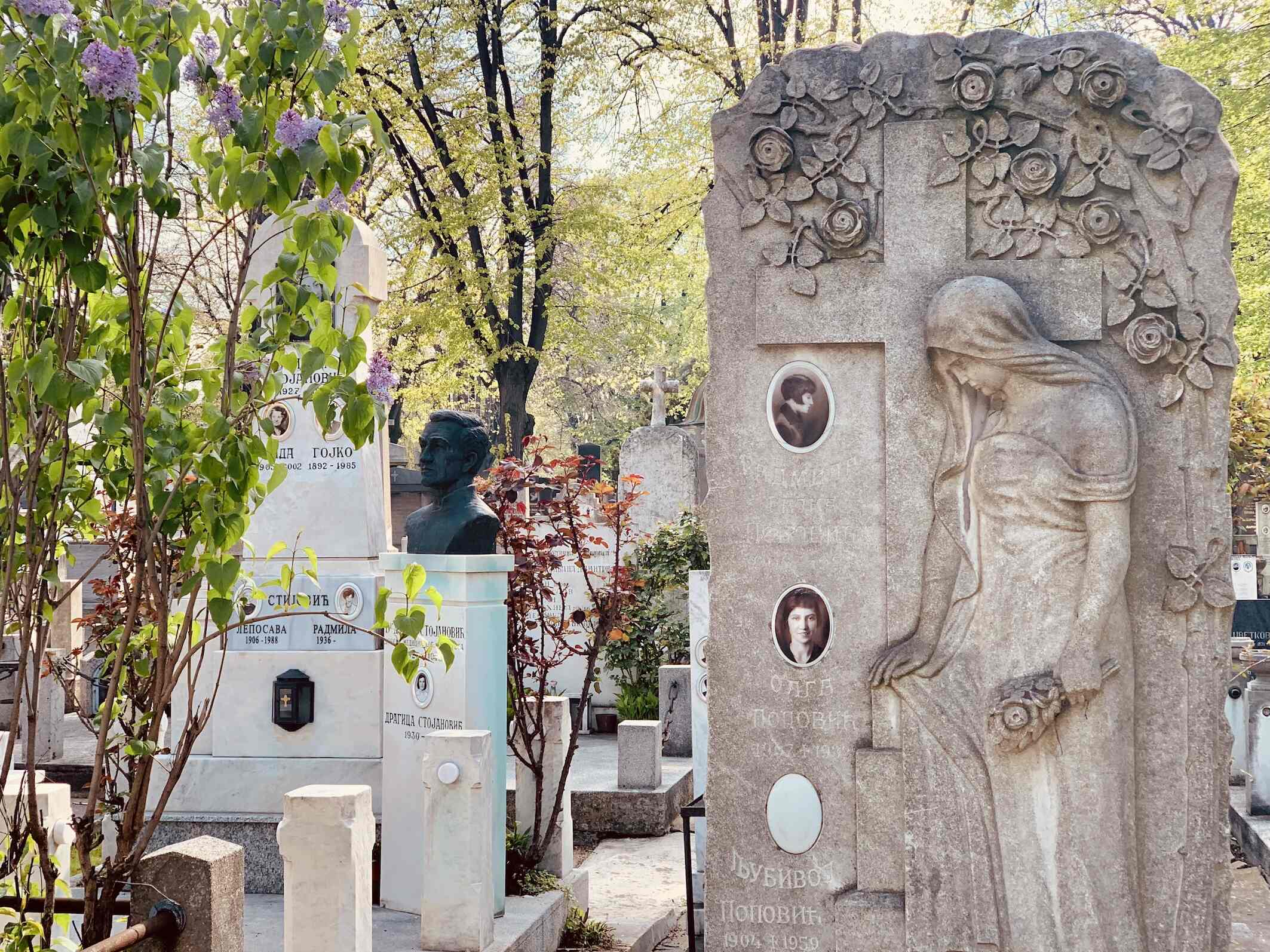
Memorial stone to an early 20th century family by the name of Popović.
With a bit of online detective work, we were able to track down some of these amazing artists. And in the process find out more about the people whose graves these guardians protect.

A beautifully sculpted grave angel.
Take Toma Rosandić (1878-1957), for example, a Serbian artist who created this “angel and male bust” for the grave of the politician Milorad Drašković.

Silent Sentinels at Belgrade New Cemetery.
In January 1921 Drašković became Yugoslavia’s Minister of Foreign Affairs. He was a staunch anti-communist who was instrumental in enacting key pieces of anti-communist legislation. But just six months into the job, a Bosnian communist assassin by the name of Alija Alijagić shot and killed Drašković as he left his office. The politician was 48 years old.
Milorad Drašković (1873-1921).

Silent Sentinels at Belgrade New Cemetery.
In the 1880s a number of skilled Italian sculptors arrived in Belgrade seeking their fortune. One was Giovanni Bertotto, who crafted the below tomb for a family called Sokić.
A kneeling weeping female figure speaks of Mihailo and Ljubica Sokić’s immense sorrow at the loss of their children. While no cause of death is given, the gravestone details that their son Milovan died aged 6. Their daughter Ruzica, meanwhile, was just 1 year old. Both passed away in 1928.

Silent Sentinels at Belgrade New Cemetery.
Giovanni Bertotto eventually became one of Belgrade’s most respected sculptors who, for several decades, had the largest stonemason’s workshop in the city. Furthermore, he ended up creating something of a family dynasty. Indeed his son and nephew also went on to become renowned sculptors.

The Bertotto family tomb.
Another Italian master was a Genoa-born chap by the name of Achille Canessa. Considered one of the all-time great funerary sculptors, he once made a garden monument for the iconic Italian general and revolutionary Garibaldi.

The Canessa sculpture we saw was at the grave of Joca Jovanović, a wealthy tobacco merchant. However, it remains unclear who the sculpted woman in a crinoline dress is. His wife? Mother? Sister? Lady friend? Whoever she represents, there’s definitely a lost story waiting to be uncovered.
Silent Sentinels at Belgrade New Cemetery.

‘Woman in a Crinoline Dress’ by Achille Canessa.
Next we came upon the grave of Živojin Mišić, the most decorated military officer in Serbian history. The sculptor Đorđe Jovanović crafted his bust along with the lady who watches over him. In one hand she holds an olive branch, which she drapes over his shoulder. In the other she grips a torn flag from the battleground.

Silent Sentinels at Belgrade New Cemetery.
Rising to the rank of field marshal, Mišić enjoyed a formidable combat record. He fought in and survived the Serbo-Turkish War, the Serbo-Bulgarian War and the First and Second Balkan Wars in addition to World War I. Finally though, having survived decades of unthinkable danger, it was lung cancer that got him at the age of 65.

Živojin Mišić (1855-1921).
Speaking of soldiers, both Sladja and I literally stopped in our tracks when we saw these fierce sculptures in honour of a brother and sister who lost their lives during World War II. Saša and Tamara Žuržul joined the Partisan resistance movement in Belgrade in 1942.

Silent Sentinels at Belgrade New Cemetery.
Tamara was executed by Chetnik soldiers in 1944 aged 17. Her brother meanwhile perished aged 20 in a battle against German forces in northern Serbia in 1945. Earlier in the war, he had succeeded in escaping from Banjica concentration camp. Both siblings subsequently became icons of Titoism.
Saša and Tamara Žuržul.

Silent Sentinels at Belgrade New Cemetery.
We could have spent more than just a few hours admiring all the cemetery’s magnificent sculptures. But there was still so much more to see, hence we set off on a leafy trail that would lead us to the compound’s Neo-Byzantine church.

En route to the church.
Along the way, we came upon a number of family chapels. Apparently there are 37 scattered across the cemetery. All of which belong to well-to-do, moneyed Belgrade families. In most cases they are locked, so you can’t view the tombs that lie within.
This one holds the remains of Dimitrije Stevanović and his extended family. There are not many details about their lives, just a note that Dimitrije was a manager of some description who oversaw Belgrade’s water supply service.

The Stevanović Family Chapel.
We also stopped to take a look at the gorgeous Russian Chapel. A group of Russian immigrants erected it in 1931 shortly after fleeing their homeland for Serbia following The October Revolution.

Silent Sentinels at Belgrade New Cemetery.
The structure was modelled on the Iveron Chapel located on Moscow’s Red Square. Take a look at the original church and the resemblance is striking.

Belgrade New Cemetery’s Russian Chapel.
Compared to the Russian chapel, the main church turned out to be fairly standard. Built in 1893, the Church of Saint Nicholas has nevertheless held funeral services for some of the most significant figures in Serbian history.
Silent Sentinels at Belgrade New Cemetery.

Church of Saint Nicholas.
Popping our heads inside, we took a moment to sit down, enjoy the peacefulness and take in the handsome iconostasis by the famed Serbian painter Stevan Todorović and his wife Poleksija.

Silent Sentinels at Belgrade New Cemetery.
After consulting our cemetery map, we left the church and headed to the first of two grandiose monuments. There’s certainly no missing the Memorial Ossuary to the Defenders of Belgrade 1914-1918. Completed in 1931, it stands in tribute to the soldiers who died defending the Serbian capital throughout The Balkan Wars and World War I.

Silent Sentinels at Belgrade New Cemetery.
At the top of the monument stands a statue of a Serbian soldier, rifle in hand, ready to defend his country. Out of sight, beneath the structure, is an ossuary where 4600 soldiers lie in eternal sleep.

But the most dramatic element is the giant black bronze eagle that has fallen on its back wounded, wings spread out. Its terrifying front talons turned up as it screeches in pain.

Silent Sentinels at Belgrade New Cemetery.
The eagle represents Serbia’s enemies, evil forces that tried but failed to enslave the country and its people.
Monument to the Defenders of Belgrade 1914-1918.

The eagle has… uh…. landed.
Curiously, the cemetery also features a Russian Ossuary, also known as the Monument to Russian Glory. Unveiled in 1935, it became the world’s first monument dedicated to Russian WWI soldiers situated outside Russia itself.

Silent Sentinels at Belgrade New Cemetery.
The monument features two figures. A wounded Russian soldier positioned just above the entrance doors, and a statue of Archangel Michael (commander of the heavenly army) on top. The ossuary beneath holds the remains of 387 Russian soldiers who lost their lives in the Balkans.

Russian Ossuary Monument.
Despite hours of exploring we had still yet to investigate the cemetery’s most visited section. So at last we headed off to the Alley of the Greats, which houses the tombs and urns of Serbia’s most celebrated icons.

Silent Sentinels at Belgrade New Cemetery.
Here lie famous Serbians from every profession you can think of, including journalists, politicians, architects, singers, soldiers, painters, philosophers and writers.
Many of the memorial stones bind people together by their various professions. Like the one below that honours successful sportsmen. Among the names are Borivoj Vukov, a world champion wrestler, and the Olympic gold winning water polo player Uroš Marović.
Silent Sentinels at Belgrade New Cemetery.

Alley of the Greats.
This is definitely an amazing part of the cemetery. However, visually I found it a touch disappointing. Because, unlike the rest of the compound, here there were no images on the headstones. Nor were there any sculptures or accompanying artwork to distinguish the mostly identical gravestones and wall plaques.

Silent Sentinels at Belgrade New Cemetery.
Nevertheless, we were delighted to track down the graves of Serbia’s most beloved movie star couple, Milena Dravić and Dragan Nikolić. The Serbian Katherine Hepburn and Spencer Tracy, if you will. I’m gonna write more about these guys in an upcoming article.

Alley of the Greats.

Milena Dravić and Dragan Nikolić. Gone but certainly not forgotten.
It was time for us to head home. Joining a path towards the nearest exit gates, there was so much more to absorb on the way. Not least in the form of numerous military cemeteries. This is the British Commonwealth World War II graveyard. It is home to British and Commonwealth casualties brought in from more than sixty burial grounds across former Yugoslavia.

Silent Sentinels at Belgrade New Cemetery.
We also passed a French Cemetery, where 375 graves honour French soldiers from World War I.

Silent Sentinels at Belgrade New Cemetery.
There’s a huge Italian Cemetery too, also dating back to World War I, where 796 soldiers are buried.

Silent Sentinels at Belgrade New Cemetery.
And of course we passed hundreds more headstones, a cluster of grand tombs and more wonderful funerary art. What an incredible place Belgrade New Cemetery is, I hope you enjoyed joining our tour.
Silent Sentinels at Belgrade New Cemetery.

Tomb of the Serbian novelist and playwright Branislav Nušić (1864-1938).

Grave of the Russian diplomat Nikolaj Henriković Hartvig (1857-1914).

Grave of a woman named Katarina Lazarević (1973-2008).
Like this? Check out my many articles from across Belgrade.
You may also enjoy my pieces from all over Serbia.
I’ve been living, working and traveling all over the world since 2001. So why not check out my huge library of travel reports from over 40 countries.



44 Comments
Superb shots of the grave stones Leighton and so interesting to learn about the cemetery. Used to love The Smiths, especially as they are from Manchester!
Thanks for joining us on this tour of Belgrade New Cemetery Marion. I absolutely love The Smiths so it was nice to be able to tie one of their songs into an article.
what a fascinating and incredibly well researched article leighton. i agree that once one sweeps aside any sense of morbdiness cemeterys can be fantastic places to learn more about a countrys cultural identity. i adore all these sentinels as you call them and the associated stories you uncover. bravo to slada obviously for making such an article possible. the monuments are pieces to behold especially the marvellous fallen eagle. so sad to read about the brother and sister in ww2 but greatly enjoyed being whisked through the alley of the greats. this might be your best piece of the series. i wanted to add one of those clappy emoji things but cant work out how to bloody do it
No worries Stan, your kind words are more than enough. I feel Sladja is the real star of this piece as without her there would be no article. Belgrade New Cemetery is an amazing place that, for obvious reasons, not many go out of their way to see. Cheers!
Very impressive. Seventy-four acres and 1500 sculptures. A lot of resources went into that. I’ve always found cemeteries to provide interesting insight into cultures and ethnicities. It has been said that funerals are for the living. I think graves and cemeteries are too. Grave sites where a family can rent a plot are especially revealing/confusing. Glad you had Sladja along to assist in translating. That had to have added tremendously
Some interesting observations Memo, I agree on all fronts. Sladja was a star and did a great job of translating a huge amount of information. Thanks for reading!
A beautiful title and an article, Leighton. It’s another deep dive into the Serbian soul and the history of the capital. I cannot imagine many tourists visiting this cemetery. I am surprised that I’ve never heard of it. It should be up there with the Recoleta and Parisian cemeteries. The story of the two brave young anti-Nazi fighters and how their legacy became manipulated by the regime is quite interesting. And there is that pyramidal tomb – what’s that all about? The monuments you featured are poignant and expressive, and the stories fascinating.
Cheers Helena, I’m glad you enjoyed reading about our exploring around Belgrade New Cemetery. The pyramid tomb of Branislav Nušić is indeed a curious one. Apparently it was the writer himself who came up with the idea of its design! Sadly we couldn’t find out any more info than that.
Cemeteries are certainly interesting places to visit, as your post clearly shows. However there are people who wouldn’t be seen dead in such a place… ha ha!
Well… I have no problem being seen alive in one 😉 As for being dead in one, hopefully they put me on the inside of the grave when the time comes.
Wow. I can see why you were dying to visit this place…pun intended. Cemeteries are a snapshot of history for sure. Amazing how we glorify people once they are gone as well as glorifying a warring history. It makes you wonder how some people were treated when alive. It would almost be worth reading the news of the day to see if the eulogy matched the reality. This place was a real sculptor’s dream with so many grand monuments. Thanks for sharing Leighton. Hope you had a Happy Saint Patrick’s Day. Allan
You are ‘dead’ right about cemeteries Allan. And I agree that there is often a stark disparity with how folk view the dead and how they treated their loved ones while they were alive. Such is the way of the human race. Thanks for following along with us Allan at one of Europe’s great cemeteries. Happy St. Patrick’s! (also my brother’s birthday).
Yes! Someone who also understands the beauty of visiting cemeteries. Morbid as it sounds, I enjoy visiting cemeteries on my travels, not only for the peace and solitude, but also to learn more about the country’s famed, historic figures who are buried there. I’ve had great experiences checking out cemeteries like Père Lachaise in Paris, the Mirogoj in Zagreb, and la Recoleta in Buenos Aires. The Belgrade New Cemetery looks lovely and somber, and I see it was a tranquil visit when you went! Thanks for sharing, Leighton.
Ah you’ve made my day Rebecca, I’m glad that you also ‘get it’. Like you we have a collection of memorable cemetery visits, nearly all of which I still have to write up. Sigh. We loved exploring this cemetery, I think not adding it to my Belgrade series would have been a ‘grave’ mistake.
I love it when cemeteries are also places to visit, like Père La Chaise in Paris or Arlington in Washington. There are beautiful sculptures and it’s also a tribute to the valiant dead of our past to whom we owe the society we live in, however imperfect it may be.
So glad we’re on the same page with cemetery visits. I haven’t been to the one in Paris but agree that Arlington is an amazing experience. Thanks for your contribution!
I won’t say I make it my mission to roam cemeteries (especially when the sun has already set). But even I have to admit that Belgrade New Cemetery is an exceptional place to visit. Neat graves tightly adjacent to each other (reminiscent of a metropolis), memorial stones, statues, sculptures and churches – it certainly looks like a museum. The brother and sister’s sculpture is poignant and as always, I enjoyed the history in your post (is the right word “enjoy” when you wrote about the dead?)
Hey Corna, I’m so glad you were able to take all these things from the article. As much as I love exploring cemeteries I also wouldn’t go adventuring around at night. The closest I’ve gotten to that was when we visited an ancient cemetery in Sarajevo late afternoon and were just finishing up after the sun went down. Creepy to say the least. Yes, I give you a full pass on saying you “enjoyed” the tour 🙂
Hey Leighton, excellent post; you put a much effort into researching the people laid to rest there. Very poignant, and your photos are stunning. I guess we all leave a legacy of some type, which hopefully is presented honestly for all who happen upon it.
Thanks so much Tricia, this post was a solid week’s work with much help from Sladja. Not sure it’s what many people will be seeking out in terms of Belgrade attractions but what the heck. It’s always good to know that there will be a core group of readers like you who appreciate such reads.
War cemeteries are a must visit for me even though it fills me with incredibly sad thoughts while on the other hand I’m amazed at what people erect in memoria as the majority are forgotten about within a decade.
Totally agree about the mixed emotions of visiting war cemeteries Gary. Thanks for reading about Belgrade New Cemetery, it must surely be one of Europe’s grandest and most underrated memorial complexes.
What a massive and impressive cemetery. So many fantastic gravestones in honor of their loved ones. In western Canada ours are rather plain. But, I love your introduction and will be singing Cemetary Gates for the rest of the day! Thanks 😊 Maggie
Ha, I’m always happy to inspire a bit of Smiths love. Cemetery Gates is such a silly, uplifting twee song that it shouldn’t really work. That’s the magic of the Morrissey-Marr partnership I guess. Thanks for checking in Maggie.
That is an impressive cemetery. It’s always interesting to look around and compare the different headstones and memorials. I haven’t visited many cemeteries while traveling, but I do enjoy the cathedrals with tomb stones. I would visit cemeteries but catacombs are a hard pass for me, I think seeing all the bones is kinda creepy.
Bones and skulls are not everyone’s cup of tea eh? For Christmas last year we spent some time in the Serbian city of Niš. One of their main sights is an incredible but uncompromisingly grisly Skull Tower. Yes, a stone structure embedded with the skulls of fallen soldiers from an Ottoman Empire era battle. After that, I reckon I can handle pretty much any other bone-related sight. Yikes.
I love visiting cemeteries, and also was very taken with Highgate’s gothic masterpiece. Belgrade’s New cemetery looks amazing, it’s so interesting seeing all the individual monuments, like the Russian Chapel – all the different designs add colours and architecture. The best thing about cemeteries for me is reading the stories and learning about the people, I’ll never forget reading on headstones ‘dress caught fire by candle and she died, aged 11’ or something equally as tragic. It makes death human, and the dead people who mean something or affect us with their story.
Hey Hannah, thanks for reading and for your meaningful contribution to the thread. Agree with you about the stories behind the headstones, it really gets the imagination running as you try and comprehend what kind of lives they might have lived. Death from clothes catching on fire sounds like a horrific way to go, poor girl.
Hey Leighton, I’ve had a terrific day, then come back to our apartment, read your post about so many lost souls, and….heaven knows I’m miserable now. I’m not, of course – we too have wandered through many cemeteries in cities around the world, creating in our minds the stories behind the memorials. I’m not sure we’ve seen many as spectacular as Belgrade though, this really is home to so many poignant tributes in so many different artistic and meaningful ways. Your ability to research and present information does you proud, my friend, this article was as stimulating as walking around the place myself.
Ah Phil, I’m so sorry for bringing you down from your fantastic day. It’s a case of “Bigmouth Strikes Again” I guess. Seriously though, thanks for the kind words, this article took way too long to complete if truth be told. I’m so glad you enjoyed the tour of New Belgrade Cemetery, I have no doubt you guys will get there at some point as the destinations you haven’t been to continue to rapidly narrow. As for Belgrade’s lost souls, I suppose we should try to look on the bright side and have faith that, against the odds, “there is a light that never goes out”.
Leighton, We’ve also long been fans of touring cemeteries of note when we travel for the same reasons you stated. Never, however, have we spent the many hours in one as you both did in New Belgrade Cemetery. What a fantastic tribute to so many lost souls. You did them proud.
Hey Annie, it’s lovely to have you back! Glad to hear that you guys also love exploring cemeteries, thanks for checking out my article on Belgrade New Cemetery!
Beautiful art, and dedications to those who have lived before us.
Thanks for reading Allie, I’m glad that you can appreciate the beauty of Belgrade New Cemetery. 🙂
I’m such a fan of cemeteries too, especially the really old ones. That being said, I wouldn’t want to visit one at night though! This one looks impressive. It’s crazy to hear how huge it is.
Thanks for following along with us, Belgrade New Cemetery is such a fascinating place.
I love wandering through cemeteries. I love seeing the different headstones and reading the dates and imagining the life lived marked by that stone. I always find some of the most beautiful works of art in cemeteries and this cemetery certainly seems full of beautifully and lovingly created pieces of art from the headstones to the buildings to the green spaces. A beautiful and peaceful walk to enjoy with you today 🙂
So happy that you are another reader firmly in the ‘yay to exploring cemeteries’ camp. Thanks for touring Belgrade New Cemetery with us Meg!
What an interesting walk through history!
Thanks Callie, I appreciate the read and the follow 🙂
Not a big fan of cemeteries – I find them sad – but impressed by the statuary in this notable one. The young man with the accordion and the romantic image of the woman looking down (also your opening photo) are very moving.
Thanks for ploughing through this piece despite not being a big fan of cemetery wandering. There were so many moving moments during that walk. most of which left me hungry to know a bit more about the various folk whose graves we stopped at. Stories untold…
Wonderful article leighton, very well researched with great photography. I’m delighted to follow your blog today.
Hey James, so you finally made it onto WordPress! It’s great to have you onboard, I see you’ve been busy reading through recent articles. Thanks for the support, much appreciated.